Sean Penn’s Ugly Words

usa-001Of course the Oscars were long. Of course, the presenter’s cue card jokes fell flat. Neil Patrick Harris, so effortlessly charming at the Tony’s, appeared stiff, even in B.V.D.’s and black socks. Still, Lady Gaga made the most of her prime product placement spot by singing better than many thought, even if she’s no Julie Andrews.

I winced when Sean Penn strode on stage to present the Oscar for Best Picture. I should like this guy – Haiti philanthropist and gay-rights champion – but he’s so dour. He proved his Oscar-awkwardness a few years ago in his tone-deaf defense of Jude Law against host Chris Rock’s jabs.

imgres-1But he eclipsed that last night when inserted the phrase, “Who gave this son-of-a-bitch a green card” for millions to hear before announcing Mexican Alejandro González Iñárritu’s name for Birdman as Best Picture. Perhaps in better comic hands it might have seemed a joke. But from too earnest Mr. Penn, it was beyond insensitive. It was wrong.


We are a nation of immigrants. We should be proud that the United States offers Mr. Iñárritu creative opportunities and that chooses to pursue his creativity within our borders.

I hope that Mr. Penn offers Mr. Iñárritu a sincere and public apology today. And I hope the Oscar powers keep Mr. Penn off the presenter’s podium for years to come.

Posted in United States | Tagged , , , , , , | Leave a comment

W.E.B. DuBois Says it Better than Me

haiti-001In Architecture by Moonlight, I struggle to describe my fellow workers. Haitians work ethic is different from ours. I don’t wish to romanticize it, nor imply it’s lesser or greater. Although many find value in my descriptions, the third-world experts at Partners in Health objected that I was politically insensitive; they need to guard against their precious donors. Meanwhile, freewheeling critics in the twittersphere – thirsty for cyber blood and beholden to no one – lifted phrases out of context and stabbed me as a paternalistic neo-liberal. Since I offended, and was offended, from all sides, I figured I was doing a fair balancing act. Still, my descriptions fell short of what I wished to convey.

Fortunately, I camimages-1e upon a W. E. B DuBois’ passage of in The Gift of Black Folk:

“As a tropical product with a sensuous receptivity to the beauty of the world, he is not as easily reduced to be the mechanical draft-horse which the northern European laborer became. He…tended to work as the results pleased him and refused to work or sought to refuse when he did not find the spiritual returns adequate; thus he was easily accused of laziness and driven as a slave when in truth he brought to modern manual labor a renewed valuation of life.”

I am honored to be speaking at Howard University this Monday February 23, 2015. I am particularly glad to have come upon Mr. DuBois description before that event. If there is anywhere in America where the contributions of black labor should be most accurately represented, it is at Howard University.

imgres-2


Posted in Haiti, United States | Tagged , , | 3 Comments

Boys, Toys, and Video Games

usa-001I just spent ten days with three boys, aged 8, 7 and 3. Like all children they were cute, surprising, hilarious and exhausting. Their dad, Brad, is an Army Captain deployed overseas; their mother Caitlyn is a deep reservoir of calm patience. (All the names are changed in keeping with Army privacy protocols for deployed soldiers).   I went to ease Caitlyn’s load and give the boys a break from after school programs. If the definition of vacation is to immerse in a different pattern of life, it was the most complete vacation I’ve had in years.

imgresThe older boys, Nathan and Sam, got their own Kindle’s days before I arrived; little Kyle inherited an older model. Caitlyn programmed the devices to approved games for a maximum two hours a day. During our first few days, most adult / child conversations revolved around negotiating allowable games and time limits. Without restraints, the boys would rove their thumbs over tablets from dawn until dark.


imgres-1On Tuesday, Caitlyn announced that tomorrow would be our Kindle-free day. The boys groaned but didn’t revolt. Wednesday was an early release day. During snack they talked about school, mostly the drama of recess. They did homework without complaint, taught me Uno, and we all played Life. Following a round of after-dinner wrestling, they went to bed with less fuss than usual.

But first thing Thursday they clamored for their Kindles once more.

On Saturday morning three-year-old Kyle managed to circumvent his mother’s diligence and downloaded a shooting-based video game. By the time Caitlyn discovered the breach, all three were deliriously shooting up bad guys. The rest of their morning romp was gunplay.

imagesThere are no studies that link toy guns to real life violence, contradictory evidence of the benefits and pitfalls of violent video games, and real evidence that computer games enhance anxiety. I was not privy to any controlled study. I just observed three ordinary boys for a week. I witnessed how they mirror adult responses to the wired word, in a very direct way. When they were fully unplugged, they were most fully alive and connected to each other. Yet whenever available, they craved wired connections. Then they mimicked what their virtual worlds revealed to them.


Posted in United States | Tagged , | 3 Comments

I Give Up: A People’s History of the United States

usa-001I tried to read Howard Zinn’s A People’s History of the United States, I really did. I slogged through every word of the first hundred pages, and then skipped the (abundant and repetitive) quotations through page 250 to focus on text only. All that effort got me to the fateful year 1877 with nearly 400 more pages to go. I just couldn’t face another description of history from the loser’s point of view – the women, blacks, Indians, poor farmers, working stiffs and immigrants who are beaten down, time and again, in Mr. Zinn’s narrative.

I agree with Mr. Zinn’s history in principle. But that doesn’t make his one-note harangue against rich white guys a compelling narrative. His penchant for chronological mash-ups led me to suspect he sought events to support his thesis rather than letting the order of events form a thesis. On one page alone, in the chapter leading up to the Civil War, he references the years 1790, 1860, 1800, 1822, 1831, 1859, and 1808, in that order.

imgresHe reports the miserable conditions of the downtrodden in our country with relish, but never once addresses the question that refused to leave my head. Things were terrible here, and still are for the less fortunate in our stratified society, but weren’t things worse elsewhere? He never tries to explain why people came, why they stayed, and why they still come to America. Sure, the streets were never paved with gold, but they still held more opportunity than streets anywhere else on earth.

Two hundred fifty pages of Haward Zinn confirmed, as so many passages of our history do, that Winston Churchill understood us better than we understand ourselves. “You can always count on Americans to do the right thing, after they’ve tried everything else.” Mr. Zinn documents painful, unnecessary paths towards each person’s claim his or her rightful place in this world. But he dismisses the gains, however slowly attained, and omits the global context that made the United States an attractive destination despite its inequities.

imagesWe still have far to go. I am amazed, time and again, at the obstacles our political system erects before the average person. Why do the rich and powerful care to deny their fellow citizens a living wage, equal justice, healthcare, educational opportunity and real economic opportunities? They already have everything they need and more. But I can’t accept a history based on the idea that the 99% have always been chattel and will never be other than that. I still believe that the United States, messy and fragmented as it is, will find its way to greater equality. Even if we don’t get there until after we’ve tried everything else.

Posted in United States | Tagged , , | Leave a comment

Ten Highlights of Six Hours in Seattle

usa-001I had six hours to tour Seattle between light rail depositing me at Westlake Station and meeting my niece and her three boys for pizza in Capital Hill. The next nine days would be family-focused in a small town an hour from the Emerald City, but for six hours I got to confirm / confound stereotypes on my first visit to the Pacific Northwest. An architect on his own with a good pair of boots and a yellow slicker can see a lot of Seattle in that time.

1. It rains all the time.

images-4Yes, it rained the entire time I was in Seattle. But it’s benevolent rain. It reminded me of Ireland.


2. Seattle is bigger and more affluent than I imagined, but hardly fashion forward.

images-1I walked by Barneys, Brooks Brothers and Tiffany’s but I don’t know who shops there because everyone I saw wore baggy jeans, T-shirts and flannels.


3. What passes for counterculture everywhere else is mainstream here.

il_570xN.666851712_rfqdGuys wear wool ponchos, identical the one I wore as a costume at a Woodstock Party last summer, without a trace of irony.


IMG_1366The Comet Tavern is one of several bars that trumpet being open and accepting with more fanfare than a Unitarian church.


IMG_1360I ate a delicious BLT at a place called Honeyhole. In Boston, that would either be a specialty donut or X-rated video.


4. There’s a Starbucks on every corner.

IMG_1361True for starters. But there’s also a competitor midblock for the folks who can’t stagger a full block without a caffeine fix, like this line outside the Monorail Espresso at 2:00 p.m. on a Thursday afternoon.


images-3And there’s the new Starbucks Reserve Tasting Room, which takes up almost a full block.


imgres-3In between are awesome bakeries, in which I indulged.


5. People are incredibly nice.

images-2When the elderly women next to me on the train from the airport didn’t have the correct fare card, the collector was so gentle and polite. After he scanned her ID against future lapses, he actually called her by name when he handed it back. At least three people told me to have an awesome day – one told me twice. That much awesomeness required more coffee.

6. People are also incredibly thin and pale.

imagesThey look like they drink too much coffee and get too little sun. But how do all those bakeries figure into the gaunt aesthetic?


7. The Seattle Public Library is a quirky bit of contemporary architecture.

imgres-1It’s way more than that. It’s a terrific piece of urban architecture whose gravity defying cantilevers slip into view from blocks away in Seattle’s grid.


explodedviewThe interior organization is intellectually brilliant, which is not the same as being user-friendly.

IMG_1362The building is mobbed, but why is the fifth floor called the Mixing Chamber? It’s the computer floor – every human there is engaged in parallel play.


8. Seattle loves writers and readers.

IMG_1359I was afraid no one would show up for my reading at Elliott Bay Book Company, 3000 miles from home. But I had a solid crowd and over an hour of Q&A.


9. Residents of the Emerald City love the Seahawks even more.

IMG_1365IMG_1364I kept my Boston roots on the low-down. Even the churches were against me.


10. The only thing I wanted for in Seattle was – more time!

imgres-2


Posted in United States | Tagged , , , , , , , | Leave a comment

Loving Bookish Seattle Even Before I Arrive

usa-001People buy more books, per capita, in Seattle than anywhere in the United States – one and half times the national average. Although I cannot vouch that they actually read more (since they’re also busy spending more than twice the national average on pinball and video games), I can attest to the warm embrace they give writer’s, even East Coast guys they don’t know.

I am flying out (weather permitting in snowy Boston) to visit my niece and her boys, so decided to contact Seattle’s independent bookstores. Hooray for Elliott Bay Book Company, who scheduled an event for me (February 5, 2015 at 7:00 p.m. if you happen to be in town). I decided to help promotion. The Seattle affiliates of the American Institute of Architects, Architects without Borders and Architects for Humanity all agreed to announce my reading on their calendars. I also sent an opinion piece to The Seattle Times, which they published on January 12, 2015. Perhaps they liked the piece so much because it happens to be about books.

Regardless, I’m looking forward to visit a part of the country I’ve never seen and soak in life among book lovers.

imgres

Exterior

Seattle Public Library

Architect: Rem Koolhaus

 

imgres-1


Interior

Seattle Public Library

Architect: Rem Koolhaus


A Lesson from Haiti’s Forgotten Children

Seattle Times, January 12, 2015

I brought a carton of books to children in Haiti, but they didn’t accept them as I expected. This was back in January 2011, when we were excavating a hillside for Be Like Brit, the orphanage I designed after the 2010 earthquake. As an architect, I understood that the earthquake’s gruesome toll was largely due to shoddy construction and I wanted to lend a hand in reconstruction. Haiti’s exotic history and tragic present was infiltrating my psyche. But I couldn’t know then how Haiti would change my life. Over three years I returned to the Magic Island nineteen times. Eventually, I left my job to supervise construction of the orphanage as well as a school. I penned so many vignettes of this beguiling land that they evolved into a memoir.

My niece and her three boys collected the books I carried to Grand Goave, ten miles west of the earthquake’s epicenter. It was my fourth visit. Time enough to embrace Haiti’s charms and accepting nature. Time enough for a young Haitian to ‘adopt’ me as his blan. Time enough to realize that extreme poverty did not equate with extreme despair. Yet not enough time to fathom the nuanced differences between American culture and our resilient neighbor.

I designed the orphanage for the Gengel family from Rutland, MA, a building to honor their daughter Britney, who died in the earthquake during a service trip to Haiti. We were keen to start excavating the foundation before the quake’s first anniversary, but Haiti-style delays stymied progress. We had to negotiate the site limits with abutters and then stake the road’s path with neighbors. The backhoe we rented from Port-au-Prince was delivered to a different aid group; they claimed it as manna from the heavens. When the machine finally chugged up our hill, more than a week late, I hoisted the books alongside. Construction in Haiti always attracts an audience. I planned to give Goodnight Moon, No Place for Elephants, and Harry the Dirty Dog to children who came to watch us scrape and level dirt.

I gave directions in broad gestures and mangled Creole to the backhoe operator who wore a wool skullcap despite the heat. A quartet of women scurried across the site to snatch roots the bulldozer uncovered; the basic ingredient of charcoal. Wannabe day laborers lounged in a circle; we hired two at $4 a day to hand dig the latrine pit. With construction underway as orderly as Haiti allows, I corralled the dozen or so children under a straggly tree and distributed the books.

I reserved Ferdinand the Bull for Dieunison, the eight-year-old boy who shadowed me every day. Dieunison was a conniving rascal yet useful helper: ever ready to hold the end of a tape measure when I needed a length. One day he’d wear a starched white shirt and stiff pants, the next day rags. He said his mother lived “over there” with a nod toward town, but I never saw her. He was clever and strong, lazy and endearing. To me, all the promise and peril of nine million Haitians were concentrated into his 70 pounds of unpredictable energy.

When we finished Ferdinand I indicated it was Dieunison’s to keep. The boy looked at me in comprehension, and then set it on the pile under the tree. All day long, children looked at the books, but didn’t take any.

Our excavation grew deeper; our book pile remained tall. A child sat cross-legged on the dirt with a volume, pointed out letters and studied pictures. If another child elbowed in, kicking, clawing and screaming ensued. But once finished, he returned the book to the pile.

I thought children with so little would crave possessions, but their interest in the books extended only so far as actually using one. Perhaps they had no place to keep a personal belonging. Owning something can be more burden than pleasure to children who lack their own room, or bed, or even pockets.

After a week our excavation was complete. On the last afternoon I placed a book in each child’s hand and they ran off. In fifteen subsequent visits to Grand Goave, through sweat-soaked days of digging and moonlit nights of concrete, I never laid eyes on those books again.

I don’t ascribe nobility to their disinterest in material possession. But like so many experiences in Haiti, great and small, I appreciated the altered perspective the children gave me. There’s a logical simplicity to claiming something during use, without assuming the burden of ownership.


Posted in Uncategorized, United States | Tagged , , , , | Leave a comment

Father Comes Home from the Wars (Parts 1,2,3): Reminiscent of Another Iconic Drama

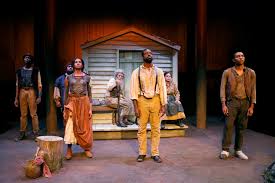
usa-001As I took my seat after Intermission at ART’s production of Father Comes Home from the Wars (Parts 1,2,3), I was struck that Suzan-Lori Parks’ historical drama is first cousin to another epic of another disenfranchised group in another era: Angels in America. The two plays share structural similarities. Both spread out over multiple performances, though Ms. Parks’ next installment, (Parts 4,5,6…) is still gestating. Both utilize the same actors in multiple roles to highlight dichotomies of human nature. The runaway slaves in Part 3 are more poignant having been the plantation slaves in Part 1. Both make individual stories universal through telling them as fables. The actors front the audience; they even refer to us. Dialogue bounces between members of the aptly named chorus without the pretense of actual conversation. Ms. Parks tells a mammoth tale from the perspective of the least significant, yet most affected, participants.

imagesFather Comes Home from the Wars’ connection to Homers’ The Odyssey is more direct than its analogy to Angels in America, but once the link to Tony Kushner’s play lodged in my head, the more satisfying it became.   Hero, Ms. Park’s main character, is a flawed hero, if he’s hero at all. His charisma instills more devotion from those around him than his actions. In that way he’s related to Prior Walter, another imperfect leading man. Each play relies on an omniscient external force to relay its truth, though its telling that an angel delivers the message to the world of gay men, while a dog delivers it to the world of slaves.

The two plays also share a pattern of reporting action occurring elsewhere. At first I was annoyed by Ms. Parks’ tendency to tell rather than show, just as Angels keeps us cooped up in Prior’s bedroom. Until I realized that was the point – we don’t need to see the Main House or the actual battle to understand that the events shaping these slaves’ lives are outside their direct control, just as Prior is incapable of controlling his disease.

images-2Perhaps the most satisfying analogy is that both Father Comes Home from the Wars (Parts 1,2,3) and Angels in America are so well written. Tony Kushner’s subtitle, A Gay Fantasia on National Themes, would have been pompous except that it’s true. One dying man’s rants reveal a disturbingly wide spectrum of human behavior, while Ms. Parks covers a comparable range of insight from a shanty porch.

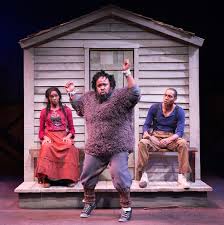
I can’t applaud very aspect of ART’s production. The set is innocuous; too literal to spark imagination, too stark to add drama. The raked walkway without beginning or end that occupies upstage is lifted straight out of The Color Purple but is less well executed. ART’s renown for flawless execution fall short, particularly when spots fail to pick up Steven Bargonetti’s amazing guitar and banjo picking song interludes that bridge transitions. Benton Greene is adequate as Hero, but less engaging than his supporting players. This is especially true in Part 3 when, after Jacob Ming-Trent’s phenomenal bit as Odyssey Dog, the play falls flat for several minutes. After writing such a loving, comic, thoughtful canine monologue, which is performed to maximum effect, even Ms. Parks must accept that it’s impossible to follow a great animal act.

imgresimages-1These shortcomings are mere quibbles compared to the power of Father Comes Home from the Wars (Parts 1,2,3). For the lights, sets, music, and actors all exist in service to the language, and the language is three hours of the most thoughtful poetry to ever grace a stage.

Walking home from the theater, I considered how Father Comes Home from the Wars (Parts 1,2,3) does for African-Americans what Angels in America did for gays. Until I realized that was wrong. Angels in America did not catapult the consciousness of gay men, their consciousness was already set. The power of Tony Kuscher’s play was to force that consciousness onto the rest of our culture. I imagine that African-Americans already understand the rage, the futility, the compromises their ancestors made to exist, and thrive, under slavery. Father Comes Home from the Wars (Parts 1,2,3) doesn’t need to raise that consciousness. Instead, at a time when questions of race and equality are as raw and relevant as ever, Suzan-Lori Parks deepens slavery’s pain for the rest of us. We cannot participate in this play and then look away.

______________

Father Comes Home from the Wars (Parts 1,2,3) plays at ART through March 1, 2015.


Posted in United States | Tagged , , , , , | Leave a comment

MIT Takes a Slice of my Life

haiti-001The MIT Alumni Association publishes a Slice of Life every day. Back in October they made a podcast about my work in Haiti, (MIT Alumni Interview) which proved so successful they followed up with a short video, available on You Tube. Without doubt the best three-minute synopsis of what my time in Haiti was all about.

Thanks to everyone at the Alumni Association; I appreciate their support.

url


Posted in Haiti, Personal | Tagged , , , | 1 Comment

Dream Cycle: The Dreams of Boys, the Dreams of Men

vitruvian_man-001Last week I posted an essay about my dreams for the world, coincident with Martin Luther King Day. Serendipitously, the next day my niece emailed family and friends soliciting dreams for her seven-year-old son. My nephew’s been waking from bad dreams so mom’s compiling a Good Dreams Jar from which he can choose an uplifting idea each night before bed. After contemplating what a caring and creative mother my niece is, I got on task. Within minutes I realized there was scant correlation between the dreams I wished for on MLK Day and those I offered my nephew.

imgresI dreamed that every person had a fair stake in this world. I dreamed that my nephew slept all night with a puppy in his arms.

I dreamed that everyone had basic shelter. I dreamed that his hero Emmet came over and they built the entire world of The Lego Movie.

I dreamed that everyone had enough food. I dreamed that he had a bowl of ice cream that filled itself after every spoonful.

I dreamed that education and economic opportunity were universal. I dreamed he grew so tall his feet hung off the bed.

imagesI dreamed the dreams of a man pushing sixty, blessed with friends, family and creature comforts that derived from luck as much as effort. Simple, though unlikely, dreams to spread my bounty and create more balance in the world.


images-4For my nephew, I dreamed the dreams of a boy pushing eight. A boy wanting to be bigger, to be noticed, to know how he was different from others, if not downright better.


Making this list of dreams two days apart for two different generations made me realize how difficult it is to reconcile human aspiration. Wishing for equal justice is not the opposite of wishing to make the winning soccer goal, but the desire to be champ can undermine fairness. After all, this dream thinking occurred the same week as the New England Patriot’s deflate-gate brouhaha.

Youthful dreams must be personal – they reflect our quest to know who we are. As we age, our dreams can be more far-reaching, but only if our circumstances allow. If I were homeless or hungry, those immediate needs would command my dream list.

images-1If my nephew is lucky, his good dream jar will lead him to better sleep. He will grow into a teenager and dream of having his own wheels, then a man with dreams of career and family prospects. Eventually, I hope his dreams will look like mine of today, dreams of sharing based in gratitude. By then my own dreams will likely contract. I’ll dream of keeping my teeth intact and my mind firm and my bed sheets dry.

While his son and his grandson’s dreams will include unending ice cream.

images-5


Posted in Uncategorized | Leave a comment

Another Check off the Bucket List

vitruvian_man-001I’m no fan of the term ‘bucket list’. It elevates the idea of peak experience, and thus diminishes the reality of life in the moment. Still, among guys my age (emphasis on GUYS) it’s a topic that comes up time and again. What do we want to do before we die?


Some friends have dozens of feats on their list – a litany of physical exertion and frequent flyer mile expenditures that leaves me dazed. I’m never going to run a marathon or traipse through Machu Picchu, and will turn to dust content with those shortcomings. But I must admit to harboring three long-time bucket list wishes: write a book, be published in The New York Times, and ride my bicycle to the 48 contiguous states.

I accomplished the first item – writing a book – last year. I’m very satisfied with Architecture by Moonlight, but the gestation process was unnecessarily painful and some people I value terminated our connection over my depiction of them. Filling my bucket brought unanticipated downsides.

On January 11, 2015, ‘Haiti’s Economics Aftershocks’ was published in The New York Times, bestowing a legitimacy every writer craves. Reading my essay under that letterhead was eerie. I sounded just like someone who writes for The New York Times. I wondered to what extent I shaped my voice to the medium versus how the medium I’ve read for so long shaped my 12fallon-superJumbovoice. The amazement didn’t last long. Within hours I became the target of a malicious Tweeter who spewed vitriol about the article – and me – all over cyberspace. My rational side recognized the distorted rage of an ill informed person misappropriating fragments of my argument. But the human part of me hurt. It’s discomforting the think that to thousands of Tweeters, @paulefallon is nothing more than a neo-liberal, paternalistic purveyor of tribal stereotypes who should stop meddling in Haiti and close his twitter account from shame. All things written about me until I abandoned following the Internet’s indictment against me. I stopped reading the tweets to preserve my dignity. My NY Times editor was pleased with the article, and that byline will zoom to the top of my writing resume, but the bucket accomplishment has tarnish.

It will be some time before I embark on my bicycle odyssey – Spring 2016 is the soonest I might pedal out of town. The reality of the adventure is more difficult to arrange than the easy flowing fantasy that rolls through my head. Though by now I realize that the journey, like any other bucket pursuit, will contain its share of bitterness along with the sweet.


Posted in Personal, Uncategorized | Tagged , , , , , | 3 Comments