Late December afternoon. Dark descending too early upon night. Sitting on a crowded 73 bus, antsy to be home. To be warm.
I look up. See a woman sitting opposite. Chestnut skin, red tints glowing through her brown surface. Large features. Almond eyes. Strong, Roman nose. Longish black hair, middle parted, hanging straight on either side. Tying head to shoulders. Framing her face in place.
Late 20’s. Maybe 30’s. Statuesque. A woman who was never cute. Likely a gawky little girl. An awkward teen. It takes time to grow into such noble features.
Today she looks good, proud. A decade from now she’ll be formidable.
My lips spread into a wide smile. So many good things do I see transpiring for her. She looks up, catches my stare, forms a half smile herself. Then we both look away.
I want to say, “You’re beautiful.” Loud enough to be heard above the bustle of the bus.
But, of course, I do not. I am an aging white man at the quarter point of 21st century America. I am fully aware of the propriety, the constraints, of what am I am allowed to say and what is verboten. I am, in some part, responsible for our caution. Knowing how easily the most innocent comment spirals into misunderstanding.
I sit silent through the rest of the ride. Steal an occasional glance at the striking woman. Dream what it could be like to live in a world where a stranger can say, “You’re beautiful,” and both parties simply be elevated by that appreciation. Maybe next year…
I go to prison, MCI Norfolk, about once a month. I have business there, assisting inmates with life sentences to prepare for their parole hearings, their sole chance of see the light of day free of bars. I love the work and I’m good at it, even if I‘m not particularly correct in my terminology. Although I appreciate the humanity in the term, ‘incarcerated person,’ the harsher term, ‘inmate’ more accurately reflects the reality of life inside.
I’m always anxious when I go to prison. I don’t sleep well the night before. I wear the same outfit, which I’ve learned does not set off any detectors. I get to the train early. (God forbid they should build prisons near subway lines, even though most of the inhabitants are inner-city folk.) I pocket extra quarters for the waiting room lockers, because sometimes the guards want you to retrieve stuff already stashed. And sometimes not. I am super polite to every prison official. And no matter how long it takes to process my paperwork and review my ID and infra-red stamp my hand and check the bottom of my feet and the inner lining of my waistband, I remain patient. But I don’t really breath until I’ve stood in the vestibule that separates inside from out, and the big metal outer door closes and the big metal inner door opens and I know for sure I’ll be able to see my guys.
Last week the process was super smooth. As I waited to be processed I noticed the other folks in line. Another rangy white guy, who turned out to be a BU professor teaching a course in Astronomy. Interesting subject for men forbidden to see the stars. A middle-age mom-looking woman. And a curvaceous Hispanic woman in a clingy white pants suit. Clearly, she never received the training we got on prison attire. No denim, no rivets, no open-toed shoes, no bling. This babe was a total fox, even to my aging gay eyes.
The professor and I got bumped up and proceeded to the visitor building, where “Aaron,” my client. was already waiting.
This was an unusual visit for me because it was 100% social. Aaron’s already had his parole hearing and is awaiting his decision. I came to visit just because it’s his birthday, and the sweet man has not a soul in the world to celebrate. No family, not a friend outside the walls.
Because I’m considered a paralegal, we get to sit in a private room, though I can see the main room through the glass door. Suddenly the middle-aged woman is wearing a robe and the gorgeous Hispanic woman’s holding a flower. Yes, Aaron confirms, it’s a wedding. The groom arrives, the C.O.’s are witnesses, as Aaron explains why women marry inmates. “Many of these women have been treated bad outside. We treat them well. We write. We call every day. We are always happy to see them.” Aaron explains that conjugal visits are not allowed, but the bride and groom definitely hug and kiss.
Aaron leaves and “Benjy” arrives. Benjy’s hearing was more than a year ago, and though he received parole, one snafu after another has left him here, still. The misjustice of this could be the subject of another, less sunny post, but today we’re all about good cheer and wedded bliss. I watch the bride insert money into various vending machines scattered across the visiting room, accumulating Cokes and Chee-tos and Hostess cakes for the wedding feast. Benjy got married while incarcerated, in this same room. The marriage lasted ten years, but fell apart when he was last denied parole. “She wasn’t willing to wait any longer,” he explains.
Aerial view of MCI Norfolk. Image courtesy of WGBH.
Commuter trains to Norfolk only run every two hours during the day, so I have to monitor my time carefully, or add another two hours to my stay. A visitor can’t enter/exit MCI Norfolk around noon, because of ‘count.’ You can’t do it between 2:30 or 3:15 either, as that’s shift change. I arrived at 12:30 pm today and hope to be gone by 2:30, time to walk to the 3:30 train in the center of town.
At 2:20 the C. O. knocks on our door to inform us that the prison is in lock down, so I’m there until who knows when. I shrug because the 5:30 or 7:30 train will have plenty of seats. Benjy carries on: he’s great company and hasn’t any place to go either.
Surprisingly, the C.O. returns at 3:10. Lockdown is lifted. Shift change is about to start. I can leave: NOW! Quick handshake to Benjy. Nod to the couple noodling chips in the corner. Thanks to the C.O. and I skedaddle back through the big metal doors, retrieve my phone and paraphernalia from my locker, walk double time into town, and, lucky me – catch the 3:30 to South Station. Norfolk Depot is no place to loiter into a cold December evening.
I glide home over the rails and think about the men stuck back in Norfolk for another night. They did terrible things. Most of them, many years ago. How is it useful for these guys to stay locked up so many years later? And how happy can the bride and groom be when visiting hours end and they too must part?
In 1961, as if in anticipation of Black Power, Langston Hughes wrote a Christmas pageant unlike any of that time, telling the familiar birth of Jesus story with a cast of Black actors, portraying that story from the strengths of Black artistry. The singing was Gospel rather than hymnal. The dancing was tribal, rooted. And the Biblical narratives were translated into 20th century eloquence, with a decidedly Black slant.
Miss Elma Lewis, grand doyenne of Boston, founder of The Elma Lewis School of Fine Arts, as well as NCAAA (National Center of Afro-American Artists), staged Black Nativity to Boston in 1970. The pageant has been performed every holiday season since.
As an aging white guy with takes no comfort from either the religious or commercial aspects of Christmas, there wasn’t much drawing me to Black Nativity. But as a Boston theater maven, I figured any production that’s endured 55 years deserves attendance. And from the perspective that, “this is something everyone should experience,” I recommend Black Nativity.
The singing is glorious. Simply glorious. And there’s plenty of it. Twenty musical numbers in all. Every traditional carol is rendered in a unique way; you mine new meaning from “Away in a Manger” and “O Come All Ye Faithful.” Yet there are many more songs that were fresh to me, and all are uplifting.
The costumes are very effective: simple white robes, with dazzling gold bodices. The percussionists are terrific. The dancing, to be honest, is less impressive, though the main dance feat, of Mary giving birth, is a gripping choreography that was powerfully manifested at the performance I attended (Black Nativity has rotating cast for many roles). The narration is lyrical; the more Langston Hughes strays from scripture and speaks in authentic voice, the more I appreciated the storytelling.
There were two big-time surprises (for me) in the production. First, after Mary’s incredible birth dance, she and Joseph come forward with a babe in a cradle. A live baby! I was captivated, and enchanted. When the babe fussed just a bit, Mary lifted him up and nursed him. Turns out, the woman playing Mary that night has a four-month-old baby, who now has a stage credit.
The second surprise came late. I figured that the three strong-voiced men who lead many of the musical numbers would be the wise men. Oh, no. The wise men were new actors descended straight out of RuPaul, swishing their way across the stage in sparkly, flamboyant robes that they toss about with drag enthusiasm. They create a striking contrast to the overall placidity of the pageant. But they’re fun!
The most disappointing aspect of the show is the venue. Emerson Paramount Main Stage is simply too big to fill for a three-week run. I saw the show on a freezing cold Thursday night, when the audience of maybe 150 scarcely populated the place. For many years Black Nativity was performed at Tremont Temple, and it would resonate better in a smaller theater or church.
In 2025, Black Nativity is hardly the radical theatrical was in 1961. It is now a period piece. But one worth preserving, and seeing. So prove me wrong – go buy tickets and sell out the Emerson Paramount this weekend.
Ten years ago, I showed up at Bruce’s apartment in Atlanta. I was surprised to discover my couchsurfing host was African American. Yet, when I had a medical appointment with a guy named Kevin last week, I fully anticipated he’d be Asian-American.
Why is it that I’m surprised when an African-American man has a Scottish first name, but not when an Asian-American answers to an Irish one? The reason, I suppose, is due to our presumptions around name origins, and our expectations of how close people hold to monikers that reflect their own ancestral traditions.
The origins of people’s first names generally fall into three categories.
First, there are names so common they’ve lost geographic specificity. John, Bob, Steve…and Paul… are so ubiquitous that they don’t reveal anything about the person’s familial tree. Scratch the surface, of course, and that notion proves false. The most common first names in the USA are rooted in Anglo-Saxon and Biblical tradition. According to the Social Security Administration, the ten most popular boy’s names in 2024 were: Liam, Noah, Oliver, Theodore, James, Henry, Mateo, Elijah, Lucas, and William. More than half of them have Biblical origin; more than half maintain a primarily association with the British Isles (though several are rooted in Greek or early German). Despite their Anglo-Biblical bent, these names are so broadly distributed in American society, we don’t conjure much specificity before a first-time encounter with a John or a Jim.
Second are the names of recognizable origin that have leaked beyond their native geography. Many Irish names fall into this category. Sean, Colin, Liam are all Irish, yet it’s not unusual to meet guys with those names of divergent ancestry. When I meet an Otto, my mind registers, “Scandinavian,” while Salvador clicks, “Italian.” Still, those names aren’t stuck in one track.
Finally, there are the names that are stuck in a track. Akeem or D’Andre brings an African-American to mind, while Grosvenor or Archibald is full-on English. This also applies to linguistic variations of Biblical names. Pablo evokes more preconceptions than Paul; Pierre more than Peter.
Our presumptions about given names certainly play a part in our preconceptions, but how closely people align their children’s names with ancestry is an equally important component. I know Asian-American immigrants named Daniel, Robert, and Will. It is so common for Asian immigrants to take on traditional American names when they land on these shores, keeping a traditional Chinese or Korean name is the rarity. In a different vein, immigrants from Africa and the Middle East are much inclined to bestow historic names on their children. When I’m about to meet a Devonte or an Abdul, I have a stronger image in my head than when anticipating meeting a George or a Fred.
Am I being prejudiced? Certainly someone can accuse me of that, though every single one of us creates pictures in our heads before we meet anyone. The picture is based on the information we have at hand. Stereotype? For sure. But stereotypes don’t come from nowhere. Given little information, we tend to render our fellow man in broad strokes. The challenge is to see him as an individual, when we finally meet.
So it’s really no surprise that I imagined Kevin might be Asian-American. Our country is full of medical professionals who’ve adopted names easy to many American ears. But how in the world did Bruce get his name? “My mother gave all of us simple, British names,” he told me. “She did not want people to make assumptions about us, or our race, before they even saw us.” Whether you think Bruce’s mother’s concern is valuable or misplaced, I have to admit, her objective was achieved. I’ll always remember my first and only Black Bruce as a distinct individual.
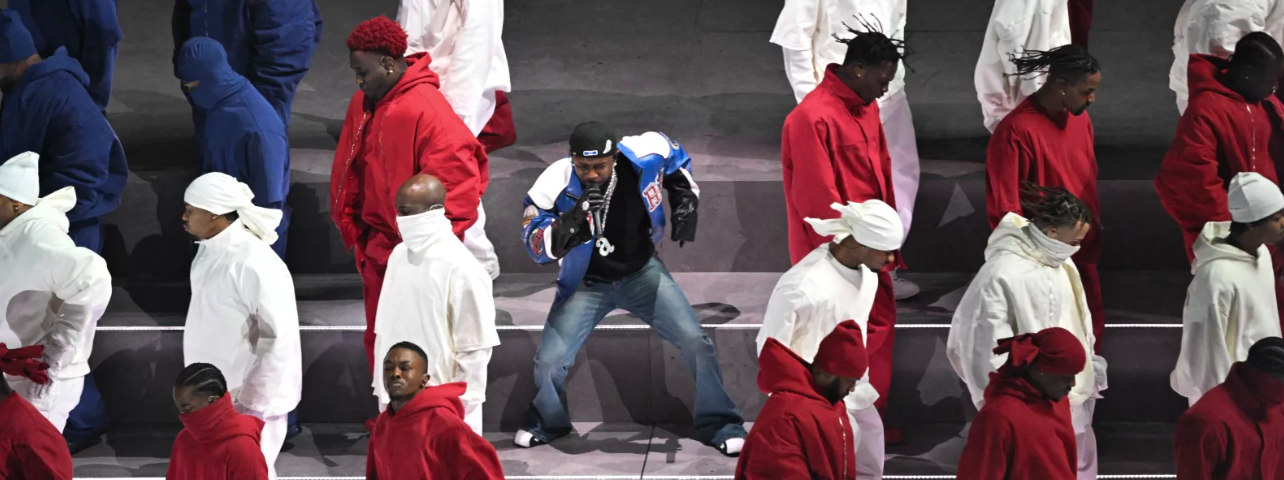
Kendrick Lamar and dancers at Super Bowl. Photo courtesy NPR.
I caught Kendrick Lamar’s halftime show at the Super Bowl last year. I saw a guy in jeans and a jacket, with backup dancers wearing red, white and blue shirts.
Apparently, I missed a lot. Lamar’s $1200 jeans, design from Celine, triggered a five thousand percent bump in internet searches for “flared jeans.” Meanwhile, Uniglo boasted that the white T-shirts the back-ups wore were their U AIRism Cotton Oversized T-shirts. They retail for $20. Though to me, they look just like the ones at Target that come in a package of three for ten bucks.
Clearly, I know nothing of fashion, or the power of media persuasion. This comes as no surprise to anyone who knows me. Paul Fallon’s fashion look is easy to describe. All solid colors. Shorts until Thanksgiving. Skechers Vigor 3.0 on my feet. A hat on my head. Multiple pairs of gloves. Nothing new.
Like most people, my fashion attributes are tied to fundamental parts of my identity. First, I am color blind, so solid colors are easier to coordinate than stripes or patterns. My primary mode of travel is bicycle, and shorts are more accommodating than long pants. Shoes are the bulkiest item to stuff into a pannier, so I found one comfortable shoe that accommodates my wide feet and I wear it everywhere. No matter where I go, I never pack a second pair. I’m balding, so a hat is imperative. The coldest part of any cyclist is his hands, thus a variety of gloves for all conditions. Finally, since I’m the same size I was in college and possess both a big closet and severe eco-frugality, I have clothes from thirty, forty, even fifty years ago that still fit. So why buy anything new?
I’m a poor prospect for as $20 T-shirt, and would never even look at a $1200 pair of jeans. But for some reason, I savor The New Yorker fashion issues. Recently, Lauren Collins’ September 22, 2025 article about Uniqlo made my head spin at the tentacles the world of so-called fashion spreads across our planet.
Ms. Collins writes, “Uniglo is the universal donor of fashion, intended to go with any lifestyle or aesthetic.” The clothes seem innocuous enough to support that statement; they strike me as basic and bland. but we really ought to tack an additional phrase to that assertion, …any lifestyle or aesthetic rooted in consumption. Our world is so consumed with consuming stuff that we take constant consumption as a given.
The ten-page Uniqlo spread, like so much of fashion, is mostly puff. The Japanese company in bald pursuit of global dominance in selling clothes is compared to Ikea in its ubiquity. The article applauds the company for designing for real-size humans, and explains how it only produces clothing in colors that complement a full range of skin ones. A kumbaya spirit cloaks the entire enterprise.
There is one paragraph, however, that reveals the underbelly of all this bonhomie. “The ecological implications of manufacturing at this scale are staggering…more than a decade ago, when the company had less than half the stores it has now, it boasted of producing six hundred million items a year.” These days, Uniqlo won’t even publish that number, so it must be truly damning.
According to Vogue, Americans buy, on average, 53 garments every year. Some estimates go as high as 68 per year. Either number is ridiculously high, given that we buy twice as many clothes annually as we did in 2000, and wear most items no more than three times. The world is awash in clothes, and Uniqlo’s pretty self-portrait as a company that is both sustainable and on a march of ever-expansion is both disingenuous and impossible.
My closet.
I understand that fashion is one way in which we humans differentiate ourselves (even if that assertion contradicts Uniqlo’s uniformity). My own threadbare preppy look, however drab, accurately reflects how I choose to present myself to the world. But why are most people’s presentation so fleeting?:How many people who purchased $1200 Kendrick-Lamar-wanna-be jeans (or the many lesser priced knockoffs that flooded the market post-Super Bowl) are still parading our city streets?
I didn’t have to succumb to the trend, because I already have a pair of flair-bottom Lucky jeans circa 1970-something, pre-worn, a little tattered. Who knew my wardrobe was so cool?
Ronny Chieng’s Netflix comedy special, “Love to Hate It” is a biting hour political satire worthy of The Daily Show correspondent. The humor is rooted in dichotomy rather than punch lines, and though it leans left, Ronny strikes at the absurdities that pock both sides of our political divide. However, unlike most comedy, which amuses and then flies out of my brain, “Love to Hate It” left me puzzling over some fundamental questions of a citizen’s relationship to their country.
“I love my country. I would die for my country.” Ronny parodies the blind patriotism of the right. Then he skewers it.
First, from an oblique angle. “What do we do for things we love? First off, we give them money.” Ronny lists all the things we love and support: young children, aging parents, sporting events, favorite charities. When we love something, we invest in it. So why, when it comes to the right, do they proclaim a deep love of country, yet disdain having to pay taxes to support it?
He lets that discrepancy hang in the air before tackling the deeper contradiction. “I love my country. I would die for my country.” Really? Who does that serve? If you love your country, wouldn’t you want to be around, to nourish it? Then Ronny riffs on the various challenges facing the US and realizes that what we really need to maintain our edge in the world is a more technically adept workforce. We don’t need people to die for our country. We need people to learn math. But no one has said, “I love my country. I will learn multi-variable calculus for my country.”
Chieng’s delivery of these ideas is much funnier than my writing about them. And the humor is underscored by his essential Asian immigrant perspective that can find parity between mastering math and offering oneself up in nation-affirming war. For that is what Americans truly mean when they say, “I love my country. I would die for my country.” They mean they would die in a war defending our country. Although the notion of ‘defending’ our country is too often writ broad, since virtually all of our wars take place on someone else’s soil.
I love my country, but I would not die for my country. Because I’m a pacifist. Because all wars destroy more than they construct. Because my highest and best contribution to my country is not dying for it; it’s living, constructively, sustainably, resiliently, within its extents.
I may not be the most patriotic person in America, but I am the most patriotic person I know. I pay my taxes, without any fudging, despite how much I despise our Defense budget, and I volunteer as a tax preparer to assist others in paying their dues. I vote in every election, and actually work at my local poll. As a young man I served my country as a VISTA Volunteer; now I help newcomers acclimate to our country by tutoring immigrants in English.
These tangible examples of loving my country are augmented by the extensive ways I’ve met my fellow Americans, listened to their points-of-view, and tried to understand them, no matter how alien they stray from my personal experience. I’ve been to more cities and towns in the US of A than anyone I know, and I relish every place I’ve visited, every person I’ve met. The great benefit of coming-of-age in Oklahoma and being adult in Massachusetts is that I’ve lived both sides of our political divide, and hold some appreciation, and disdain, for each perspective.
So what does it mean to say, “I love my country?” Does it mean you love the land: the purple mountains; the fruited plains? Does it mean you love the people: tailored New York bankers and overalled soybean farmers? Does it mean you love your tribe, the community of folks you call home? Or does it mean, as it does for me, that you love the ideals upon which our nation was founded, however short we perpetually fall in striving to achieve them?
If you’re like me, you demonstrate your love of country, not by dying for it. Rather, by working every day to reach for the lofty goals of a democratic nation in which every person has equal opportunity to reach their full potential.
As we approach Thanksgiving, and we reflect upon what we’re thankful for, I hope everyone takes a moment to consider how you love our country, and how your actions reflect that affection.
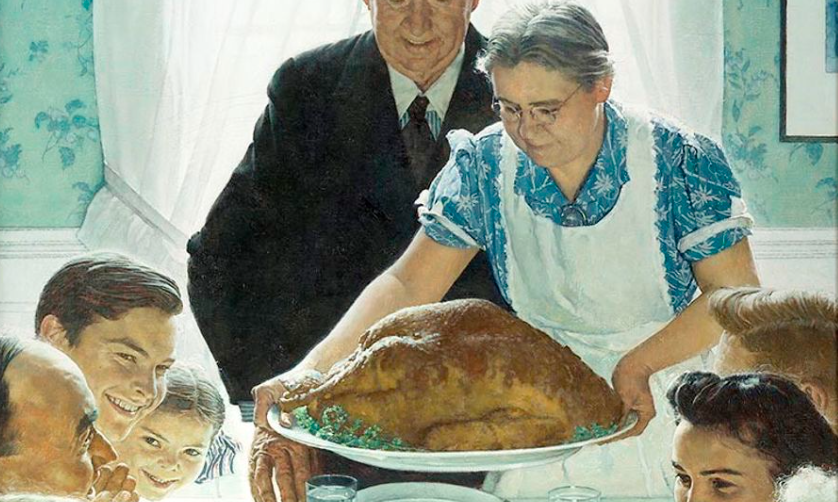
Portion of the painting, Freedom from Want by Norman Rockwell
Lyla Randall as Young Alison and Sarah Bockel as Alison. All photos by Marc J. Franklin
The Huntington’s production of Fun Home hits all the right notes and delivers the emotional wallop this tragicomedy deserves.
Fun Home, winner of five Tony Awards for 2013, is based on the graphic novel by Alison Bechdel. I’m not sure why it’s called a novel when the story so closely resembles her life. In fact, three different actors play a character named Alison Bechdel at three different stages of development, often all three on stage at the same time.
The play starts with forty-something Alison, a lesbian cartoonist, light years away from her rural Pennsylvania roots, trying to make sense, graphically and emotionally, of her deceased father. Deceased is too polite a word. Right off we learn that Bruce Bechdel kills himself when Alison, the oldest of four children, is in college.
Early on, the play is schizophrenic, as befits life in Fun Home. Bruce is a prickly dad; an historic house renovator; a high school English teacher; and owner of Bechdel Funeral Home, from which the play’s abbreviated title is derived. Sometimes Fun Home is actually fun, but most of the time it’s a Victorian monstrosity teetering on edge, as the family tries, always tries (and always fails) to meet the unreasonable expectations of a man whose internal conflictions turn cruel toward those he supposedly loves. Early scenes ricochet between family love and family disasters, with Young Alison and her three childhood siblings singing and dancing and hamming it up in the face of trauma.
Medium Alison goes to college. Discovers she’s gay. Treats the audience to the most hysterical coming out scene ever. Then tells her parents she’s gay. No response. Followed by weird response, as Alison’s mother reveals that Bruce has had male lovers throughout their entire marriage. Even before. When Alison returns home, with girlfriend Joan, she anticipates a warm talk with her dad, now that they share being gay in common. Needless to say, that’s not what happens.
Sushma Saha as Joan and Maya Jacobson as Medium Alison
Enough of the downer plot. Did I mention Fun Home’s a musical? Really, it is. Though, to be honest, the music’s not all that memorable. Wherein lies the strength of The Huntington’s production. The music is there, and the production numbers with the kiddies are welcome palate cleansers, but Huntington’s focus is on the emotional entanglement between father, mother, and daughter. I’ve seen other productions of Fun Home, but none that left me so distraught at play’s end; so in awe of the human capacity to twist and thwart those we love.
The Huntington set is a remarkable collection of moving parts that assemble and dissemble Fun Home and other locales. I couldn’t figure out the point of the bucolic tree background, nor why the band is framed in a floating sky. Odd, but not necessarily bad.
Cast wise, some of the secondary roles deserve more heft. Nevertheless, the three Alison’s carry the show as a perfect trio. Maya Jacobson as Middle Alison is a particular standout. Jennifer Ellis is also noteworthy in maintaining tight composure as the long-suffering wife. She finally gets her own voice in “Days of Days,” which I find the most affecting song in the show.
Jennifer Ellis as Helen Bechdel
As to Nick Duckart as Bruce Bechdel, I must confess that I dislike the father in this play so much, I can’t imagine praising anyone in the role. I know a thing or two about growing up under a volatile father. Also about being drawn to men yet marrying a woman, fathering children, coming out, and raising them. It’s not a clear path, but it can be navigated with dignity for everyone involved. When I watch Bruce pick up his former students, and leave his young children alone at night to prowl, my skin crawls. When I see him throw himself in front of a truck, I feel no empathy. Rather, I see the commitments—wife and children—abandoned by this needling, narcissistic man. When I see Alison, so many years later, still trying to reconcile her relationship with the man, I want to scream, “The asshole isn’t worth the effort.” But then I realize that he’s her father, and don’t each of us try to reconcile the sins and mistakes of our own parents, no matter how dastardly they might have been.
You don’t need to be a gay dad, or even be gay yourself, to savor the rich emotional journey into Fun Home. You just need to get to The Huntington by December 14 and be prepared for a deep dive into perdition and forgiveness.
Ed Markey’s a great guy. As honest as a politician can be, a faithful public servant, a progressive voice from the bluest state in America. He’s running for reelection to the U.S Senate in 2026, yet it’s time for him to go. Why? Because the guy will be eighty years old next year, and no one that age should be entrusted with a six-year term for any office. Period.
Call me ageist, but I’ll lean into the science on this. There’s a natural arc to the age of man, and to every particular man. We ramp up in intelligence and physical capability, hitting our physical peak around age 28, and our mental peak about the same time.
It’s no secret that most great scientific discoveries are made by younger folk. We are accustomed to seeing Einstein as a wizened old man with a mass of great white hair, but when he published his theory of relativity, at age 26, he had close cropped, dark hair and a neat moustache. Einstein added much to world throughout his life, but his truly bold contribution happened when he was young. Similarly, Louis Pasteur was 35 when he introduced the theory of fermentation, Thomas Edison 32 when he invented the incandescent light bulb, Neils Bohr a mere 28 when he described the components of the atom. Each continued to develop and refine, but their novel thinking happened when they were young.
Politicians are not scientists. Their contributions to the world do not rely on an “Aha!” moment. Their skills are better tuned to the wisdom of age. For some reason, as we have less time on this planet, we tend to become more patient; we gain longer perspective. Those are admirable traits in a politician. Thus we find many effective politicians in their 50’s, 60’s, perhaps even into their 70’s,
Ed Markey in 2025. Courtesy WGBH.
But at some point, the notion that age connotes wisdom runs smack into the reality that age creates senility. I’m a pretty sharp guy. I’ve tackled some challenging puzzles in my day. At age 70, I’m a full decade younger than Senator Markey. Sure, I forget names. But I also get the occasional brain fog, I miss important connections. I don’t have any diagnosed condition: I’m just getting old. I still have good ideas and well-founded opinions, but I know they’re not as sharp as those I held as a younger man. Fortunately, for me and everyone else, I’m aging gracefully out of any leadership role. No one calls on me to make important decisions anymore.
Democrats love to proclaim themselves the party of science. Except, of course, when the science doesn’t fit their point-of-view. There is no doubt that Ed Markey is less sharp than he was ten years ago, even twenty years ago. That’s not prejudice—it’s science. Time for him to retire graciously, bask on his well-earned laurels, and hand the reins of advocating progressive ideals to a younger person.
Keiji Ishiguri as Lizard Boy. All photos by Benjamin Rose Photography.
Twenty years ago, Mount St. Helens erupted, a dinosaur spewed forth, landed at a nearby playground, was beheaded by EMT’s, and the blood that spewed onto five children gave them various superpowers. All except Trevor, who was doused with the most blood. He simply turned green.
If that premise inspires or delights you, you’re going to love Lizard Boy as much as I do. If the comic book silliness is too much for you, the times are ripe to snuggle up with George Orwell. But…you’ll be missing so much fun.
Trevor (Keiji Ishiguri) is a shut-in, embarrassed by his green skin, except for one night a year, when Monsterfest brings out all sorts, and he can blend into the crowd. He hooks up with Cary (Peter DiMaggio), though it takes the two some time to navigate the minefield of hook-up versus date. Eventually, they go clubbing and hear a singer (Chelsea Nectow), who’s the Siren of Trevor’s bad dreams. The trio are uniformly good. Chelsea is a stand-out. All Joan Jett and Grace Slick, until she releases her Siren scat across the horizon of heaven.
I won’t try to relay any more plot because, frankly, I didn’t understand what was going on much of the time. But really, I didn’t care. Comic books are about color, action, and splash. So too, is Lizard Boy.
Lyndsay Allyn Cox’s direction, energetic to the precipice of frenzy, perfectly suits the tenor of the play. There are only three actors, doubling as the musicians, but they are everywhere, all the time, generating the presence of a complete ensemble. There’s piano and guitar, as in any indie-rock musical, but also ukulele and kazoo and cello. Yes…cello! The percussion is as surprising as it is insistent. The rubber hammer against the steamer trunk is a reliable motif, but when Siren angrily bangs the guitar case on the floor to the beat…I thought it was just hysterical.
The interaction of cast and music and instrument reaches a crescendo in a superbly crafted choreography when the action peaks – just as the world is about to end!!! Holy tambourine, Bat Man! I never crossed such a violent cello!
The cast of Lizard Boy
The mere title, Lizard Boy, conjures memories of Speakeasy triumphs past. The 2003 production of Bat Boy: the Musical, (which this longtime Speakeasy patron considers its finest show ever) had its run extended I can’t recall how many times. The similarities between the two shows go beyond the title word, Boy. Each displays the plight of a human creature augmented by extra-species characteristics. Each title character considers their difference their weakness and futilely strives to fit in, until they realize that their difference is their strength. Or, as Trevor finally sings in comic book lingo, “My difference is my superpower!”
Surprise, surprise, the world doesn’t end. All are saved. Hope blossoms. And you’ve just enjoyed a marvelous ninety-minutes escaping the Orwellian shadows of present times.
In September, my brother and sister and her husband held a mini-reunion over a nine-day visit to Ireland. I’d been to Ireland before (my daughter and I explored the lesser travelled precincts of Donegal back in 2007), so I knew the joys of visiting the Emerald Isle. The people are so grand!
This trip was different in that it was a guided tour—my first. It could have been titled ‘Ireland 101’ as it hit the usual high points: Dublin; Cork; Killarney; Galway; Blarney Castle; Ring of Kerry; Cliffs of Moher; Jameson; Guinness. Basically, a photo op at every calendar image of Ireland. I had my doubts about being part of a tour bus herd, but the tour proved to be fantastic: excellent food and digs; nice fellow travelers; terrific guides.
Cork City Jail
Constance, our guide in Cork, was particularly engaging. After motoring through the city and making a surprisingly interesting visit to the 19th century city jail (Cork was a rough place back then, and tales of the jail’s inhabitants are remarkable), we headed to neighboring Midleton to see the Jameson Distillery. Just before the highway exit, Constance pointed out an unusual sculpture, barely visible through the trees. We arrived in Midleton with a free hour for lunch, so I decided to hoof it back to that sculpture and savor the endearing backstory Constance had told.
When you visit Philadelphia, you get steeped in the Declaration of Independence. In Cambodia, you must go to the killing fields. In Paris you cannot escape Hausman’s boulevards. In Ireland, you have to confront the Great Hunger. More than a million Irish died in the 1840’s. Even more emigrated. Within a decade the population of Ireland was cut in half, only recently returned to pre-famine numbers. The Great Hunger is a tale of blighted potatoes, English cruelty, and the limits of the land to provide. And though it occurred almost two hundred years ago, it is ever present in the Irish psyche. Famine is the benchmark of their national character.
Kindred Spirits
Here is the beautiful story that Constance told.
In 1847, at the height of the Great Hunger, the people of Ireland received a notable gift from an unlikely source. The Choctaw Nation knew a thing or two about hunger, having traversed the Trail of Tears from Alabama and Mississippi to Oklahoma during the 1830’s, experiencing decimation, disease, and famine along the way. When they learned of the famine in Ireland, the Choctaw took up collection and sent $170 to aid the Irish. A huge gift at the time, from one impoverished people to another.
The Irish have long memories of hunger and of generosity. In the 21st century, the Midleton Town Council commissioned Kindred Spirits, the monumental sculpture by Alex Pentek, in appreciation for the Choctaw gift. A delegation of twenty Choctaw travelled to Midleton to attend the sculpture’s unveiling in 2017.
How often in life is the assistance we desperately need delivered by those who, seemingly, have so little to offer.