I Have a Dream – 2015

usa-001On this Martin Luther King Day I have a dream that today this nation, this world, will rise up and live out the true meaning of the creed that all men are created equal.

That we abandon labels that divide – white from black, Democrat from Republican, rich from poor, man from woman, gay from straight, Christian from Muslim, American from Russian.

That we all share a fair stake in it this world

That black lives matter and police are respected

That educational and economic opportunity are available to all

That justice is equitable and punishment restorative

That everyone enjoys basic food, shelter and healthcare

That pulling our weight and caring for our neighbor is a privilege rather than a burden.

imagesI have a dream that when we look into the cosmos, we realize this is the only world we have.

That we share it with seven billion other humans

That we are stewards of countless other creatures

That we are no stronger than the weakest among us

And that lasting peace will only come when we celebrate all being in this together.


Posted in Uncategorized | Leave a comment

After the Earthquake’s Anniversary

haiti-001It is incongruous that the fifth anniversary of the 2010 Haiti earthquake, on Monday January 12, provided such a flurry of excitement and activity for me. I am just coming off the media blur. However, I was happy to participate in discussions about Haiti and voice a more positive perspective on our deserving neighbor than the media usually portrays.

Throughout January I will post all of the articles and interviews I did surrounding January 12. Today I want to thanks my friends at WBUR: Fred Thys, Kelly Horan, Anthony Brooks, Frannie Carr, and Mark Degon. Anthony interviewed me on Radio Boston and the station published the following essay on WBUR Cognoscenti, with an accompanying audio commentary.

__________

On Shaky Ground: Haiti, Five Years Later

Five years ago today, January 12, 2010, a 7.0 earthquake shook Haiti. We’ll never know how many died; precise statistics are difficult in that imprecise country. The official toll is 316,000. Other estimates are smaller, yet still in six figures. The following month Chile experienced an 8.8 magnitude earthquake and 523 people died (USGS) – a count as precise as Chile’s stringent building codes. The comparative math from these two events is staggering: Chile’s earthquake was 60 times more powerful than Haiti’s, yet the Haiti suffered 500 times more deaths.

Three girlsI had visited Haiti the summer before the earthquake and fallen in love with the Magic Island’s casual charm. As an architect, I understood that shoddy building construction was responsible for most earthquake-related deaths. Haiti’s long tradition of concrete construction, excellent at supporting direct pressure but weak if pulled or shaken, exacerbated the tragedy. Concrete requires steel reinforcing to withstand forces from all directions, but since steel is expensive and building codes nonexistent in Haiti, underreinforced concrete crumbled when the earth shook. People were crushed.

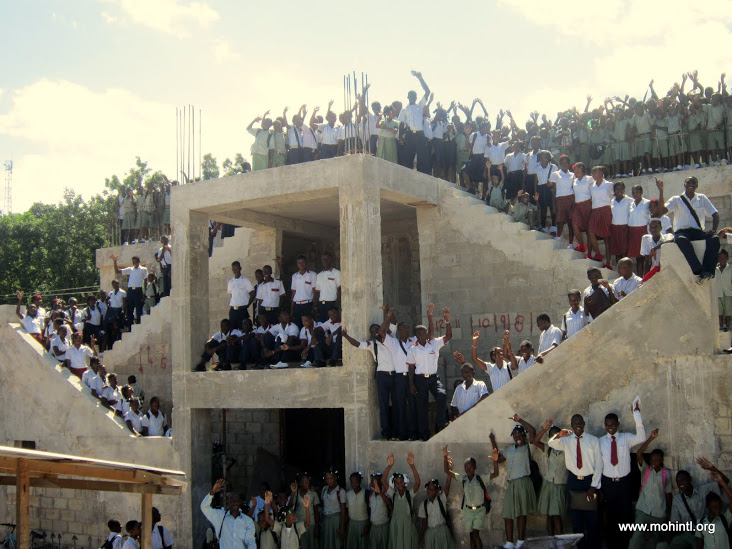
My desire to contribute to Haiti’s reconstruction led me to design two buildings in Grand Goave, a town ten miles west of the epicenter. The Gengel family from Rutland, MA built an orphanage to honor their daughter who died in the earthquake; Mission of Hope, a Haitian-based organization with strong Massachusetts’ ties, built a new school. Boston-area engineers and craftsmen designed innovative earthquake-resistant structures and trained local Haitians how to make traditional concrete construction stronger. After a few more visits, Haiti infiltrated my psyche and by 2012 I left my stateside job to supervise construction and live there half-time.

120402 19 Bucket BrigadeEach day in Haiti was ripe with surprise, wonder, and frustration. Local women collected the stumps our excavation unearthed to make precious charcoal. We vied with other aid groups for scarce construction machinery. We built our own concrete block plant to cast stronger blocks. We mixed concrete by hand, in simple ratios of cement bags to buckets of sand and gravel. Concrete floor slabs, that might take eight guys and line of ready-mix trucks six hours to pour in Boston, required two hundred men working 40 hours straight, day and night. At six dollars a day, labor was cheap and plentiful, while materials were expensive and machinery rare.

120308 Rebar CarriersIt took Sisyphean effort to complete these buildings. The orphanage is a quarter mile up a hill so steep that trucks delivering reinforcing couldn’t climb the grade. Laborers carried over 100,000 pounds of steel uphill on their shoulders. I calculated over 1250 hours of brutal hauling. At a total cost us less than $1000 in wages.

The school and orphanage have been open for over a year. We envisioned them as prototypes of Haiti’s vernacular construction reinterpreted to withstand earthquakes. Unfortunately they proved too expensive to become a new standard. Before the quake, Haitian buildings cost about $25 per square foot. Post-earthquake inflation has doubled that price. Our engineered buildings cost even more – $75 per square foot. Compared to U.S. construction, this is cheap. But Haitians struggling to feed, clothe, and educate their children cannot justify buying sturdy two-dollar block from our factory when they can mix sand and gravel with a handful of cement and a bucket of water to form sun-dried units at half the cost. These inferior block crumble under the slightest pressure, but tomorrow’s earthquake is a distant rumble compared with today’s growling stomach.

DSC03287We created two sturdy buildings in Haiti, but like most philanthropic groups, we fell sort of the larger objective: helping Haiti become self-sufficient. Transforming a subsistence economy into a productive one requires incentives that reinforce each other to improve the overall quality of life. Everyone agrees that Haiti needs better education, more jobs, and transparent government. From my particular perspective, Haiti also needs to adopt – and enforce – building codes. Codes would require better construction materials and improve construction practices. The increased cost of higher standards would eventually be absorbed by an expanding economy. And many more children would be protected against the next earthquake than our school and orphanage can ever shelter.

121212 MoHI School with children


Posted in Haiti | Tagged , , , , , , , | 2 Comments

5 Years after the Haiti Earthquake: 20 Visits & 10 Gifts Received

haiti-001Five years ago, an earthquake devastated Haiti. Hundreds of thousands of people died, though exact numbers are elusive in that imprecise country. International aid poured in. Some helped, much didn’t, despite First World hubris that we would ‘build back better’.


I leant my hand designing and building a school and orphanage in Grand Goave, ten miles west of the earthquake’s epicenter. I’ve been to Haiti twenty times. The buildings are finished and serving their community. Yet, on this anniversary of the tragic event, I am celebrating the resilience of the Haitian people and the incredible gifts they’ve given me. Treasures equally valuable what I offered them.

  1. The more you give, the more you get.

121212 MoHI School with childrenThe most valuable human experiences emerge come from exchanging wildly different things. Swapping apples for oranges is worthwhile, but exchanging apples for an exotic fruit is more satisfying. I was a middle-aged guy hankering for adventure and purpose; Haiti needed concrete and steel. What began from afar led to occasional visits, and eventually leaving my job to supervise construction. The more invested in Haiti, the greater satisfaction I received.

  1. Witness rather than judge.

DSCN2151Crowds assembled to watch local laborers and blan (Creole for foreigners) build portable shelters from 2×4’s and tarps post-earthquake. When the blan flew home, construction ceased. I couldn’t understand why, since the structures were easy to erect, better than tents, and manpower was plentiful. Until I realized that my idea of ‘better’ didn’t align with theirs. Life in Haiti was difficult before the earthquake and difficult after, albeit in different ways. I brought energy to build, they countered with a more valuable survival skill: resilience.


  1. ‘Be’ before you ‘Do.”

120308 ParadeUpon introduction, Americans often ask, “What do you do?” It’s an irrelevant question in a country where organized jobs are scarce and the concept of unemployment doesn’t exist. Haitians are bound by relationship rather than title. They aren’t defined by what they do, but who they are.


  1. Work for purpose above money.

MoHI ConcreteHaitians despise “the man”, whether French plantation owner, corrupt government, U.S. Marine or patriarchal aid organization. People seek money for basics and indulgences, as we do the world over, but pride as the world’s first black Republic trumps the money motivator. When I aligned our objectives, crews worked harder than any I’ve seen. When I got bossy, they turned lazy. Mere wages couldn’t make them toil.

  1. Cherish what’s useful in the moment.

DSCN1515I brought a carton of children’s books and placed it under a tree at the construction site. When a child read a book, he battled any who challenged his right of ownership. But once finished, he left it behind. I thought children with so little would crave something to own, but they saw no point in claiming possession of something no longer in use.

  1. Find depravation’s upside.

DSCN1048No lunch? Dinner will taste all the better. No lights? The stars are magnificent. No cement? We have an afternoon to swim. No gasoline? Walking home along the river is peaceful. I never met people who had so little, or laughed so much.


  1. Where death is commonplace, life is precious.

DSCN1891During 2012 I spent two weeks every month in Haiti. On every visit, someone died. The most tragic deaths were a mother and four children, smothered when their tent collapsed in a mudslide triggered by Hurricane Sandy. Most deaths were preventable through public health measures like clean water, sanitation, lifeguards or pre-natal care. Haitians mourned hard and loud, then stirred their spirits to resume lives never taken for granted.

  1. Magic thrives in a world governed by physics.

DSCN2182Haiti’s richness lies in its conflicting truths; eighty-five percent of Haitians are Catholic; ninety percent believe in Voodoo. We built heavy concrete structures with steel reinforcing to buck the tidal earth. Explaining the value of massive construction was difficult, almost heretical, to men seeped in the belief that earthquakes are messages from angry gods. Who are we to fortify ourselves against their wrath?

  1. Small boys tell big stories.

DSCN1308I met Dieunison on my second trip, when he adopted me and became my construction helper. Over the next four years his mother died, he lived with relatives, then strangers, got shuttled to Port-au-Prince, and escaped back to Grand Goave. When I decided to adopt Dieunison in return, my desire that he conform prompted the boy to run away. Only when I ceded the freedoms he demanded did Dieunison accept a sturdy roof, regular meals, and solid education. Dieunison wants the advantages the world can offer, but only on his terms.


  1. 10. Share a ball with the widest circle.

120304 BeachOne afternoon, swimming in the Bay of Gonave with another volunteer, a group of Haitian’s flagged us to join them. We jumped high and dove long, splashing and tossing their ball with the exuberance of American eight-year-olds. Yet we were ages 20 to 56, strangers all, except for our common love of a ball and the waves.


Posted in Haiti | Tagged , , , , , | Leave a comment

Cambridge May be Cushy, but We’re Not Afraid of the Cold

usa-001The thermometer dropped below zero last night, and the City of Boston closed public schools today. Really? There’s no snow on the ground, little ice and the sun is bright.

One might have thought that the precious, coddled People’s Republic of Cambridge would stay inside by fiat when the mercury shrunk. But truth be told, Cambridge is a lot heartier than its fuzzy liberal image allows.

True, the DPW plows are out with the first flakes; they even slated the bike path on my way to yoga this morning. But in 14 years of my children attending Cambridge Schools, they rarely closed for weather, and were open for learning today.

imgresThere are other fascinating contradictions about living here. The city has a reputation for being Socialist, when it’s actually a hotbed of capitalism. All the start-ups. All that intellectual capital. There are more jobs in Cambridge than residents. What other city can boast that statistic?

As a result, our commercial tax base is phenomenal, and our residential property taxes only half to 2/3 of neighboring communities. Yet services in Cambridge range from excellent (all those plows) to exorbitant (Cambridge spends over $27,000 per student in our schools) to absurd (we have a full time Peace Commissioner and Smokey-bear outfitted ranger who patrols Fresh Pond).
imgres-2Cambridge takes itself too seriously and is prone to discuss everything too much. It takes days to determine the results of City Council elections due to our uniquely completed form of electoral government (proportional representation – good luck figuring that out). Yet, we have a long history of squeaky clean government. The city is simultaneously complicated and transparent.

imgres-1In short, although it’s not perfect, Cambridge is a city that other localities can only dream of becoming: an affluent place with a solid social safety net, distinctive schools, high paying jobs and moderate taxes. But all of our advantages don’t make us soft. We don’t close down just because it’s cold.


Posted in United States | Tagged , , , , , , | Leave a comment

I Hate This Ad

usa-001I opened the cover of this Sunday’s New York Times Magazine and there she was – again. A young woman in casual clothes holding a cup of coffee, her hand pressed against an expanse of floor-to-ceiling glass, overlooking the sea. The water is the silky blue of the Pacific, the ocean of the future, rather than the murky grey Atlantic, which looks back to Europe and the past. She stands alone, in an opulently sterile house with a wild skin rug and a single chair that speaks of art more than life.

She strikes a three-quarter pose; we can’t quite see her face. She is so independent she ignores even us, the creatures she’s trying to entice. We are supposed to imagine her face could be ours, the view could be ours, the money she has to live in such exclusive seclusion could be ours; because BNY Mellon does such a bang-up job managing her assets. If we had enough assets to require management, we would be wise to seek out BNY Mellon. Then we could be like her.

IMG_1303

What a horrible thought. That the point of being rich is to live, by ourselves, in a place with a distant view, of no one, with a an elaborate rug that confirms our domination over the natural world, and a single chair because we don’t even welcome other human company.

I’ve always lived with others, and always appreciated that the trials of getting along with them are the stuff of life. Not always fun, but always real. The idea that the perfect life is one of complete independence from others is not just an illusion: it is wrong. Humans are social creatures. We need each other. And though I fully embrace Virginia Woolf’s search for a room of one’s own, the idea that we should crave a complete environment incapable of accommodating another human being espouses a socially and biologically corrupt level of independence.

Don’t hire BNY Mellon to manage your wealth.Don’t crave a solitary perch with a view of nothing. Don’t support the idea that objective of life is to disconnect yourself from the other 6 billion people on the planet.

Let’s mix it up with our families, neighbors and friends, spread our wealth around, and share our humanity.

Posted in Uncategorized | Tagged , , , | 3 Comments

Happy New Year

vitruvian_man-001I guess 2015 is going to be the year of finding beauty in unlikely places.  After cleaning up from a terrific New Year’s eve party, I opened the dishwasher to discover that plastic wine glasses suffer from the heat.  But they are tantalizing in the winter sunlight.

I hope you find beauty in everything this year.

IMG_1296

IMG_1297

Posted in Uncategorized | 1 Comment

Cooking Lessons

vitruvian_man-001It is a truth universally acknowledged that I am a single man in possession of a good fortune who wants for nothing. Like many eighteenth century characters my fortune is measured in income rather than wages. Although I don’t possess an estate worthy of Mr. Darcy, the drafty four-family house I purchased over twenty years ago suits me well. At the time, everyone snickered at my white elephant boarding house. Now they envy the economic independence it affords. I have good health, good friends, wonderful children, a debonair housemate, and ample time to explore my interests. Yet despite Jane Austen’s authority on such matters, I am not in want of a wife. Or even a husband. I assume my debt to society for such undeserved largesse is to acknowledge my gratitude and offer my hand to those with less benevolent luck. Nevertheless, my circumstances continue to improve.

IMG_1061Among the perks that fell my way without strategy or calculation is my housemate, also named Paul. He’s a good cook, incapable of making small portions, and allergic to leftovers. As someone who refuels rather than dines, I was accustomed to pots of rice and beans that lasted for days. Now, as Paul’s bottom feeder, I eat like a prince. I consume only refrigerator items over 24 hours old, yet a typical day might include leftover sirloin tips with an onion and mushroom tapenade for breakfast; chicken with homemade biscuits and fresh peas at lunch; lemon haddock with rice pilaf for dinner.

Paul not only cooks huge quantities, he also buys more than he eats. If he fancies an éclair, he purchases a package of five and eats one. You know who gets the rest. When he orders a pizza he savors two slices, maybe three. The majority of the pie goes to me.

Recently, my bounty blossomed even further: Paul took cooking classes. This was akin to James Joyce enrolling in a Grub Street workshop, but the results of Paul’s embellished craft only mean more, better, food for me.

IMG_1114Week one was knife skills. Paul came home with a Mercer Rule. In the days before computer drafting, architects called it a template; I had dozens to guide drawing circles, toilets, and chairs. Paul’s indicates the precise size of Julienne versus Batonette, small dice versus Brunoise. For the next week our food was chopped so fine I scarcely needed teeth. Of course, all of our knives were deemed unconscionably dull and got professionally sharpened.

Week two was eggs. Everything got beat light and fluffy.

IMG_1082Providentially, the week before Thanksgiving was stews and stocks. I’ve been cooking Thanksgiving for twenty years, and have mastered the sequence of roasting turkey, carving, eating, stripping leftovers, boiling carcass, and making turkey barley soup from the leftovers. That tradition was crushed by Paul’s enthusiasm for making stock. He confiscated the carcass, which got boiled on Friday, then strained, chilled, fat removed, and reduced. Actual soup didn’t appear until Saturday. Yes, it was better than mime, but perhaps only because we had to wait so long.

Week four was slow cooked meats. Week five was white sauces. Paul’s repertoire grew complex. Our diet grew heavy. When Paul asked, “Will you be needing the kitchen tomorrow afternoon?” I stayed in my office and enjoyed the vapors wafting up the stairs. He only asks from politeness, for although the deed proclaims this as my house, the kitchen now belongs to Paul. New gizmos arrive daily. He brandished something called a potato ricer. I thought rice and potatoes came from opposite corners of the world.

IMG_1118Sometimes, I miss my kitchen and the peasant fare I used to boil there. When Paul traveled over Christmas I considered making crock-pot beans and cornbread. But the refrigerator was crammed with more elaborate goodies. So I sautéed shitake and chanterelle mushrooms in remnant stock, folded in chicken liver pate and poured it over garlic croutons. It was delicious, but left me feeling disconnected with my fellow man.

After another multiple day round preparing more stock, more soup, Paul said, “Tell me when you want some soup and I’ll compose it.” What is he, Beethoven?

IMG_0884An important part of our chef / bottom feeder game is that it occurs without comment. I pride myself as expert in guessing what’s beyond Paul’s due date and pass on anything Paul might still eat. I would never task him to heat – excuse me, compose – soup for me. He realized that later. “Since we don’t eat at the same time, I made portions you can heat up any time.”

I waited a day, then heated up a lingering bowl of fresh squash soup with burnt pumpkin seeds and slow cooked sausage. I may want for nothing in life, but that soup was so delicious I savored some more.

Posted in Personal, Uncategorized | Tagged , , , , | 1 Comment

One Hundred Years Ago Tonight

vitruvian_man-001

A poem by my friend, Bertrand Fay:

|

|

My name is John Wiggand

My mates, good lads all, call me Wiggers

Countrymen, my fam’ly for generations

Know the woods and fields of Hertfordshire

My Ma is gone. My Da alive, back home

Yes, and sweet Sarah, ‘less I was born t be a ghost,

She’ll be my missus when this war is done.

|

I joined up, like most, as soon as we declared

Pro Patria runs deep in me.

I know my gun, the bayonet blade, how cold steel is

So far these thirty days it’s muck and mud

That’s what it is, this bloody trench.

|

We’ll not be home for Christmas

Though they said this somber night is Christmas Eve

Anno Domini ‘14

Not what you’d call a midnight clear

Just a star or two shining down on No Man’s Land

|

And I don’t know, I might be hearing things

But across the frosted barrens a low sound comes

Like nothing you’d expect to hear.

A thrum, at first, then growing into a melody

And words, German words, Stille, heilige

Unmistakable, the tune from our side

Lad’s voices lofted on the frigid air

Silent night, holy night

And in my heart, amazement takes the place of fear

|

In the hush a wee, faint light

Another and another until I lose count

Rising ‘bove the breastwork of the Boches’ dugout opposite

As if suspended in the atmosphere a hearty glow

‘Tis then I see so many candles flick’ring on an evergreen

Tannenbaum, the Christmas tree

|

It draws us Tommies, man by man

We mount the berm, climb out from the trench

And soon sworn enemies here on the Western Front

Yet each a son away from home

Are gathered in the snowfall, smiling

Absurdly at first, then shaking hands

Clapping shoulders, exchanging what we have to share

Tobacco, oranges, a flask of schnapps

|

My harmonica, I take it from the pocket of my greatcoat

A German chap who says, in English, that his name is Franz

Is fingering a mandolin

Together we play, not quite in tune

Bach’s Jesu Joy, Bleibit meaine Freude

When we finish Franz says Wiggers, das war gut

|

Someone has a soccerball, starts a game and in the dark

We are again what we all are

Boys

Who ne’ertheless this wondrous night

Own a world where nothing seems wrong

The Great War, just begun

A Christmas truce, heav’nly peace

Midnight to dawn at first light

Strife and sorrow, more to come

But what we had ‘twas not a dream

|

 imgres

Posted in Uncategorized | Tagged | Leave a comment

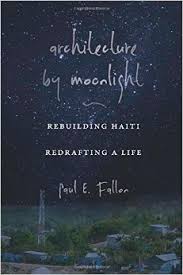
Architecture by Moonlight – Reading Group Guide

haiti-001Here is a Reading Group Guide for Book Clubs who are reading Architecture by Moonlight.  Enjoy!


imgres-2Reading Group Guide for

Architecture by Moonlight:

Rebuilding Haiti, Redrafting a Life

By Paul E. Fallon


Overview

Architecture by Moonlight chronicles author Paul E. Fallon’s journeys to Haiti after the 2010 earthquake to design and supervise construction of the Mission of Hope school and Be Like Brit orphanage. The rudimentary tasks of building in a developing country provide the context for a deeper exploration of this beguiling land, so different from the United States, yet rooted in our shared history as the Western Hemisphere’s two oldest republics.

The book reveals Paul’s personal story of balancing contradictory demands. The Gengel’s, a boisterous American family, seek to construct a memorial for their deceased daughter. Lex and Renee Edme run Mission of Hope, but their evangelical missionaries are sometimes more interested in saving souls than filling bellies or educating minds. Tradition-bound construction workers are more comfortable with magic than the physics of earthquake-resistant construction. The soul of the narrative belongs to Dieunison, a wily Haitian orphan who captures Paul’s heart and exemplifies both Haiti’s tragedy and its indomitable spirit.

From the simple yet sturdy buildings that Paul conceives, Architecture by Moonlight posits larger questions about our individual and collective response to tragedy, the act of construction as a path through grief, the benefits and pitfalls of philanthropy, and the shortcomings of international aid. By the time the two projects are complete, he envisions Haiti, unhinged from outside directives, mapping its own future.

Architecture by Moonlight is the eloquent tale of “an ensemble of incomplete people struggling in a land of great trial and great promise, trying to better understand their place on Earth.” Paul reveals how, when seemingly different people come together, we succeed by seeking our commonality. Therein lies the strength we need to rise above disaster and celebrate recovery, perseverance, and humanity.

Discussion Questions

  1. One out of every 40 Haitians died in the earthquake; an equal number were wounded; and one in six of the survivors were homeless. Americans believe our infrastructure and technology will protect us from such a catastrophe (as it did in Chile’s February 2010 earthquake). Yet the damage inflicted by Hurricanes Katrina and Sandy were much worse than we anticipated. Can you envision a natural disaster of that scale occurring in the U.S? Would we cope better or worse than Haitians did?
  1. Do you think Dieunison, the boy who ‘adopts’ Paul as his blan, exemplifies both Haiti’s problems and its promise? Which of his characteristics can be extrapolated to Haiti’s larger society? What aspects of Haitian culture does the book describe which Dieunison does not represent?
  1. Paul states, “When it comes to acknowledging feelings, I am as opaque as any guy.” (page 4). At what point in the book did he move from having a vague tug toward Haiti to understanding his reason and purpose for being there?
  1. When Paul brings a carton of children’s books to the construction site, he notices, “If a child picks up a book, his right of use is fiercely guarded, and a clawing fight breaks out if another child tries to snatch it. But once finished, the books returns to the pile, available to whoever might want it next.” (page 34). Why do the Haitian children have such a casual sense of ownership? Is it a desirable trait that fosters sharing, or reflect a lack of respect for valuable possessions? Would their attitude be different toward objects of greater immediate value, like sneakers or cellphones?
  1. Paul comments on the simplicity and directness of Haitian Creole (page 110), a language with a limited vocabulary and no tenses, while English contains more vocabulary than any language in the world. What are the advantages and limitations of having a language or unlimited vocabulary versus one of few words?
  1. How would Paul’s working relationships with Lex, Renee, and Len have changed if they knew his personal feelings for Lex? Should he have been more forthcoming in sharing those feelings?
  1. Do you agree with Renee Edme’s statement, “Haiti is a country of teenagers?” Is that a positive or disparaging remark?
  1. After Nightline visits the orphanage site, Paul reflects, “…we have all been willing fools in the dream machine.” (page 117). Does Nightline provide positive value? How could the segment be reframed to more accurately portray the project?
  1. Paul interprets Len Gengel’s statement, “Cherylann and I have given the most anyone could to Haiti, and that’s our only daughter” (page 157) as an attempt to reframe Britney’s death to provide Len some control over it. How do you interpret Len Gengel’s statement?
  1. Paul does not believe in pure altruism; he purports that every good deed is motivated by some self-interest, however defined. He is often frustrated by the Evangelical missionaries’ conversion agendas. But how different are their actions from the personal agendas that the Gengel’s, and even Paul, bring to Haiti?
  1. Do you agree with Paul’s statement on page 120: “I don’t really believe humans seek peace and light, or we would make more of it on this earth.”?
  1. Are W.B. Seabrook’s words, written in the 1920’s, “…our attitude now in Haiti is superior, but kindly” (page 161) still applicable? Is it an appropriate attitude? If not, how should we consider our Haitian neighbors?
  1. There have been many commentaries about whether the international aid that flowed into Haiti after the 2010 earthquake was appropriate or effective. The book raises these issues in only a tangential way. (“All this aid is making someone rich.” page 163). Is this story enhanced or compromised by remaining apart from the details of politics and policy?
  1. Architecture by Moonlight does not provide a blueprint for how to improve Haiti. It extrapolates from two specific projects to suggest broad approaches to enhancing Haiti’s participation in the 21st century. Would the book be more successful by offering more concrete suggestions? Does reading this book give you have specific ideas of how Haitians could improve their conditions?

Author Biography

Paul E. Fallon is an architect whose career focused on design of hospitals and medical institutions. Architecture by Moonlight, a memoir of reconstruction in Haiti after the 2010 earthquake, addresses design and construction at a more intimate scale. The book evolved from blog posts (www.theawkwardpose.com) written as a means to comprehend his experience on the Magic Island. Paul has written for The Boston Globe Magazine and Christian Science Monitor and is a regular contributor to WBUR Cognoscenti. He is an MIT alumnus, father of two grown children, and lives in Cambridge, MA.

Posted in Haiti | Tagged , , , | 1 Comment

30,000 Years Lost, 20 Years Found

vitruvian_man-001Twenty years ago this month, archeologists discovered Cave de Chauvet Pont d’Arc in southern France, with paintings more than 30,000 years old. Scientists from around the world have digitally mapped the cave, built raised walkways above its floor, and established protocols that limit access to 12 people for eight hours during two 15-day periods each year. These constraints are designed to minimize man’s effect on the site, while accommodating our human itch to explore and comprehend. We cannot know with certainty how our interactions affect a cave that was sealed for thousands of years – there’s no sister cave we can submit to double-blind testing. But I fear these safeguards are an illusion that salves our conscious while enabling us to poke around. Humans cannot simply leave something alone.

images-1Werner Herzog filmed “Cave of Forgotten Dreams” during one research cycle. The 2010 film begins with a sweeping view of Pont d’Arc, leads into the cave, and alternates between illuminating the remarkable images and describing ongoing research taking place there. By film’s end, we understand these paintings through a dual lens: as extraordinary ancestral art, and an exquisite demonstration of our scientific ability to reconstruct the past.

imagesJulien Monney, an archeologist in the film relates the story of a 1970’s Australian aborigine; a man who’s my contemporary age-wise, but the Chauvet Cave painters’ kin in his habits. When the aborigine encounters a faded rock painting, he mixes pigment and rejuvenates it. To him, the painted rock is not a fixed entity with a unique author. It’s a human contribution to the natural world that can deteriorate and be refreshed within nature’s rhythm.

Our response to the paintings at Chauvet has been exactly opposite. Through the researchers interventions, we preserve the cave floor we deem valuable, while violating other areas by erecting a walkway. We collect and analyze charcoal fragments. We chip away and stabilize, but we do not contribute, add or embellish.

images-2Dominique Baffier, Curator of Chauvet Cave, explains what she considers important research findings. She attributes a pattern of red dots on a prominent rock to one specific man, six feet tall with a distinctive thumbprint, yet determines that other paintings contain elements that span five thousand years. A five thousand year timeframe is akin to me, in 2014, contributing stone to an ancient ziggurat.

imgres-2The cave paintings resemble contemporary compositions. Horses with multiple legs and a female pelvis embracing a bull’s head are Picasso and Duchamp’s spare, elegant forebears. I’ll never see them in person, and I never should. But, thanks to the digital age, I can appreciate them through Mr. Herzog’s film, 3-D mappings or the replica constructed a few miles from the cave.

I don’t understand the film’s title, Cave of Forgotten Dreams. The cave is not forgotten – it’s found. And forgotten dreams are not accessible to our consciousness, while we’ve spent twenty years applying scientific ‘how’ and ‘what’ to scratch at the spiritual question that plagues us: why.

imgres-1The true cave of forgotten dreams is yet undiscovered. Once found, it will be subjected to the fashionable human prodding’s of that time. If Chauvet Cave had been pried open 5,000 years ago, it might have provided shelter; 500 years ago, an opportunity for plunder; five decades ago, a bonanza for tourism. Instead, the cave was found during a period fixed on preserving and replicating. We revere ancestors by freezing them in time. We coopt them by recreating their 30,000-year-old sanctuary in three years. Are our preservation efforts a tribute to our ancestors, or do we set ourselves above them by refusing to contribute to their collective expression?

We are also left to ponder Herzog’s central question: What is time? We’ve known these paintings for less than one-one-thousandth of their existence. We determine that they’re ancient, yet consider them new because we measure existence from discovery. What is time when more than a thousand generations lapsed between Chauvet Cave ancestors and us, yet aborigine cousins touch up similar paintings in our lifetime? Why do we care that a single man painted red dots while other compositions evolved over millennia? Are our preservation efforts a tribute to our ancestors, or do we set ourselves above them by refusing to contribute to their collective expression?


imgresMy gut response to research in the Cave de Chauvet Pont d’Arc is to cease our meddling and seal it back up. But we cannot pretend the cave away; it is found, and humans are compelled to explore. Our constant push to achieve, obtain and understand drives progress. That’s why we dominate this planet, even to the point of endangering its natural balance.


What bothers me is our pretension of preservation. Cave de Chauvet Pont d’Arc is a phenomenal example of early man’s capabilities. Our analytical bent and technical prowess dictate that we study it rather than add our hand to it. But we’re only kidding ourselves in believing that our walkways and lasers and simple presence don’t alter this remarkable place. We make our mark by keeping our hands off, but future generations will know we were here.

____________

This essay was published December 18, 2014 by WBUR Cognoscenti under the title: “Ancient Cave Drawings, Modern Science, and the Pretense of Preservation”.

Posted in Personal | Tagged , , , , , , | 1 Comment