
As part of my remembrance of my friend, Phil Saviano, who died on November 28, I retrieved this stream of memory I wrote after our trip to Mexico in 2000. I decided not edit it; even as some of the language and observations are blunt in light of 2021. It reflects a vivid experience, recounted through the lens of that time.
I arrived in Mexico without a phrasebook. I had no potable water, no map, no pesos. My flight was three hours late; my bags were lost in Houston. It was 11:30 at night in the largest city in the world. I had no place to stay. I was so unprepared, I was ready for anything.
I had a few assets worth consideration. A virgin passport, a bundle of traveler’s checks, a carry-on bag with four novels, a toothbrush, a roll of toilet paper, and my travelling companion, Phil. Phil is an afficionado of Mexican handicrafts. Carved wooden figures, pressed tin, embroidered blouses. Two or three times a year he flies to Mexico City and buses south to Oaxaca to buy his treasures. He sells many of them, but lots collect in his Jamaica Plain flat; an interior awash in the shiny, brilliant colors of indigenous art. Phil is also a friend. We get together every couple of months to eat in an ethnic restaurant or squander an afternoon at the beach. We belong to that census bulge of people who live alone, yet we planned to spend nine days together. In the sallow fluorescents of Mexico City Airport, I was keenly aware how little I knew him.
Mexico is foreign from the moment you exit the airplane. Neither the Burger King straight ahead nor the luggage carousel spinning the same revolutions as in hundreds of airports mask the foreignness of the place. It’s in the air. The air has texture, it has mass. It tastes incredible, of bitter chocolate and charcoal. You breathe in your first gulp and its interesting, so you want more. A few hits and you’re intoxicated. You take it deep until you are full, and by then you have no choice but to keep breathing. Within minutes you’re sick of the taste. It collects on your tongue, grittier than the residue of your plane ride, more irritating than the headsetted teen who warbled off-key through the entire flight. But air is precious in high altitudes, even if it is laced with pollutants, so you suck the noxious molecules into your lungs and abandon yourself to this foreign place.
The arrivals area is a vast space with an interminable grid of lights, yet no fire sprinklers or diffusers to supply fresh air. I felt a headache emerge. A bead of sweat trickled down my neck as I weighed the likelihood of inhaling carbon dioxide or suffocating in an inferno. I held anxiety at bay by conjuring an alternative scenario. Perhaps a flower peddler might enter the arrival gate and fill the dense space with a fragrance so exotic as to intoxicate the crowd to bliss, as in some fantastic Latin fiction.
Phil was frantic about our situation. He dislikes Mexico City. He planned for us to take a bus straight to Puebla, bunk there overnight, then continue to Oaxaca. But it was fast approaching midnight and it seemed unwise to trust our lost bags to whatever faceless claims agent might stumble upon them. He decided we would stay the night and retrieve our luggage, in person, in the morning. I couldn’t complain. After all, I didn’t make any reservations. I didn’t purchase The Lonely Planet. I didn’t so much as look up Oaxaca on an atlas. A person with no plans is saved the aggravation of having them thwarted. We sailed through customs with only our carry-ons, exchanged a hundred dollars each for oodles of pesos, and bought a chit for an ‘authorized’ cab.
The night was dark and might have been black except for the particulate brown blanketing the sky. Mexico City possesses a sky gone amuck, the exhaust cloud from a pickup careening down a dirt road, expanded to infinity. I love to ride in cabs. To sit in the back and peer out the window, watching the world go by at a speed determined by another. The six-lane boulevard with the high-rise Marriott gave way to a four-lane street bordered by continuous walls of concrete, then to a maze of one-ways channeled between aging stucco. The cabby loved to turn. One street of men strutting in shiny black pants and nylon shirts open to display wisps of chest hair; the next silent as a bunker after a battle; another marked by pools of light where short women in shorter skirts unbuttoned their blouses even lower than the guys a few blocks back, in the hopes of slowing traffic. The cab stopped sooner than I expected. The Puritan in me might have wished more distance between the hookers and our hotel. Still, I was glad to have arrived.
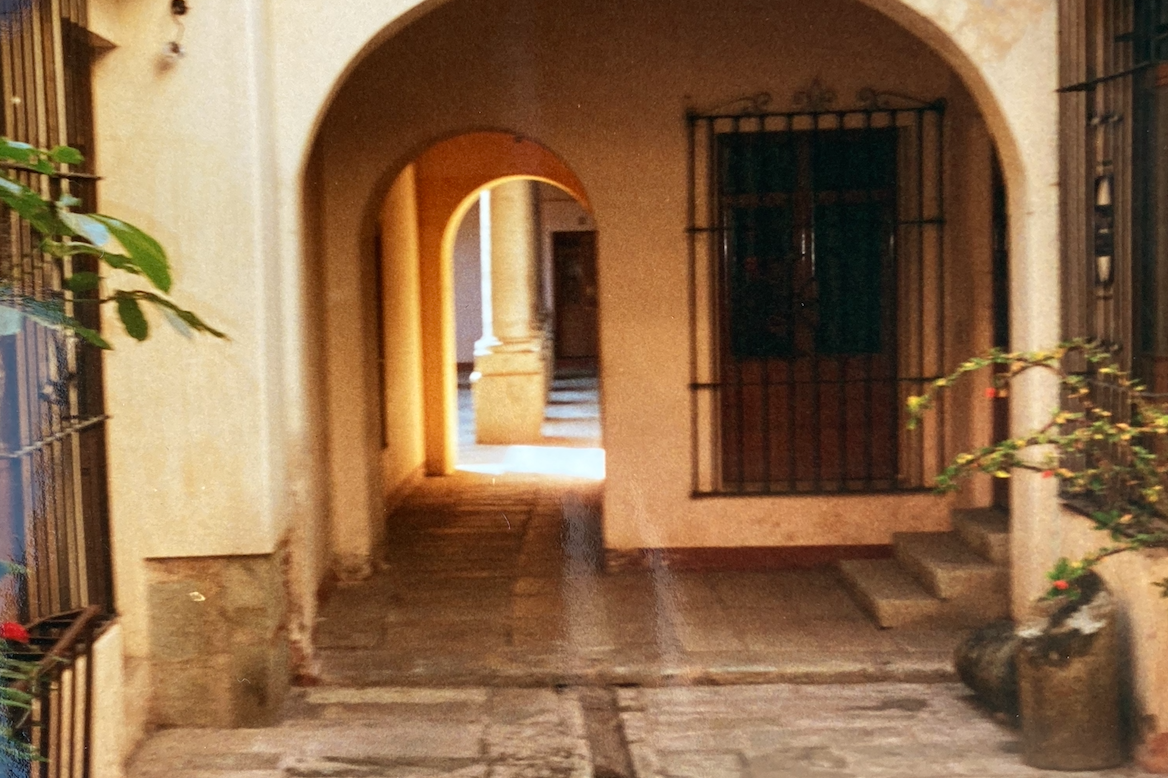
We were left in front of a pair of great wooden doors, at least eight feet wide and ten feet high. Thick planks with hefty cross frames, bolted tight against the night. We pulled the iron bell and a smaller door, carved within the larger leaf, opened to let us in. Hotel Monte Carlo is a typical urban building of Mexico, though I had no way of knowing that at the time. I simply knew that I loved the place. The procession of arches before us, the courtyard open to the sky, the grand stair that split symmetrically and then reunited overhead, the turned ironwork, the lantern flickering in the distance, all pulling us inward. In the morning I would understand the double courtyard arrangement; a formal front court with potted plants, reception desk, and dazzling tile work; and a rear service court with an old well and two aging pick-ups that drive through the lobby to reach the street. It is a common arrangement in Mexico. But on this first night, with the brackish sky blurring what is indoors and what is out, the dimply lit spaces were not notable as architectural precedents. They were fascinating as mystery.
Our room ($17 for the night) was elegantly simple. A pair of French doors with frosted glass and an operable transom opened into a square of white space with tall ceilings and carved wooden beds. Nestled in the quiet depth of the building. I fell into a sleep so rich in dream there was scant difference between the imagined landscapes of my mind and the strange, soothing place where my body lay.

I was up at first light, hitting the pavement with a few pesos in my pocket. I instinctively turned left, away from the direction of the ladies we passed last night. In a few minutes I came upon the Zocalo, the central square that is a fixture of virtually every city in Mexico. The Zocalo in Mexico City is a large paved square, bordered by authoritarian buildings; an ideal setting for crowds clamoring for revolution. I walked past the National Palace, sinking under the weight of so much stone on so much mud, through a glazed arcade filled with elegantly coiffed women, and around street corners littered with uniformed men shouldering rifles. I absorbed these sidewalk scenes in lieu of a complete tourist itinerary.
Directly across from the Hotel Monte Carlo is the Ideal Pasteleria, a heavenly bakery. On one side is the cake room, tribute to the confectioner’s art. Full glass to the street and mirrors on the other walls reflecting a space brimming with frosting. Sheet cakes depicting legendary heroes, layer cakes four and five tiers high flowing with garlands. A fantasy land for brides and grooms, proud parents of babies to be christened, or simply people craving these marvelous concoctions. Phil and I were not looking for buttercream calla lilies to fortify us on our bus trip, so we turned to the adjacent room, piled with tables of pastries: dough balls filled with meat or cheese; sugar pastry pressed into shapes; and cream-filled cakes with fruit topping. The place was swarming with workers, Men molding pastry by hand, girls arranging the tables, women tabulating our purchases, others collecting our pesos. Though I tried to be prudent, temptation compelled me to select more than I could eat in a day. Still, when my total was tabulated I could not believe how much could be purchased for so little. It was my first experience with an economy quite different from our own. One rooted in abundance of labor and dearth of technology.
We walked along Isabel de Catholica to the subway. I had become so used to the air it tasted like a friend. The subway was efficient and clean, the trains arrived every four minutes, as if in Germany, and the cars were full of people who looked alike. Not identical, of course, but similar. I have occasionally been a singular white person on a train in Brooklyn or Roxbury, but subways in the US are typically a mix of black and white and tan, young and old, laborer and collegiate. In Mexico City everyone is brown, everyone is full faced, everyone has coarse dark hair, and everyone is shorter than me. I’m an ordinary looking guy, unaccustomed to being a curiosity. Yet enclosed in an underground box, stripped of the architecture and activity of the street, I was keenly aware how homogenous Mexicans appear, how much they can derive who they are as a nation by how they look. A definition that could never be ascribed to us from the United States.
We got to the airport, claimed our bags, hustled to the bus station. Phil was antsy to be somewhere else, but I found every encounter with the ways of Mexico equally interesting. We motored through the cluttered streets very much the tourists, looking down on the people from the air-conditioned splendor of our first-class bus.
There are two separate bus systems in Mexico. First class buses are superior to their American counterparts, with comfortable seats, an on-board hostess, and continuously playing straight-to-video American movies dubbed in Spanish. Second class buses are poor relations to our school buses. They depart from stations in squalid neighborhoods and are likely to carry as much produce and livestock as passengers. The first-class trip to Oaxaca takes six hours via the interstate-type toll road while the second-class bus runs on back roads without a schedule. Phil is a thrifty traveler, but he gladly pays the premium for first class.
Within minutes, we left the defined precinct of Mexico City; the city configured by the original Aztec settlement of Tenochtitlan over 600 years ago; the city of boulevards, stone buildings, and picture postcards. Then we drove for over an hour through contemporary Mexico City; the city of the last thirty years. The city straining without pattern in every direction; the city of two-story concrete pouring itself over the brow of every hill; the city of immigrants and squatters who leapfrog ahead of the infrastructure of sanitation and transit; the city of twenty million people staking their claim under the ambiguous sky. Many builds are occupied while still under construction. The steel reinforcing to support future floors projects from masonry, anticipating expansion, while men squat idly in the scraps of shade created by the walls. The further from the center of the city, the less complete the buildings become until in some places, there is so much reinforcing sprouting out from the ground it seems as if the land which once grew maize has yielded to a new crop of iron.
Mexico is a country bursting with intention. The landscape is littered with fields that have been turned over but not cultivated, crops overtaken by weeds, segments of foundation that resemble a sort of reverse ruin slowly being brought to function. The countryside is astonishingly incomplete. At first, all of these wallowing resources bothered me, but as I grew accustomed to the landscape, I understood how this country, this climate, and this people have very different motivators than those which drive us. A building left open through a New England winter is damaged beyond repair. A field delayed in planting by a month misses an entire season. Such natural deadlines fall away in a land of perpetually moderate temperatures and modest rainfall. There is no great danger in a roof that is not tight, no compelling need to plant crops on any particular day. I fancied each partially competed building and half-fallow field as a soap opera; the ongoing saga of a nagging wife harping on her spouse for improvements while the recalcitrant husband shrugs his shoulders, dodging her pleas for one more day. Some days she prevails and he pours a bit of concrete or plants a row of corn. Other days she yields her pressure and sits in her own shade with a cool drink. The result of this tension is less a geography accented by discrete human interventions than one of ongoing negotiation.
There are people everywhere. I expected people in Mexico City, where over a quarter of the population lives, but they’re all over the countryside too. People walking along the roads, lounging under trees, whacking at crops, perching on the piers of future houses. Houses that offer little in the way of shelter and even less privacy. The activities of daily life are performed without concern for our usual division of public façade and private space. From the height of my first-class seat, I watched people air their laundry, trade banters, steal kisses. I marveled at the fluidity of their existence.
We changed buses in Puebla. Continuing south, the fields give way to rocky slopes. The volcano Popocatepetl rises abruptly, smoking in the distance. The road takes on curves and altitude, into beautiful barren mountains. Miles passed without sight of another human being, then suddenly we came upon a toll booth in the middle of nowhere. A toll booth with a group of rifle-toting soldiers sitting around a picnic table and a line of hawkers thrusting cigarettes and candy bars at the windows of the bus. The driver boarded one peddler, a man who delivered his pitch for skin oil with equal enthusiasm to each passenger, row after row. He didn’t sell any, but when the driver deposited him ten miles down the road, Phil and I figured he’d enjoyed his few minutes of air-conditioning, and we found him more diverting than the movie.
It was after six when we climbed the hill to the first-class station in Oaxaca City. Oaxaca City is quaint compared to Mexico City or Puebla. There’s little active construction; the partially completed buildings appear to have been that way for years. High above the city stands the statue of Benito Juarez, the Oaxacan Indian who led the 1861 resistance against Maximilian. Below rests the colonial center, punctuated by the towers of the three main cathedrals. Along the river flats is the second-class bus station and the Central Market. Barrios claw up the crevices of the mountains beyond. In the distance, Monte Alban, the Zapotec ruin, rests on a plateau. More than two thousand years of human history have settled upon this gentle valley, a place of order and chaos, rising empire and cultural decline, great wealth and extreme poverty.
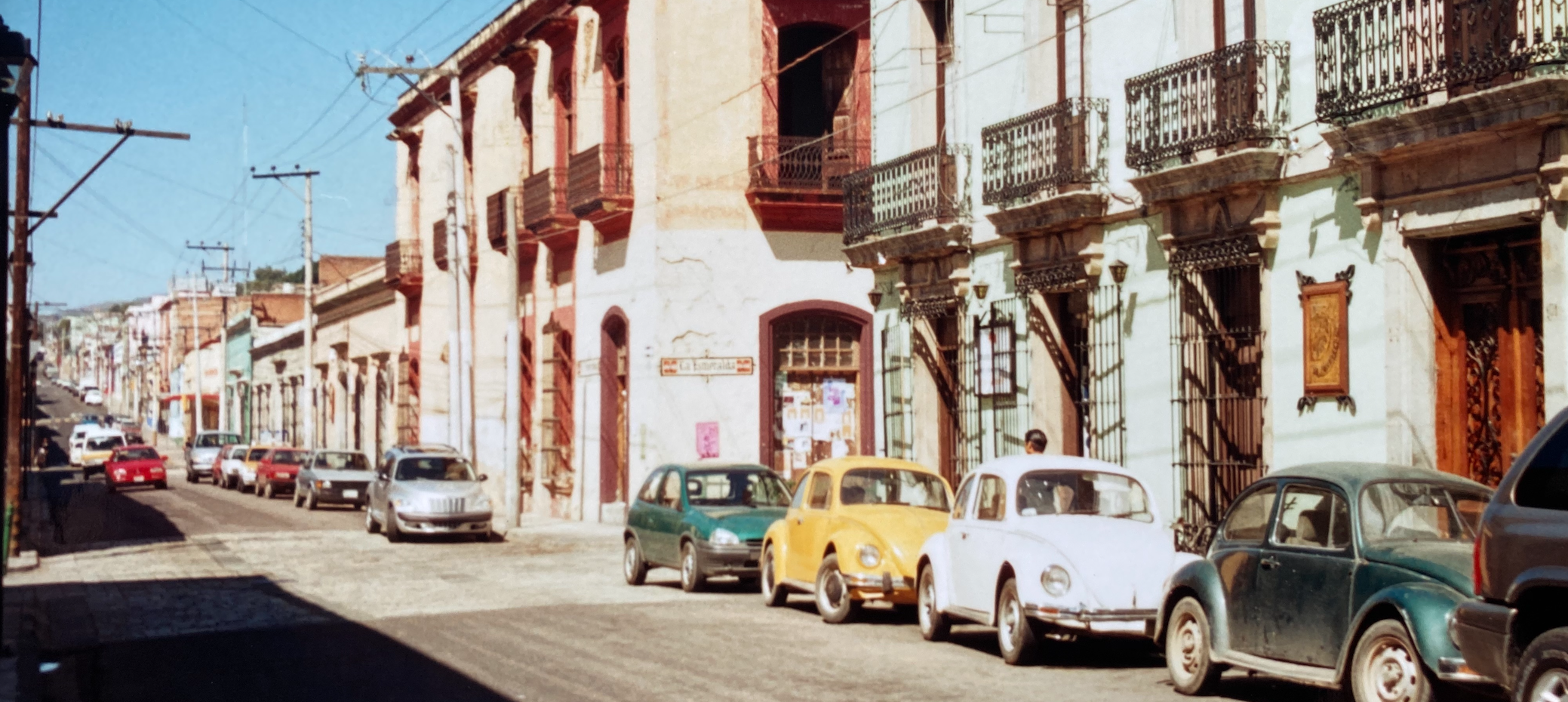
Hotel Principal is a smaller, more genteel version of our hotel in Mexico City. Ochre and airy, with a deep balcony along three sides of the courtyard and a leisurely stair leading to a cool room blessed with perpetual shade. It is filled with repeat visitors who prefer a hotel removed from the bustle of the Zocalo. We deposited our bags and went out to stretch our bus weary legs.
Oaxaca City is simple to understand. The Cathedral and the Zocalo claim the center, surrounded by a grid of square blocks lined with sixteenth to eighteenth century buildings tight to the street. It takes an hour or so to walk the width of the central city, but it’s more enticing to meander through blocks for hours on end. The air is better here than in Mexico City, yet still dense enough to taste. One quickly learns to avoid strolling streets where the buses run. A ring boulevard, perhaps a mile out from the center of town, separates the older city from more recent, less ordered development. The large-scale features of a contemporary city—the huge amphitheater on the hill to the northwest, the cemetery to the east, the Central Market and the second-class bus station to the southwest—all lie beyond the ring road.
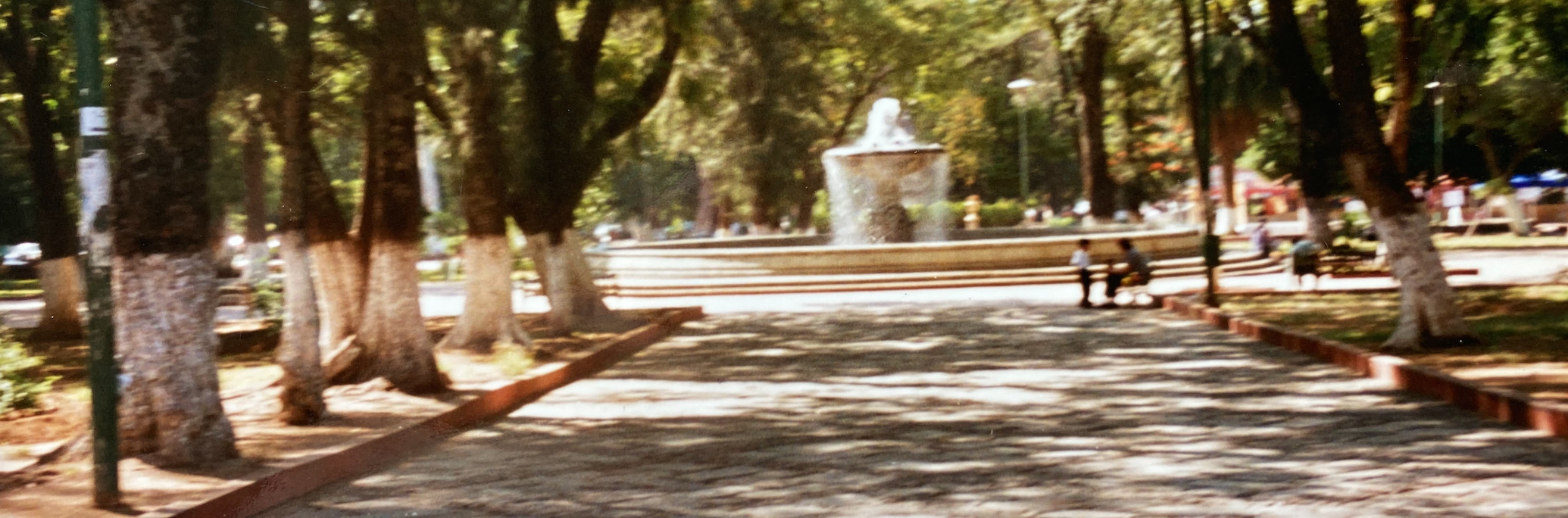
We walked in the direction of food and drink and people. Alameda de Leon and the Zocalo form a pair of open spaces that flank the front and side of the Cathedral. The church itself is a massive affair with squat towers, which dates from 1702; replacing the cathedral of 1535 that was destroyed by an earthquake. The catty-corner plazas, the shady tress, and the filigreed gazebo make the center of Oaxaca more conducive to festivals than revolutions. On our first night, like any other night, the Zocalo was full of artisans selling their wares, trumpeters performing in the bandstand, and Anglos drinking coffee in the cafes.
Phil was not inclined to sit among the tourists, so we continued to the old market, a brick building barely visible for all the street vendors clinging to the bead of sidewalk along its edge. We wound through aisle upon aisle of small stands selling fruits, vegetables, drinks and trinkets. A few stands afford stools where a customer can sit and enjoy an ice cream or grilled taco, but most are no more than a grouping of baskets piled high with peppers or cheese, surrounding women trapped to the foot of the floor space behind their wares. They clamor for attention, chattering in Spanish, smiling, gesturing with flourish, anything to make their pitch. Some women do not even have a stall. They perch at intersections with a basket in their lap, pushing tortillas or chapulenes. I’d never heard of chapulenes, little brown crunchies, thousands to a basket. A woman stuck out a few in her hand. They smelled of charcoal. I asked Phil what they were. Roasted grasshoppers. A Oaxacan specialty, though not one he had ever tried. I know Phil to be cautious about food, and I decided not to be. I accepted the grasshoppers and popped them in my mouth. They tasted of smoky pepper. There was no meat to speak of, but plenty of crunch. I liked the texture in my mouth, though not so much to buy a whole bag. I smiled in refusing to make a purchase; the vendor was not upset. She thought me gutsy for a tourist.
It was too early for dinner—restaurants don’t open until nine—so we bought a guava shake. Walked back through the Zocalo and up Macedonio Alcala, a street of elegant stone buildings that has been turned into a pedestrian way leading to the church and convent of Santo Domingo. Santo Domingo is a complex of massive stone walls, intricately carved entrances, and domed bell towers built over the period of 1551 to 1666. It is more impressive than the Cathedral, especially in the evening dusk as the lights set into the stone plaza throw luminescent shafts one the sheet towers. They literally disappear into the heavens. A marimba band, decked in red and gold, hammered out jazzy tunes that reverberated off the hard surfaces.
As we listened I felt an itch on the back of my neck. The band played the traditional Mexican hat dance, which got a big hand from the crowd. I scratched my scalp. The band moved on to an interpretation of Paul Simon’s ‘Graceland,’ as exotic as it was familiar, then ‘Guantanamera.’ My shoulders started to itch; it was difficult not to scratch too. Hard. Phil turned and stared in shocked amazement. “What happened to you?” I had no idea. “You’re all blotchy.” I took my nails away from my face and let my fingertips ride the surface of my skin. I was a field of moguls and craters. We hustled out of our seats, my hands fidgeting wildly as I scratched my face, my arms, my chest.
I had hives. Surely from eating the chapulenes. Phil was worried, but the gravity of the situation escaped me. We went to a drug store and needed nary a word of Spanish; my face cried out for Benadryl. I took the first dose right in the store and Phil offered comfort by describing how hives in my throat could swell up and choke me. I convinced Phil that my outbreak didn’t justify turning in early, so we went to his favorite restaurant for dinner, Flor de Oaxaca. The waiter laughed at the sight of me and mimicked being a grasshopper after I pantomimed my plight. Phil order a special; I had only beans with tortillas. I’d had enough culinary adventure for one day.
The next morning I woke with a smooth face and an empty belly. After a breakfast of eggs and sausage, tortillas and sweet rolls, papaya juice and a kicker dose of Benadryl to ensure a lasting peace with the chapulenes, we headed towards the second-class bus station, our first foray to the villages. Each village around Oaxaca specializes in one type of craft. Teotitlan is famous for their rugs, San Bartolo Coyotpec produces pottery, San Antonio Arrazola and San Martin Tilcajete are renowned for wooden sculptures. Phil spends much of his time in these ‘wood carving’ villages, but frequents lesser-known hamlets as well.
The second-class bus station is dominated by a tin roof in the shape of a horseshoe, hundreds of feet in diameter, which defines a dirt corral where the buses congregate. A thin layer of dust sticks to every seat, every window, and every purchase villagers carry from the Central Market next door. We climbed aboard, two pale spots in a sea of brown. The driver named a fare and we placed pesos in a tray. Everyone seemed to pay a different amount but no one argued with what the driver charged. Despite the tray full of coins, he refused to make change.
The road is a two-lane bumpy affair. Traffic moves erratically. There are pick-up trucks, ancient Chevy’s and new Jimmy’s. Hitch-hikers are everywhere; people brake in the middle of the road to add a new passenger. There are no solo drivers. We disembarked at a rise in the road under a billboard of a barbequed chicken, and Phil pointed to a patch of dirt across the highway.
The place was eerie in silence, only the sound of road dust settling back to sleep after being roused by our shoes. The first building we approached was a tin shack with a Pepsi sign. It looked to be more a store than a house, with no windows and a recess for a door. Before we came abreast the opening, a group of children popped out of the building and shrieked, “Gringos! Gringos!” They laughed and grabbed each other and ran away down the road, in awe and surprise and a touch of fear. But I was the more amazed. They actually called us ‘gringos.’ From that moment, I felt eyes upon me at every step. No one travels far along the road to this nameless compound without every soul knowing, and by the time we reached the house of Feliciano Santiago, we were already expected.
Immediately inside Feliciano’s gate, a group of men sat cross-legged around a pile of sticks. Each had a small knife in his hand and was whittling wood scraps into usable shapes. Oaxacan wood carvings are make from the twisted branches of the copal trees that grow abundantly throughout the valley. The wood is easy to carve when it is green, usually with a machete or pocket knife. It has few knots or visible grain. After a figure is carved, it is dried in the sun for three days, then sanded into smooth contours, ready to paint.
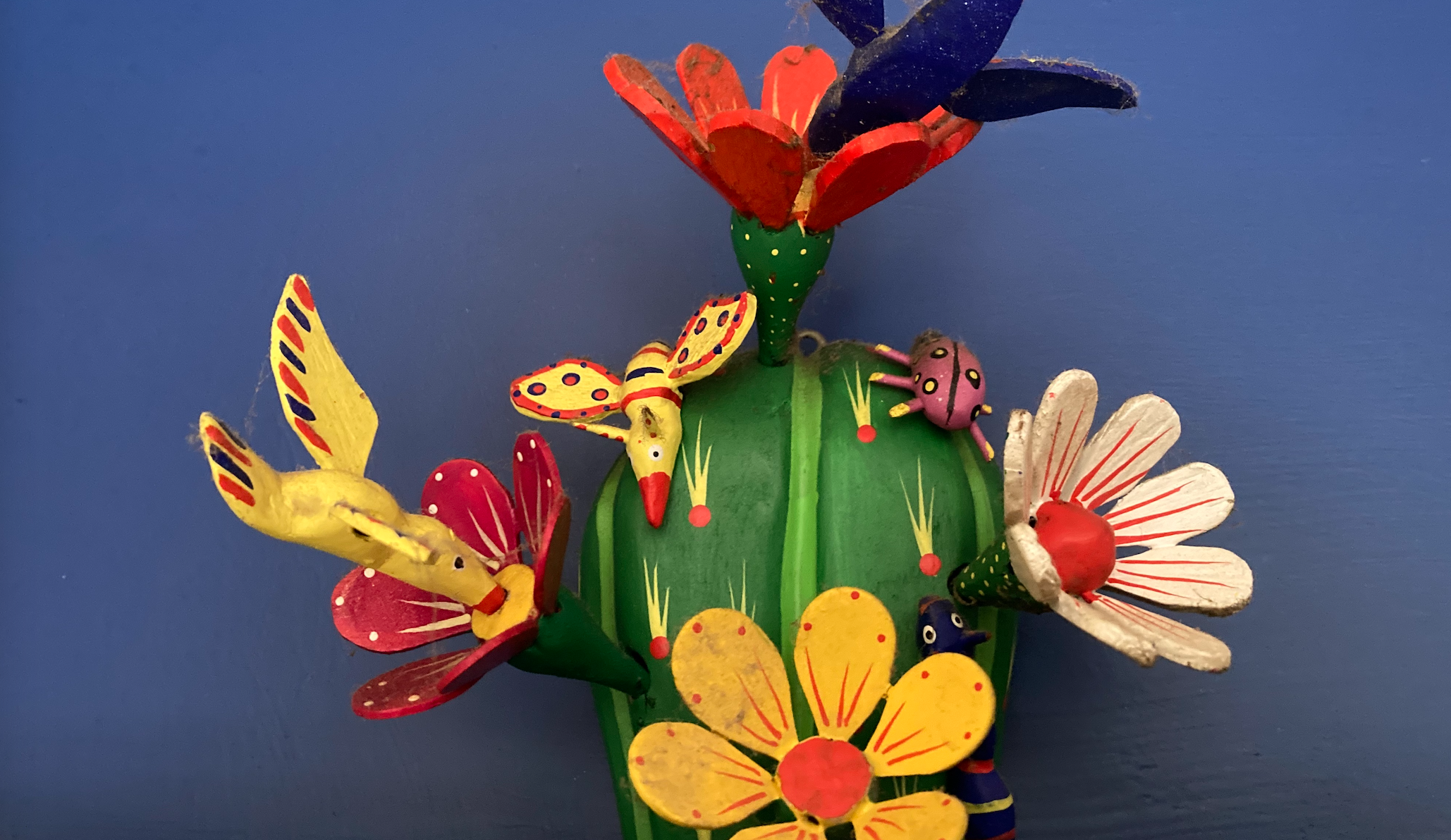
Feliciano emerged from a tin lean-to. The heavyset man greeted Phil with a handshake and a smile and gesticulated a rudimentary greeting. He led us inside to show us his cactus sculptures. Feliciano’s workspace is full of buckets. Buckets of rough shapes that he whittles into squat trunks, flat leaves, flower petals, squiggly bugs, and beaked birds. Buckets of more refined shapes, painted bright colors by the women who sit at the table in the rear shed, far from the men by the gate. He decorates these with vibrant dots and accent lines. The trunks are bored to accept a few leaves and some flowers, the birds are fastened to the stems, the insects are pinned along the trunk. The result is a fanciful concoction of desert life springing from a man who understands the rudiments of assembly line production.
Wood carving has been a tradition in Oaxaca for generations. It is only in the past decade that wooden figures have become collectibles with an international market. Feliciano Santiago is like many in the area who have taken up carving to meet the increasing demand for these figures. He is not a prominent carver, he is not associated with one of the villages renowned for the craft, nor does he produce unique works of art. Rather, he creates variations on pieces that he knows will sell. His prices are lower than the better-known carvers, and Phil has found consistent demand for Feliciano’s cactus sculptures in the States.
Feliciano showed us small models with a handful of attachments and large, multi-arm cacti that sit two feet high. Phil selected three large pieces and I chose a smaller one. Phil negotiated twenty dollars each, I agreed on six for mine. Feliciano spend nearly half an hour dismantling each sculpture, wrapping every component in brown paper and bundling each set of parts. There were over a hundred pieces in all. Sixty-six dollars buys countless hours of hand carving and painting. Yet, when we shook Feliciano’s hand goodbye, it was clear that everyone was pleased with the deal.
We caught another bus underneath the chicken sign and rode further, to San Martin Tilcajete. The bus dropped us off on a concrete road. When Phil first came to Oaxaca, the road to San Martin was dirt, but profits from wood carvings have allowed the villagers to pave the half mile between their community and the highway. We walked up a hill and around a curve to Miguel Salazar’s place. Another tin building, but unlike Feliciano’s, built on a foundation with real wood floors. Miguel has several chickens and a pig penned in his yard. He had a small array of angels to offer. Oaxacan figures often have religious significance and wood of the copal, which is also used for incense, has long been associated with the spiritual among the indigenous peoples of the region. But Phil has learned that religious carvings do not sell well, so there is no sale.
Martin Melchor is a longtime carver who specializes in humanoid figures riding bicycles, fishing, and sitting in Adirondack-style chairs made of twigs, He lives in a stucco house with a tile roof, has a truck in his driveway, and a storefront room for showing off his wares. The figures are whimsical and much more finely crafted than those of Feliciano Santiago, with fine spokes and expressive faces. They are not assembled, but carved all of one piece. Phil bought several. Some carvers from San Martin whom Phil likes were not home—there is no way to make advance appointments in these villages—so Phil decided to come back later in the week.
Oaxaca City has two markets, which are open every day: the brick building near the Zocalo where I had my run-in with dead grasshoppers; and the Central Market next to the second-class bus station. Many of the villages have their own market day, and the most famous in the region occurs on Sunday in Tlacolula. When we arrived at the dusty station an hour from Oaxaca City, Phil suggested I avail myself of the facilities there; they were the best in town. I plucked down two pesos for a few squares of toilet paper and when I was finished I prayed my bowels would remain inert for the rest of the day.
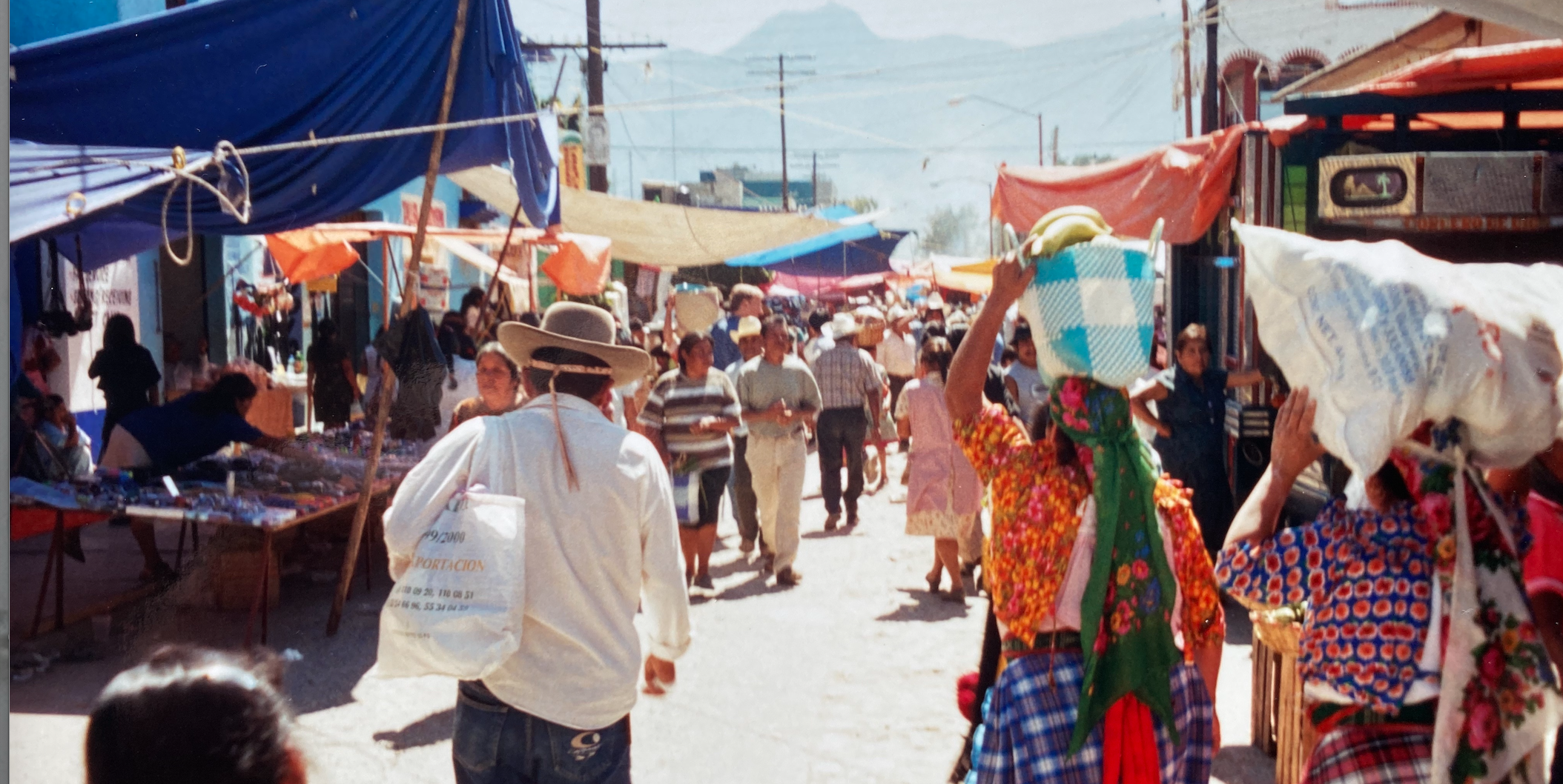
Market stands begin immediately outside the bus station and move uphill toward the center of town. Some sell plastic ware and trinkets, the stuff of dollar stores in the United States. Some sell food: avocados and bananas; wild turkeys; biftec sizzling from an open flame; chicken wrapped in tortillas; dried pork rind; dried fish; dried peppers; liquado of papaya; chocolate; hard candy; and of course, chapulenes. Some stands are loaded with household items: felt hats; walking canes; rough cotton shirts; polyester slacks; blue jeans; baseball caps; T-shirts emblazoned with Britney Spears and Creed. Near the crest of the road, close to the Cathedral and the Zocalo, are handicrafts: booths of embroidered blouses; stitched vests; sparkling tin; chiseled hides; blackened pottery; and intricate beading. There is a general procession from the tacky through the everyday to the exotic, yet a woman selling baskets braided from ancient patterns might also hawk plastic tote bags in fluorescent colors, galvanized wash buckets, and refrigerator containers with snap-tight lids. Tarps are strung across the street, offering partial cover that create dramatic shafts of light while trapping the pungent scent of roasted goat and ripe mango.
More indigenous people live in the State of Oaxaca than anywhere in the Western Hemisphere. And more indigenous people live in Tlacolula than anywhere in Oaxaca. People in Mexico City are shorter and browner than me. Here, people are smaller yet, and brown as tree bark. There are fifty-two dialects derived from eight different languages among the people descended from the Mixtec and Zapotec Indians, and every vender chatters in his own variation. The cacophony of words, the gestures to bridge gaps in understanding, the dazzling array of wares, the sun piercing the feeble tarps, the overwhelming smell of food teetering on spoil, bombard the senses. After an hour a faint nausea crept over me and I had to escape the market even as I was fascinated by it.
I left Phil on a hunt for blouses, and sought refuge in the Cathedral. Great churches transcend the particular plots of ground upon which they are built. Through mastery of material and form they create a realm set apart, for spiritual relief. As architecture, the Cathedral at Tlacolula is not Reims or Ronchamp, yet I have never been in a place that offered such serene contrast to its surroundings. The building was cool, dark, and nearly empty. It is a simple structure with along nave, cylindrical vault, and a central dome. No side naves. A few faded frescoes are intact, others are spalling from water damage to the plaster. The statues are all actual scale, plaster casts of real bodies wearing real clothes. Lace upon lace for the virgins, simple loins for the Christs, leaving enough exposed flesh for wounds and scars so grotesque I averted my eyes. At the front of the church, the statues are stacked Hollywood Squares style from alter to ceiling. At the top, outlined in a bay window, is a Virgin wrapped in curlicued gold leaf, cloaked in scarlet, drifting on a cloud of tulle. A celestial motif whose overall effect is not so much religious as swanky punk. She could easily pass for an offbeat window display on Madison Avenue.
There were a few other tourists, too pale to handle the relentless midafternoon heat beyond, stealing a few shots of the chintzy statues despite the signs in English prohibiting photography. There were also a few Indians. A thin man in army boots knelt piously in the first row; a chic girl in designer jeans and blunt cut lit a candle and bowed her head; a family in modern dress posed before the alter for a photo without the clandestine self-consciousness of the Anglos wielding cameras. And there was an ancient woman, thin, barefoot, wrapped in a shawl so shear it was mere illusion. She bent to a side altar and kissed the hem of a saint’s cloak with such passion there was no doubt that her God lived in this house.
Visiting the Cathedral at Tlacolula helped me grasp the depth of influence Spain held in this region. The Spanish did not simply build showy cathedrals in the major centers of Oaxaca, Puebla, and Mexico City. The built them in Yanhuitlan and Teposcolula, in Coixtlahuaca and Tlacolula and in dozens of other settlements. They came to the valley, wiped out half the population with European-borne diseases, converted those remaining to Catholicism, then conscripted as many as 25,0000 laborers in each community to build monuments to an alien god. The Spanish purportedly came to the New World in search of gold, but what they actually found was a people ripe for domination, a people who to this day are among the most devout Catholics on earth.
I returned to the market, where spiritual devotion dissipated before the chaos of commerce. If Thomas Jefferson viewed the United States as a nation of small famers (a disingenuous vision for a plantation owner) he likely would have described Mexico as a nation of small vendors. Trade seems to be the lifeblood of the country, and the art of the sale curses through their blood. I purchased a few souvenirs at the asking price and made satisfactory transactions. But when I bartered, held my own, walked away and then returned for a compromise price, the sellers relished my efforts even if I was the one who came out a few pesos ahead from the process. The market was full of loud, raucous exchanges over a pineapple or a scarf. Everywhere, the language of trade trumped the phrases of any particular dialect. The language of trade was most intriguing in the chocolate shop, where it mingled with the language of love.
Chocolate is an important ingredient in Mexican cooking, used for mole sauces, drinks, and baked goods. Families guard their chocolate recipes, swearing by a particular combination of sugar, cocoa, and cinnamon. The ingredients are mixed in a galvanized bucket, then one of the children—almost always a young girl—totes the bucket to the store to be ground into chocolate. Inside, there is a row of grinding machines, each manned by a young boy. The girls line up in front of a machine. Boys with cute grins have distinctly longer lines. A girl hands over her mother’s proportions of raw ingredients, which the boy hoists on his shoulder, pours into a tray, and guides into a funnel shaped barrel. He pummels the ingredients into the grinding port with a large stick, exaggerating his virility. A gooey paste emerges, which the boy pours back into the girl’s bucket. They might exchange a few words while he does this, and if the girl is pretty, the boy might take quite a while scraping the last bit of her chocolate. Surely Tlacolula is full of marriages that can be traced to the tender moment when the grinder boy returns the black delight to a young girl and their fingers brush along the galvanized handle.
The ride back to Oaxaca City was crowded but subdued. Passenger’s heads bobbed in sleep; their laps filled with goodies of the fair. Back in town we went to see Manuel Martinez, the proprietor of Artesanias Mi Mexico, a crafts boutique just off Macedonio Alcala. Manuel sells items similar to many we’d seen in San Martin and Tlacolula, at prices aimed at affluent tourists disinclined to venture on second-class buses. Manuel is an affable guy who speaks excellent English. Phil met him several years ago, and they enjoy trading stories of the craft business. Phil brought Manuel a designer knit shirt. Manuel likes to sport American clothes, and a Polo crest is a high fashion statement in Oaxaca. We agreed to go to Xoxocatlain together the following evening, for the opening celebration of the Day of the Dead.
Monday we were tourists. We took a bus along the mountain edges to Monte Alban, the Zapotec city built between 500 B.C. and 800 A.D. on a plateau above Oaxaca. Acres of mountain top graded level, surrounded by a campus of stone structures organized in strict geometry. The order and majesty of the landscape reminded me of the Mall in Washington, D.C., laid to rubble. The austere beauty of Monte Alban, the grand scale and commanding vistas, the stone skeletons rising from the central plaza, speak of a people of vision and discipline that deserve our admiration. But it reveals little of their everyday lives. I tried to imagine the imposing tan structures covered with brightly painted plaster; to envision the spaces created by the massive stone littered with the household items of the 30,000 inhabitants who once called this place home. I wanted to know more of their flesh than their bone. And later that night, in a village at the base of the mountain, I experienced the zest born into the natives of this valley.
Oaxaca is prone to celebration. There are festivals honoring almost everything, from venerable figures like the Virgin of the Soledad to the earthly delights of radishes. La Guelatguetza is the largest festival: a two-week celebration of native music, dress, and dance that occurs in July. But Phil’s favorite festival is Day of the Dead, celebrated in All Saint’s Day and All Soul’s Day. The origin of Day of the Dead predates colonial times, and likely has roots in early Indian societies, perhaps even some of those who once inhabited Monte Alban.
Near midnight, in the ancient cemetery of Xoxocatlain, hundreds of people sat around the graves of their ancestors. They brought food and flowers, cards and photos, camp stools, shawls, and candles. They drank and talked and sang as casually as if there were in a kitchen. Foods and artifacts for the deceased were arranged around the tombs, to welcome the spirits back.
The festivities kick off at Xoxocatlain on the night of October 30, though no one seemed to know why the spirits of Xoxo, the city’s nickname, arrive early. The ancient cemetery is dense with graves, statuary, and the stone remains of a chapel. The roof is long gone, as are some supporting walls, so it is possible to float seamlessly in and out of the building. In one corner of the nave, a group of men—ten or twelve—sang a song cycle specific to this festival. Phil explained that it is a village honor to be a Day of the Dead chorister, During the two to three hours we were there, the deep, rich voices reflected off the rock walls without stopping. The cemetery was crowded. We tread our way single file around the family groups. I worried that our presence might bother them, but Manuel explained that the spirits of the dead are happy to see many people when they returned; that strangers were welcome.
Phil wandered off with his camera; Manual and I stood along a cemetery wall sipping wine and talking. Mostly, we talked about the United States. Manuel was fascinated by our country, by how much we work, how much we travel, and how much things cost. He wants to visit someday. I wondered how he would enjoy the major festivals of Boston: First Night revelry at New Year; Lexington Green on Patriot’s Day; the 1812 Overture on the Fourth of July; the Head of the Charles Regatta in the fall. Grand scale performances all, that draw huge audiences; yet so unlike loitering in a village cemetery, inhaling an air of incense, and conversing between the shadow of an old woman swaying to her private chant and a group of Nike wearing teens laughing and drinking. Midnight in Xoxo is an intimate experience where the boundaries between the young and the old, the performer and participant, the quick and the dead, evaporate.
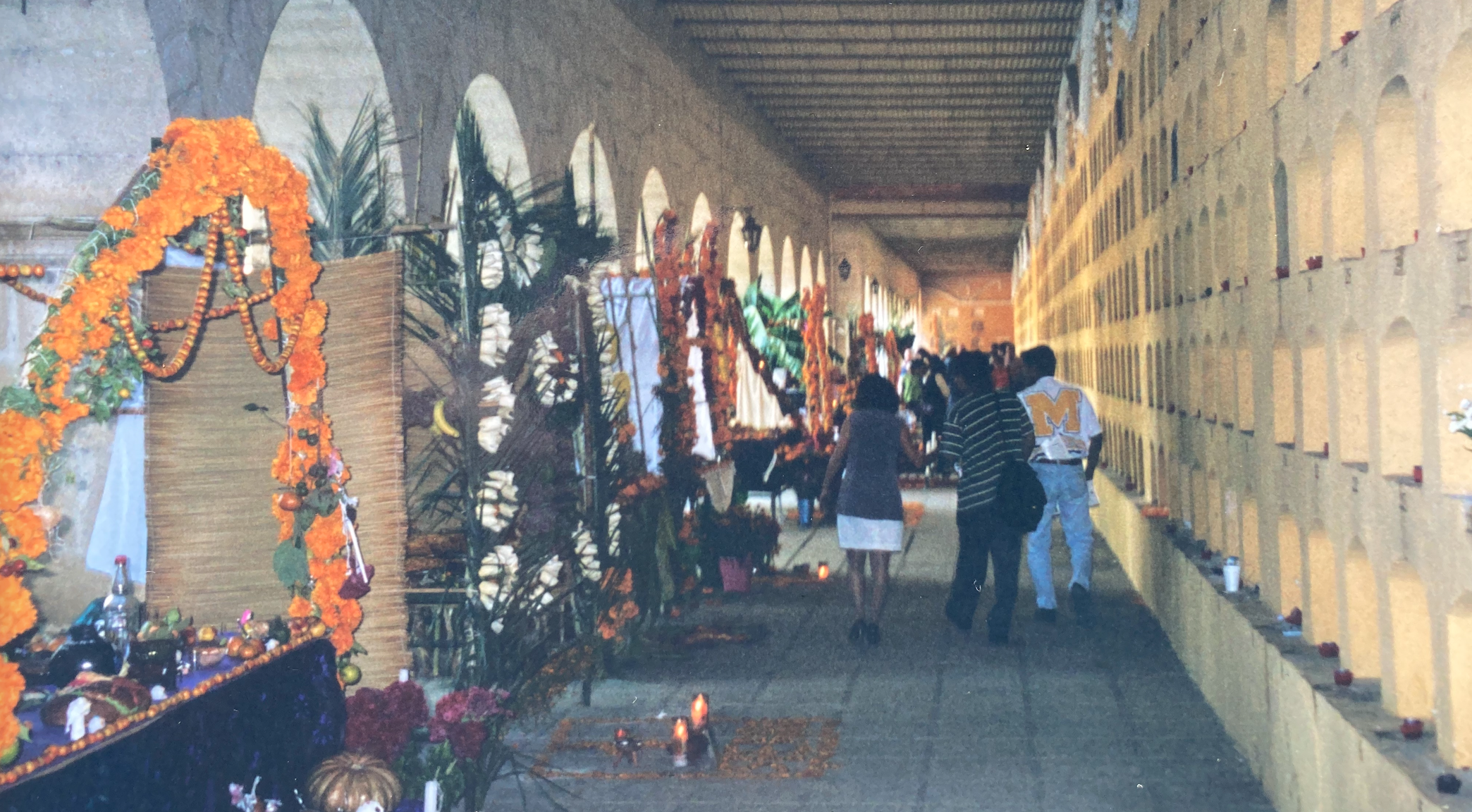
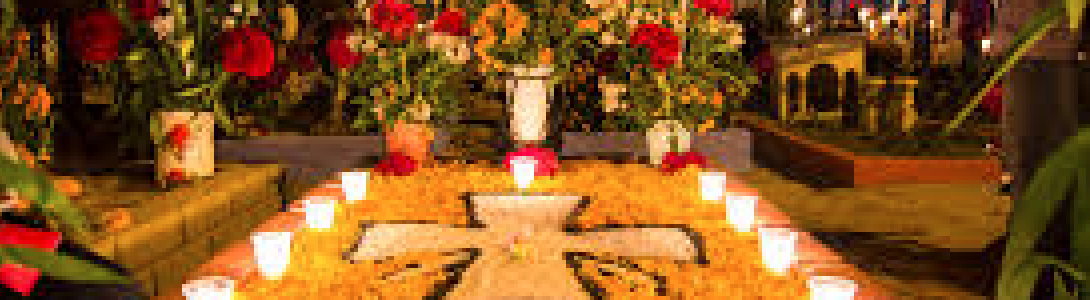
On Halloween day Oaxaca was awash in flowers. Mostly the reddish maroon and yellow mums that grow all over the valley, but also dozens of other colors. The citizens scurried with a new energy, arranging altars all over the city: altars with flowers and food and candles; with photos of the dead; with streams of colored sand that spilled off of the tables, onto the floor, and into the street. Phil and I walked the city that day, observing the constructions. In the Zocalo, sand sculptures the size of volleyball courts were being shaped; skeletal figures in fancy headdress and couples dancing on their graves. The living were having a wonderful time partying with the dead. We went to the city’s main cemetery, an immense court surrounded by a thick-walled promenade lined with hundreds of crypts, five rows high. Each crypt is defined by an arched recess where the coffin slides into the masonry. A series of altars opposite the crypts were being arranged for annual judging. These were among the finest in the city, six to seven feet high and equally deep, color coordinated with food and flowers and mementoes. The care invested in the altars is remarkable, especially when compared with the haphazard fields of corn and miles of unfinished construction we witnessed on our journey south. I mentioned to Phil that if the Mexicans put as much energy into their business endeavors as they did in their festivals, they might be the economic giants of the world. Phal laughed and said, “Yes, but they wouldn’t have as much fun.”
Halloween night in the cemetery of Oaxaca. A carnival played outside the walls, cotton candy and amusement rides, strings of bare bulbs, and teens in baggy clothes dancing to a ratty band. Cross the threshold of the cemetery and the promenade was dark, save for the light of thousands of candles, one set at the recess of each crypt, casting a fantastic relief between the hundreds of small arches and the immense wall supporting the bodies of so many dead. Crowds lingered in front of the altars; our favorite won first prize. In the graveyard, wandering bands serenaded the dead, trailed by groupies in pursuit of the music. The place was so crowded. Walking in the air, buried in the walls, resting underground, the cemetery swelled with a density of human spirit. There were scraps of Spanish in the air, fragments of dialect I didn’t understand, and the voices of people I’d never met hearkening times I’ve never known. I felt as if I could talk to them, that the spirits would be able to understand me despite my American accent. But I was the visitor in their house, and I chose to remain quiet. To simply listen to all of the languages being spoken.
Arrazola has paved roads. It has a clinic, a school, a landscaped plaza. The plaza does not sit in front of a colonial cathedral. Rather, in front of a community building. In the center is not a statue of a Virgin, but one of a rabbit. Arrazola is a village nestled on the back side of Monte Alban, markedly different from other villages. Next to a house with two bulls and a bunch of chickens sits a tile and stucco compound with a Chevy Suburban in the drive. The variety store sells frozen popsicles and Snickers bars as well as sacks of rice. The children running out of school in their All Saint’s Day costumes are tracked by slim mothers toting video cameras. Arrazola may not be small town USA, but it’s a world apart from San Martin or Tlacolula.
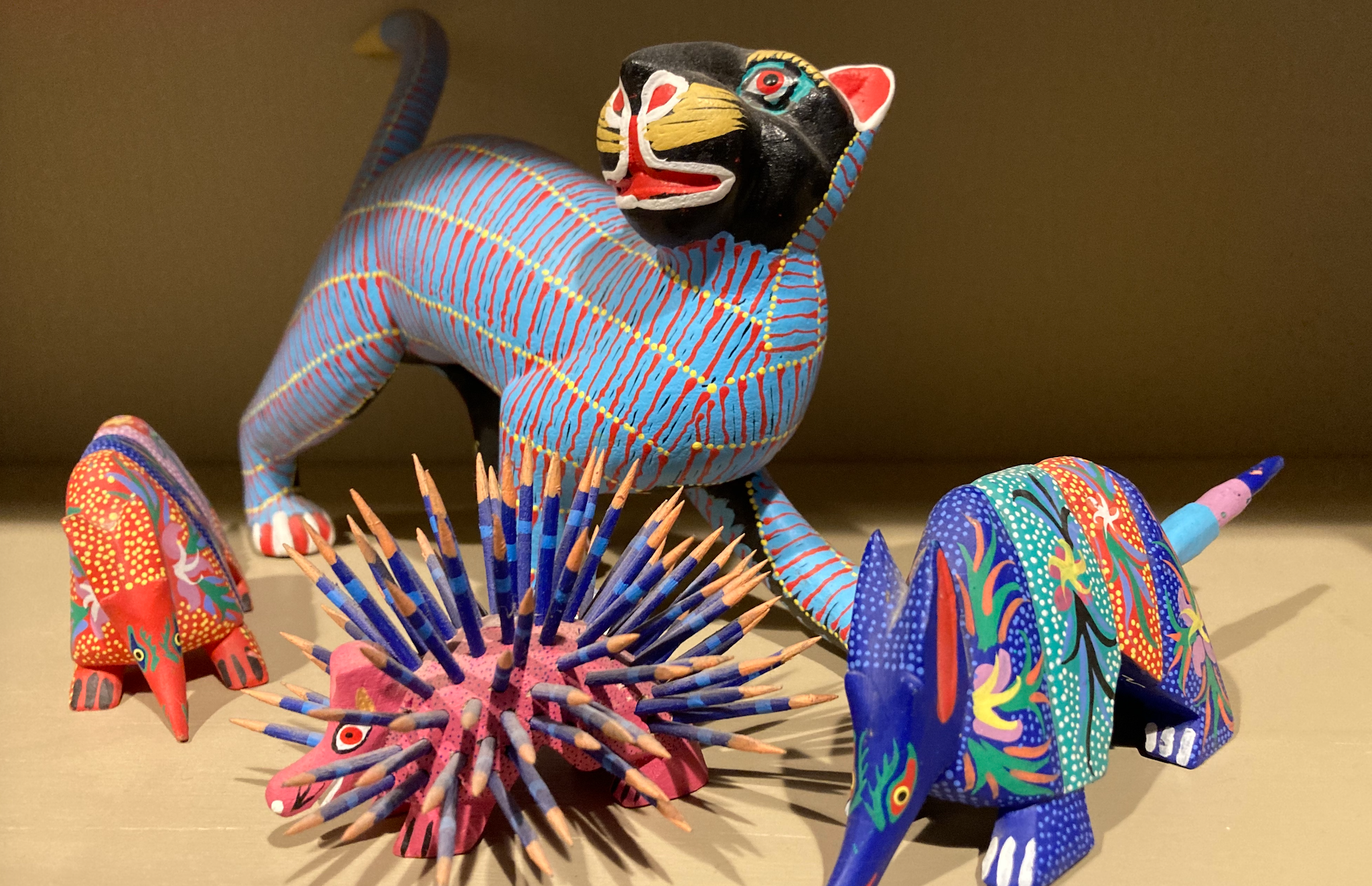
What sets Arrazola apart from other villlages around Oaxaca is nothing more or less than money. Money from wooden figures. Lots of it. Manuel Jimenez, the eighty-year-old man credited with transforming the native wooden figures from local craft into world-wide collectible, made Arrazola famous among afficionados of Mujeres de Figures.
As we approached Arsenio Morales’ house along the main street, a taxi was parked in front. Inside the court, two Americans and their Mexican driver were negotiating over a unicorn and a snake. They paid nearly a hundred dollars for each. Phil and Arsenio chatted amicably; they’ve known each other for some time, but Phil bought nothing. Arsenio has been discovered; his prices command too high a price for Phil to realize much profit on resale.
Still, other carvers in Arrazola have items that interest Phil. My favorite was Alberto Ojeda. He is an old man who lives on the edge of the village with Monte Alban in his backyard. His house is modest but new. He keeps chickens around, but I gathered they are more for company than for food. He has a room of comic frogs and dancing soldiers. Phil selected a few frogs. Alberto told us he climbed Monte Alban for Day of the Dead to talk with his ancestors. He likes being in the same neighborhood as his primal relations. After he made the sale, Alberto encouraged us to visit his son, Hector. A tiny door leads from the father’s yard to the son’s. The difference between the two domains could hardly be more pronounced.
Hector has a large house with jalousie windows, a carport with a van, a grass yard with a fountain. His wife came out to greet us, all smiles and graciousness. She led us to a display room, where I saw the difference between an artisan and an artist. Hector creates large works, sculptures that might be displayed in a hotel or civic lobby. They are painted in vibrant hues, and the enticing shapes of his dragons, fish, and serpentine creatures trigger illusions beyond their literal form. The smallest piece was a blowfish, comic and iridescent. It would look terrific in my living room. I inquired. Six hundred dollars was beyond my budget. Other pieces ranged into the thousands. Hector’s wife wasn’t pushy or negotiative. She wasn’t selling; she was marketing. Carrying on in sing-song English to any Americans who happened by because she knows that’s how to build her husband’s reputation. Hector arrived home with his son. He showed us a new hippopotamus he was carving, a rascally fellow full of character. The piece would take several weeks to complete, but was already remarkable. As removed from the assembly line cactus pieces in Feliciano Santiago’s tin shack as Hector’s wife is from the women hawking chapulenes in the market.
That afternoon we went to the Central Market, the immense grid of stalls next to the second-class bus station. In the United States, super markets, department stores, and big box stores have fostered a tradition of autonomously wandering fields of merchandize: handling; inspecting; basketing what we want, only to have another person scan it through a computer to cement the transaction. For us, shopping is about the stuff. There are more items in the Central Market than in the largest Wal-Mart, yet every item is associated with a specific person. You can hardly glance at a blanket, a bootlegged CD, or a piece of hammered tin without having the vendor accost you. Rows of stalls offer merchandise so similar that what differentiates is not the product itself, but the salesmanship. One doesn’t simply buy a pan, one buys a pan from Louisa. I was confounded by the dark maze, but I loved the intimacy of the commerce.
Along one aisle was a woman selling flowers. Giant red blooms. A little boy sat quietly in the chair behind her. Next to her another woman sold the same blooms. Only she had a little girl sitting behind her. There was a third woman, a fourth., I counted ten in all. Each selling the identical product. Many with children sitting behind them. I was possessed by the need to organize. To send two of them out to play with the children, two to get back to the fields, and a few to have a day of rest. At most, only two needed to actually sell the flowers. Of course, I said nothing. I had no way of communicating against a system so fixed that each woman rises every morning and tends her small fields, rides into town with only as many blooms as she can carry, tugging her children along to sit in silence all day next to other children burdened by the same fate. Such complicity is anathema to an American.
We returned to San Martin. I liked the village more the second visit; the stream lined with cottonwood on the edge of town, the donkey pulling the hay cart on the new paved road, the huge shade trees in front of the church. We found Obdulia Ramirez at home. Obdulia is in her thirties. She’s slim and perky, even by American standards. She moves with an agility at odds with the languid climate. She showed off her latest carvings, twisted lizards, while she chatted with us in excellent English. Her husband hovered close, following the instructions she threw off in Spanish. A young girl with a paint brush sat in a shed in the yard, dotting the spines of a box full of lizards. Obdulia’s yard is large and flat, enclosed by a wall, with a new house in one corner, still under construction, yet entirely occupied. It’s an impressive structure, two story concrete with a richly carved front door, a gracious stair, and a relief of the Virgin in a niche along one wall. True, there are no windows, no lights fixtures, and no furnishings, but I chose to compliment Obdulia on the elements present and ignored what was missing. The arch that leads to the kitchen revealed an electric stove and a refrigerator, but also a wash bucket with water tap instead of a sink, and food heaped in piles instead of cabinets. There are no chickens in the yard, but no landscaping either. Obdulia has grown beyond a life of tin shacks and farm animals, but hasn’t quite figured out how to assemble her newfangled conveniences into a complete package.
We bought figures from Obdulia. Phil did because he knows they sell well; I did because I was charmed. As she handed me a lizard, Obdulia’s eyes flickered, and she said, “I was born less than a mile from here. I was one of ten children, and were poor, dirt poor, I was so hungry I lived on the dream that if I ever grew to be an adult, I would never be hungry again. You know what I did? I learned English, And now I have my own land, my own house, and two children of my own. Two is all I will have. And they are at school right now. And they will graduate. And the reason I have all this, besides having a wonderful husband,” who blushed when she looked his way, intuiting her intent without understanding a single word, “the reason I have all this is because I learned English.” She let go of my hand, her eyes danced back to Phil, and her voice returned to its casual tone. “Phil buys from me—everybody buys from me—because I speak English.”
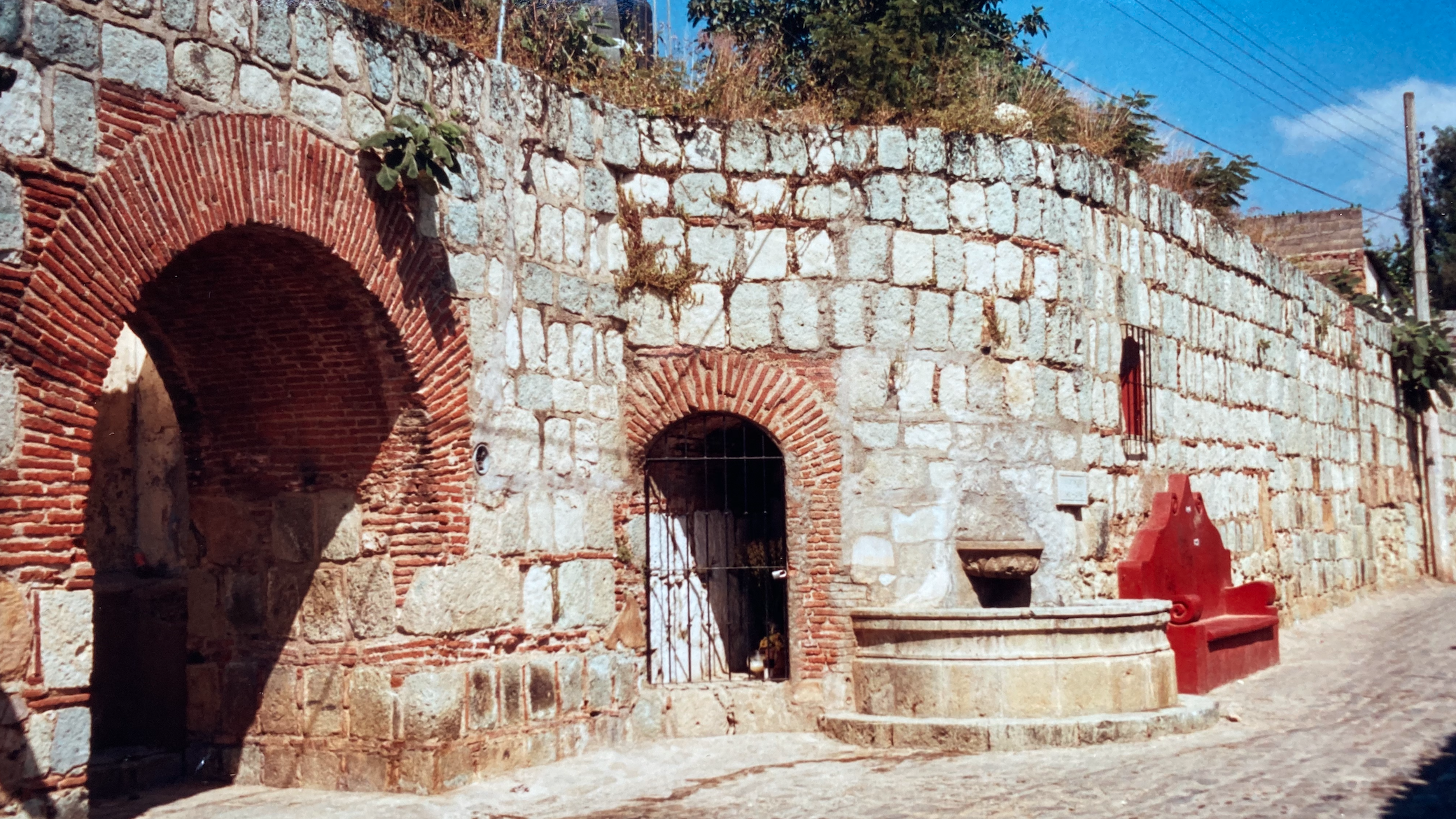
Phil’s last day in Oaxaca was spent wrapping, packing, and shipping. I spent my last day touring the city. I spent time in each of the cathedrals, ducked into courtyards, window shopped. The Colonial quadrant of Oaxaca City, so foreign just a week ago, was tame to me now. I spent the afternoon in the monastery of Santo Domingo, recently converted to the State Regional Museum. It is a massive building, arcades of stone aligned to razor precision and cool tile verandas where the religious processed in silence, no doubt contemplating a universe as ordered and elegant as their sanctuary of stone, so removed from streets of passion, barter, and disease.
That night I wondered to the Zocalo, drawn by the lights of the Cathedral, the vitality of the marimba band, and the energy of the couples dancing around the gazebo. I met a fellow traveler. We drank a spritzer in a café. We strolled the streets of the ancient quarter, graced by a dollop of romance from the shimmering rays of the moon. We talked as we walked; we stood silent at the beauty of the night. In the quiet I heard the voices of hundreds of years echoing off the stone walls of these eternal buildings, welcoming me among the legions captivated by the spirit of Oaxaca.
In the morning we headed north. Away from the valley graced with the lyrical strains of Spanish, the rhythms of dozens of indigenous dialects, and the insistent chorus of the dead. First back to Puebla, a larger city, more modern, where the Spanish is hardened by the terms of business and multinational words like Volkswagen and Xerox are ubiquitous. Then to Mexico City, where I noticed occasional areas of organized development amidst piecemeal bits of construction. Groupings of buildings and paved roads progressing in a logical order, large enough in scale that they must involve financing, and therefore accountable milestones toward completion. Precincts in which concrete trucks were moving and carpenters were hammering. No groups of men squatting in the shade. In a measurable number of months, these developments would house people and businesses in structures complete with windows and roofs and running water. Buildings whose gestation bore more resemblance to construction in the United States than precedents in Mexico.
I inhaled a souvenir gulp of charcoaled air before boarding the flight that would bear me home, As I flew towards the border, I wondered about the millions who head in my direction, not in planes, but in second-class buses or the back of trucks, hoping to elude the border guards. People who deny their identities to work minimum wage jobs in the US, wages that translate into fortunes back in Mexico.
In the northern states of Mexico, emigration is the established pattern to success, Whole towns forfeit their working age citizens to the US in exchange for the money sent home to the youth and the aged. One million dollars a day is sent to the State of Zacatecas alone. Payments from expatriates constitute the third largest source of income for the nation of Mexico. But the price of exporting Mexico’s human resources is high. Half of all native Zacatecans now live in the United States. Along with the houses and the roads that they build with the $1million they send home, comes the reality that more and more natives will never return. They will choose to remain in the United States; praying to become legal.
US/Mexico relations have always been weighted by the transfer of workers from the poorer country to the richer one. We have made attempts to ameliorate the imbalance: amnesties for illegal workers; NAFTA; the bond between our cattle ranching Presidents. But in the end, legitimate equilibrium with our neighbor depends on Mexico having economic opportunities of its own; to be a place where the young and capable do not have to leave in order to prosper.
Traditionally, Oaxaca has endured less emigration than the rest of Mexico. It is poorer, further away, more culturally distinct. Now that global systems for communication and transportation allow for greater economic decentralization, opportunity need not come at the price of uprooted communities. Instead, we can develop US/Mexican relations based less upon immigration of cheap labor than upon the exchange of what each country has to offer.
The lesson of the wood carving villages is that the talented and the motivated—the Hector’s and the Obdulia’s—have not emigrated north; they still live next to their parents, within a mile of their birthplace. They don’t merely send money home; they live among their own and thereby inspire others by their success. The health center in Arrazola and the paved road in San Martin did not come floating out of the sky on a parachute of Yankee dollars. There were built from the profits of wooden figures. Everyone in the village knows that, and therefore everyone in the village is invested in the production of that lifeblood. A man like Feliciano did not take up carving wood into thousands of pieces of ornamental cactus except for the fact that he saw others carve wood and make money and he wanted some for himself. As the entrepreneurs get smarter, as the rudiments of mail delivery and telephones get put in place, as craftsmen discover how the internet can be used to bypass my middleman friend Phil, as they learn that better quality and creativity results in larger sales, the villages will benefit even more. This is a tiny reversal of the usual order, but it is worth notice and encouragement. Instead of Oaxacans sending their best up North to seek fortune, we Americans are coming South. Not just visiting Oaxaca for its beauty and its history, but actually taking cabs right to Arsenio Morales’ door. Turning over our currency because he has made something we want. A simple matching of a buyer and a seller without the thorns of displaced families or illegal crossings.
Oaxaca is not likely to become an economic powerhouse soon. For every Obdulia, there are still ten women selling the exact same flowers right next to each other. However, as the influence of the wooden figure economy ripples through the valley, people will uncover more ways to take what is intrinsic to the native culture and capitalize on if to create better lives. To become multilingual in the best possible sense, sharing with us what has been theirs for hundreds of years; taking on new opportunities without relinquishing the old.
In the United States, there is no official language. Yet the reality is, those who don’t speak English are left behind. The official language of Mexico is Spanish, but in reality those who speak English are the ones who get ahead. Mexico has other languages as well. The pre-Colonial dialects that existed in the valley before the written word; the voices of the dead that divulge their spirits. During my time in Oaxaca I tried to understand all of the languages, gamely tripping over Spanish words and receiving warm smiles for my effort, while also contemplating upon those that do not rely on specific grammar or vocabulary for comprehension.
On our last trip to San Martin, as we left town along the paved road, a young man approached heading home from school. He wore a black T-shirt, blue jeans, and sneakers, He could have been Obdulia’s son, or a teenager from just about anywhere. “Buenos tardes.” I said in my best accent, “Hello.” He replied, in the assured voice of the future.



















 The Awkward Pose