Spielberg’s West Side Story:

Withered on Arrival, Dead at the Box Office

The nominations have been announced: welcome to Oscar season! Steven Spielberg’s remake of West Side Story nabbed seven. I call that a gesture of sentimentality.

Before last December’s premiere, my musical theater friends (of which I have several) celebrated the reboot of this American classic. My response to their excitement was: why?

Movie remakes are common. A Star is Born three times over, and each iteration has its merits. There’s also money to made remaking a classic. The original West Side Story won a whopping ten Oscars. It was also box office gold: recouping its $6.5 million budget more than six times over (worldwide receipts: $44 million). Surely we are ready for a dazzling yet culturally sensitive update.

Ahhh, I never thought so. And judging from the tepid audience response the film has received ($62 million worldwide on a production budget of $100 million two full months after release), neither do many others.

Here’s my take on why:

American film took a sharp turn circa 1970, flipping from a medium that specialized in escape to one that held up a mirror to reality. All of the flashiest movie musicals, from The Great Ziegfeld through West Side Story, The Sound of Music, and culminating in Oliver! premiered prior to 1970. Each capitalized on the silver screen’s enormous scale to create worlds so ecstatic that mere speech was insufficient. Our heroes simply had to burst into song.

Once Hollywood caught its New Wave, such exuberance didn’t fly.

Big-time musicals still churn magic on stage: theater audiences are eager to suspend belief. But film is too prescriptive a medium to accommodate the ambiguity of characters who are simultaneously like us (mere human beings) and yet not like us (when confronted by trauma or delight, they sing). Movie-worlds are very specific. They either reinforce the reality we already know, and hopefully deepen our appreciation of it, or—like most blockbusters—they provide escape to fully realized alternatives. That’s why the few great movie musicals made since 1970 (1972’s Cabaret and 2002’s Chicago) incorporate songs as commentary on the characters interior lives or society’s tumultuous times. What Rogers and Hammerstein’s ground breaking Oklahoma! accomplished on stage in 1943—integrating music as direct extension of the action—comes off as odd, even silly, on today’s screen.

Given how movie audiences have changed, Spielberg’s West Side Story battles uphill before the opening credits even begin. Hoodlums dancing through New York City streets in 2021 simply don’t elicit the same delight they did sixty years ago.

Unfortunately, once the credits begin, the film establishes a further tone of doom. The original West Side Story begins with a bright orangey-red screen. Vertical lines pop in rhythm with the upbeat overture, then morph into the Manhattan skyline as viewed from the statue of Liberty. We, the audience, are immigrants arriving in hope after a long voyage. The camera shifts up and over the city’s grid and flies us over the island, revealing the promise of America, eventually landing, softly, into the territory of the Jets.

Spielberg’s West Side Story also opens with aerial footage: demolition wrought by urban renewal. Similarly, we land on Jet’s turf. But before one single Shark appears, any promise, any hope is futile: the neighborhood is already lost to powers greater than either of these two-bit gangs.

West Side Story, based on Shakespeare’s Romeo and Juliet, is a tragedy no matter how interpreted. By the end, most of the major characters are dead. But the tenor of the original film, like most musicals, is mostly upbeat. We know the sparring between the Sharks and the Jets is petty; that it will lead to no good. But at least they’re fighting with intention over something they believe is worth having. In the recent version, the gangs are neutered from the start. Forces beyond the screen have already won, so there’s literally no one for the audience to root for. I credit screenwriter Tony Kushner for the hollow ache ag the center of this film. The language in the script is beautiful, the insights deep, yet as in any Kushner endeavor, the overall affect a downer.

There are two disparate audiences for West Side Story 2.0. People who saw the original and want to see how today’s masters handle the same material. And people too young to know West Side Story as a cultural phenomenon. The latter group, by and large, find the story irrelevant, and have stayed away. The older group, who showed up as a dismal dozen for the Christmastime matinee I attended, find it all too relevant if only because so little has changed. The prejudices, the violence, the injustices of the 1961 film are all still with us: made uglier by our media-saturated age. A movie-goer above a certain age doesn’t actually watch the film. We analyze it, comparing frames and dialogue and phrasing with an original we know so well.

There are many things about Spielberg’s West Side Story that are better than the original. Bringing “America” off of the rooftop and into the street makes sense. Setting “I Feel Pretty” among an after-hours cleaning crew cavorting through Gimbal’s is terrific. Casting Rita Moreno as ‘Doc’ is an inspired idea. Every scene with her throbs with energy, even when she delivers the loneliest rendition of “Somewhere” ever conceived.

A few of Spielberg’s moves work less well. As a director allergic to serenity, Spielberg litters Tony’s rendition of “Maria” with visual distractions. Trust me Steve, the audience simply wants to hear Ansel Elgort deliver the goods, which he does beautifully. And to whomever decided to jump from the deaths at the rumble directly to the Gimbal’s girls: bad shift.

The new West Side Story is a bountiful kit of parts: great scenes, good acting, excellent singing, lush orchestrations, phenomenal dancing. But ultimately, the pieces do not come together to create a vital work of art. The ‘updates’ strip away the fantasy elements that make musicals such delight, without being bold enough to forge an independent vision. The movie begins with a bleak view of the world, and despite snazzy dancing and colorful skirts, ends on the same drab note.

One of my most enthusiastic musical buddies claimed, “They will be talking about this movie one hundred years from now!” Without doubt, we’ll be celebrating the 1961 in version in 2061. But Spielberg’s decaying Manhattan in 2121? I doubt it.
Posted in Uncategorized | Tagged , , , | Leave a comment

On Rent Control: Part Four—Opportunity

The Joint Housing Committee of the Massachusetts Legislature recently held a virtual hearing on House Bill H.1378, a proposal to grant cities and towns the right to establish rent control. As a person who lived in a rent control apartment, then owned rent-controlled apartments, and now owns unregulated apartments, I have broad experience of the issue. This series explores the potential, and pitfalls, of rent-control as a mechanism to address our housing supply and affordability crisis.

Link to Part One—Legal History

Link to Part Two—Personal History

Link to Part Three—Prognosis

Better Options to Addressing our Housing Crisis

The knee-jerk reaction to addressing our housing crisis is simple: build more housing. That is certainly part of the solution. But a comprehensive and sustainable approach to ensuring housing for all must also include: create different housing. Different types of housing, different size housing, different arrangements of groups sharing housing.

Over the past seventy-five years, the average size of a home in the United States has more than doubled, while the average family size has shrunk. Most of us occupy more square feet than our parents, and magnitudes more than our grandparents. Space that we must heat and cool and furnish. Space that, despite stricter energy codes, consumes an unsustainable amount of fossil energy. We cannot construct housing for all without structural changes to the way we conceive and deliver housing, because the lion’s share of housing we create is simply gobbled up by the ever more affluent end of our population, while bottom dwellers are denied access.

The atomization of our housing fuels another problem plaguing our nation: the mental health of loneliness. Twenty-five percent of us live alone. A direct result of an affluent society that celebrates autonomy. Yet, humans are social creatures. For all we crave independence, isolation is unhealthy.

I began researching this series, “On Rent Control,” with an open mind as to whether Massachusetts should reenable rent control. However, the more I read, the more I understood that rent control provides housing security for a select few at the expense of others. Its most tantalizing attribute is political: the illusion equity without public cost.

There’s no value in denigrating one approach to providing affordable housing without offering options in its stead. And so, I offer this smattering of ideas that, collectively, could actually alleviate our housing crisis. They fall into two main threads: First, opportunities that require public resolve without large public expenditures. Second, opportunities that require public resolve—and public money.

Increasing Housing Stock and Affordability without Large Public Expense

Some of these ideas have been around awhile; others may be new. Some tread on existing rights of property owners, but no more than rent control does.

1. Zoning Reform. The first, most obvious, and most impactful way to create more housing, and more affordable housing, is zoning reform. Zoning’s noble roots as a means to ensure public health have been coopted to protect property values. We should abolish all single-family zoning. We should enable auxiliary units in existing buildings, or in fresh outbuildings. We should reduce parking requirements to allow greater density.

Zoning reform would actually cost less than instituting rent control. No need to create the bureaucracy of a Rent Control Board; zoning review boards already exist. In addition, rather than simply regulating existing dwellings, looser zoning would actually create new dwellings.

2. Inclusionary Zoning. Maintain, and possibly expand, inclusionary zoning. Since Cambridge is a desirable place to develop, the city currently requires 20% of residential units in new buildings to be ‘inclusionary.’ (i.e. rented to people of moderate income). Although inclusion does not serve low-income people, it is a welcome and integrated form of subsidizing moderate income housing. Can we boost it to 25%? Will the developers still come at that threshold? I think so.

3. Shared Housing. Create more generous forms of shared housing. In a college town like Cambridge, shared housing can have a bad name. Nonetheless, it exists. Current zoning defines four or more people living together as ‘group housing’, with different requirements than a single-family unit. Group housing should be better defined, more easily organized, and given inducements, so that four, five, six, even eight people can live legally and cooperatively.

4. Housing Match. Instead of creating a Rent Control Board, how about a Housing Match Board? Cambridge is full of people, mostly elderly, who have extra room. They might welcome an additional person living with them, whether for assistance, income, chores, or just companionship. Craigslist and NextDoor provide ways for individuals to trade goods and services, but don’t offer the kind of vetting that someone seeks before they welcome another into their home. What if the city developed guidelines to define and match these opportunities?

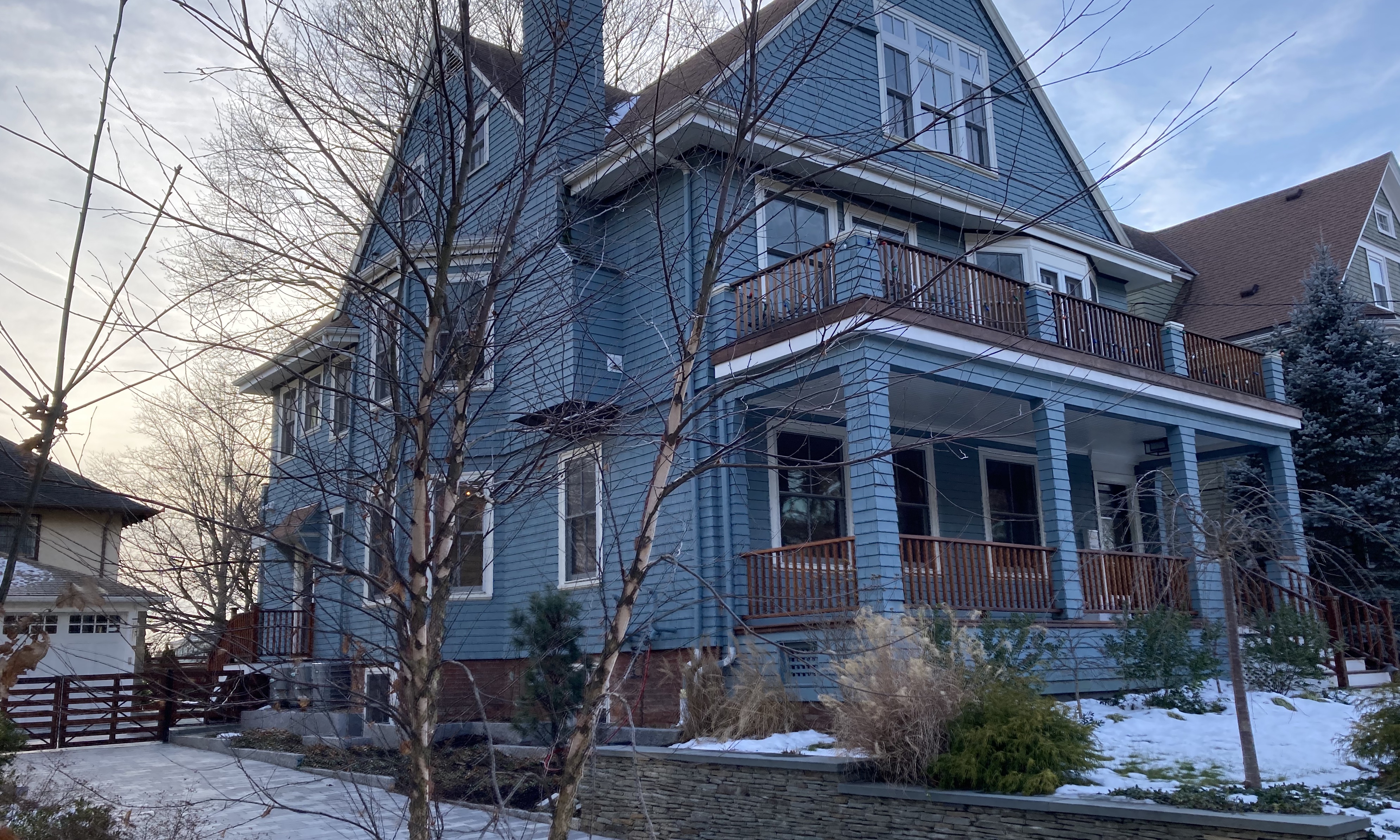
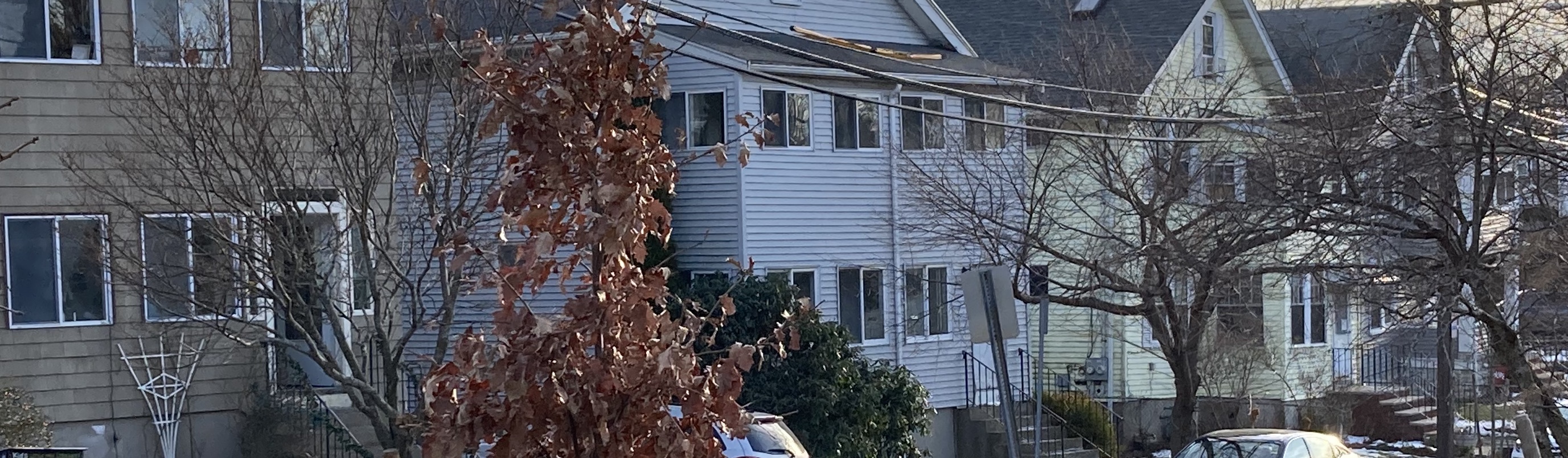
5. Legislate and/or Tax Dwelling Units Taken Out of Service. If it can be legal for the city or state to establish maximum rents on privately owned property, why not consider other, more generative forms of controlling existing housing stock? Every block of my Strawberry Hill neighborhood has two family houses that have been converted to single-family, as well as two-family houses where the owners no longer rent their extra unit. In a city short of housing, do owners of multi-family buildings have a responsibility to rent them? Can the city restrict conversions that reduce the total number of dwelling units? At the very least, let’s levy a hefty tax on units taken out of service and allocate that money to creating new housing.

Former Two-family House, now Single Family, in my neighborhood

Increasing Housing Stock and Affordability through Public Measures

Regardless of zoning reform, inclusion requirements, and disincentives to take units off line, we are unlikely to address the problems of affordable housing for all our citizens though manipulating the parameters of private ownership. Some tenants will remain too poor; too challenging. Public interest in building and operating housing for people unable to participate in the private market has waxed and waned over the past century. But we have enough examples of doing it well that if we commit with purpose, and allocate the money required, we can house everyone.

1. Expand Section 8. The Section 8 program has many benefits, primary among them that it integrates tenants in the fabric of existing community. Section 8 does not increase the amount of housing per se, but offers access to more units for low-income people.

2. Build more affordable housing. Easier said than done. Whether through the Cambridge Housing Authority or local non-profits, we need more fully affordable housing projects. The recent 100% Affordable Overlay Zone is a good step in this direction. Now, we just have to pony up funding.

3. Build more alternative forms of housing. The private development market is not a forum for innovation. Developers only build what they know will rent: independent, full-service dwelling units. The more private amenities, the better. Publicly funded housing should move beyond creating warrens of individual apartments. We should use public resources to experiment with new, more sustainable and socially integrated forms: congregate housing where four-to-six-bedroom suites share common spaces; old school SRO housing in urban centers; even residential hotels where residents’ private suites come with chits to local restaurants or a subsidized dining room. All options that provide housing for single or coupled people in less space. All options that encourage people to be out and about. All options that, if proven successful, the private market will emulate.

No one of these suggestions will solve our housing crisis. Given our culture of uber-privacy, I doubt many will be realized. The American mania for autonomy baffles me. I’ve lived with other people my entire life, as family, spouse, or housemate. I find the tremendous benefit in having someone nearby—accountable for and accountable to—offsets the downside of, like, having to get along with someone else on a bad day. Besides, living among others is more sustainable, more affordable, and more sociable.

Our housing crisis is real. Implementing rent control is an easy feel-good that won’t really address the issue. This essay outlines eight other possibilities, none of which will resolve the problem in total, any of which can provide more housing, or more affordable housing, than rent control offers. The solutions I suggest—and there must be others—will be more difficult to bring forth than simply rechurning rent control.

Do we have the resolve required to rise beyond an approach already tainted, and implement real change in how we will live and how we will care for our fellow humans?

Posted in Uncategorized | Tagged , , , , | Leave a comment

On Rent Control: Part Three—Prognosis

The Joint Housing Committee of the Massachusetts Legislature recently held a virtual hearing on House Bill H.1378, a proposal to grant cities and towns the right to establish rent control. As a person who lived in a rent control apartment, then owned rent-controlled apartments, and now owns unregulated apartments, I have broad experience of the issue. This series explores the potential, and pitfalls, of rent-control as a mechanism to address our housing supply and affordability crisis.

Link to Part One—Legal History

Link to Part Two—Personal History

Can Rent Control Help to Address our Housing Crisis?

Social assistance programs transfer resources from one group in society to another. Our reasoning for these transfers falls into two basic camps. First: all humans are entitled to basic food, shelter, and healthcare (thus: food stamps and Medicaid). Second: we attempt to balance opportunity and access in an inherently inequitable society (thus: higher education Pell Grants and set-asides for minority businesses). Ultimately, every social program debate can be reduced to whether something ought to be taken from Peter to benefit Paul. Since I believe everyone is entitled to the basic requirements of life, and that we should attempt to balance the inequities of our world, I support both approaches.

There are also two fundamental ways in which resources are redistributed. They’re either ‘targeted’ by need (again, food stamps and Medicaid) or ‘universal,’ equally distributed across the entire population (the recent Economic Impact Payments). Both forms of redistribution are valid, though each achieves different purposes.

To assess whether rent control is a worthwhile social program, let’s consider whether it helps fulfill a basic human need and/or balances inequities of our society; and whether it’s ‘targeted’ or ‘universal.’ The studies and statistics I reference are from, “Rent Control: What Does the Research Tell us about the Effectiveness of Local Action,” a white paper published by the Urban Institute (January 2019) and “America’s Rental Housing 2020,” by the Joint Center for Housing Studies.

Does rent control help fulfill a basic human need?

At first glance, the answer to this question is yes: rent control provides secure housing because it remains affordable to tenants over time. However, evidence indicates that rent control dampens the development of new housing. Thus, while it provides security for residents of rent-controlled units, it hinders the total amount of housing available.

Does rent control help to balance the inequities of our society?

In 1994, when Cambridge lost the ability to enforce rent control, 26% of people living in rent-controlled units were in the bottom quartile of income; while 30% of rent control residents were in the top half. At first glance, it appears beneficiaries of rent control at least parallel economic strata.

However, lower income people are more likely to rent than own. Over 40% of families in the bottom quartile rent, so if they claim only 26% of rent-controlled units, they are actually underrepresented. Since rent control doesn’t include income guidelines, and since most landlords will be predisposed to higher income tenants (as I am), logic follows that proportionately fewer low-income families will benefit.

If we include income guidelines into rent control, the program could better balance inequity. Unfortunately, this would usher in a new set of challenges. How would we monitor income eligibility? If a family’s income rose above a certain threshold, would they have to move out? Would this be reverse discrimination against people whose income exceeds the guidelines, as they would have less access to the pool of available rental units? Providing means tests to rent control would enhance the claim that rent control provides more affordable housing for those who need it. But the means are thorny.

Is Rent Control ‘targeted’ to a particular group?

As long as rent control does not include a means test, the only group it targets is renters as opposed to owner-occupants. Although renters, in aggregate, are less affluent than home owners, there are plenty of renters who don’t fall within most governmental definitions of ‘need.’ In fact, people who live in rent control apartments are statistically older, single, and childless when compared to renters overall. Again, the beneficiaries of rent control do not neatly align with groups in need of assistance.

Can Rent Control be applied universally?

The answer to this is: definitely not. Rent Control is limited by the number of units available to control, not the number of people who could benefit. It creates a new category of division in our cities: those who receive rent control, versus those who do not. A recent study in San Francisco estimated the economic ‘transfer’ of those living in unregulated units to those living in rent-controlled units is $2.7 billion per year. That’s a mighty big transfer to people who very likely landed their rent-controlled apartment through luck or connection rather than need.

If rent control does not meet the basic requirements of an effective social service program, why is Massachusetts considering enabling it (once again)? The answer is easy as it is illogical. Politics.

Enabling cities to establish rent control provides the illusion of doing something about our housing crisis at no direct cost. It costs the state nothing to pass the legislation. Cities who implement rent control bear only the cost of their operating boards. Politicians can say, “We made over 50,000 units in Cambridge more affordable,” without adding a single residential unit to our city.

Rent control is a politically expedient means to claim progress in our housing crisis, and a demonstrated path to creating a secure voting block among the lucky folks who wind up occupying rent-controlled units. State Senators, Representatives, and City Councilors know that the unlucky ones, who cannot find an apartment in Cambridge, won’t be voting in their district!

If rent control isn’t a panacea, how can we address the crisis of housing availability and affordability in Cambridge and beyond?

Tune in next week for…Better Options to Address Our Housing Crisis.

Posted in Uncategorized | Tagged , , , , | Leave a comment

On Rent Control: Part Two—Personal History

The Joint Housing Committee of the Massachusetts Legislature recently held a virtual hearing on House Bill H.1378, a proposal to grant cities and towns the right to establish rent control. As a person who lived in a rent control apartment, then owned rent-controlled apartments, and now owns unregulated apartments, I have broad experience of the issue. This series explores the potential, and pitfalls, of rent-control as a mechanism to address our housing supply and affordability crisis.

Link to Part One—Legal History

Rent Control and Me

My first experience with rent control came quick upon getting engaged. Time for me and my fiancé to move out of our respective group houses into a place of our own. Our budget was tight, apartments scarce. In July of 1979 we found a 425 square foot one bedroom on Mass Ave between Central Square and Harvard. Four tiny windows facing a blank wall. A measly abode in an excellent location for $224 per month. We signed a September first lease, confident that love would bind in such tight quarters. In the last week of August we received a notice from the Rent Control Board: the rent on our apartment was reset to $277. What the $#@**%. A 24% increase! So much for rent control, like, controlling our rent. We tightened our belt and winced every month as we wrote out the check.

Years passed, and the traditional single-family house always dangled beyond our financial grasp. We moved to Oklahoma City and purchased a two-family house in a place where no one’d ever heard of rent control. Moved back east in 1986 and purchased a two-family in Somerville, where rent control had already been terminated. By 1992, we had two children and decided to relocate along the Route 2 corridor: Lexington, Arlington, Belmont or Cambridge. I’m a city guy, but Cambridge was a long shot: houses were either super experience or, if under rent control, in shambles. Lucky us! We come upon an albatross: an asymmetrical four family with a large three-story unit attached to three flats. The sellers (SPOA activists) had legally subdivided the place down the party wall, but the communicating porches and cross-doors defied the simple line drawn on the paper deed. Our real estate agent proved a savvy negotiator, and we flipped from being out-priced seekers to mortgaged owners of a 5,000 square foot behemoth. Still, everyone wrinkled their brow at our stupidity: you bought a house under rent control?

The illogic of the system became immediately apparent. The smallest apartment, an attic studio, had the highest allowable rent, by a wide margin. The appraiser thoroughly investigated the side we would inhabit, but declined to even walk inside the rent control side. He explained, “The value of a rent control property is established by rents set by the Board; the actual condition is irrelevant.”

Within a week of closing, I received notice to appear before the Rent Control Board. I arrived in dress shirt and tie, clueless to the agenda. I was greeted as the enemy, with full bore skepticism and derision. “Why did this building get legally subdivided?” “How are you trying to circumvent rent control?” I knew that the rent control equation was a zero-sum game: the previous owner had subdivided a four-family building, in which one unit was owner occupied and three under rent control, into two legally separate properties. As the new owner of both properties, we would live in the ‘single family’ while the ‘three family’ would remain under rent control, since it was not owner occupied. The legal description of the property had changed; the de facto rent control status had not. This reality did not stop the Board from grilling me from every angle, convinced I was up to no good. I remained uncharacteristically calm; while they fumed.

The following summer my attic-studio tenant moved out. Within an hour of posting notice, I had three applicants. One was a single mother with a young child. The second, a single woman who planned to run an at-home day care out of the apartment, The third was a medical resident at Children’s Hospital. Since rent control did not demand a means test or other social criteria, I did what any conscientious landlord would do: rented to the person with the highest and most secure income. The medical resident proved to be an excellent tenant.

In the run-up to the 1994 state ballot initiative that ended rent control, local media was ripe with pro-rent control articles. One morning, the front page of the Cambridge Chronicle featured an article about the woes of a tenant who claimed “I will not be able to afford my apartment if rent control is eliminated.” The quote stuck in my throat. The subject of the article was my own tenant and no one— from the Chronicle or anywhere else—had asked me, her landlord, what her uncontrolled rent might be. I called the Chronicle, accused them of pandering, and lambasted their shoddy reporting. The following week, the cover page story featured me, explaining how small landlords valued continuity and would not necessarily toss out every tenant in the city.

For the last thirty years I’ve managed the three apartments attached to my own house. I am attentive and fair in the rents I charge and maintenance I provide. So far, I’ve only had one tenant to whom I have not offered an extended lease: the woman from the Chronicle article. I am disinclined to be generous toward people who malign me, even if indirectly.

My three apartments are safe and sanitary, yet hardly fancy. The rents I charge fall within the guidelines of HUD’s Section 8 rental assistance program. I could sign on for the program and be guaranteed tenants and rent. But I do not. I know how arbitrary HUD guidelines can be from my days designing affordable housing, and rumors surrounding the hassle of annual property inspections keep me from welcoming the housing authority into my 120-year-old building.

I am fully aware of the inconsistency in my behavior. I believe everyone should be entitled to basic housing, and I could provide truly affordable housing to at least a few people. Yet I steer clear of inviting government busyness into my affairs, and choose to rent to folks whose decent incomes don’t require subsidy.

My personal experience with rent control reflects a program that proclaims a set of benefits far different than what it delivers. If the state once again passes enabling legislation to allow rent control in Massachusetts, and if the City of Cambridge adopts it, of course I will comply. But we’ve already lived through one generation of rent control, and it failed to deliver affordable housing to those in need. I wonder: can rent control be structured to better align with our objectives, or are there are better ways to achieve stable housing for everyone?

Next Up: Can Rent Control Help to Address our Housing Crisis?

Posted in Uncategorized | Tagged , , , , | Leave a comment

On Rent Control: Part One—Legal History

The Joint Housing Committee of the Massachusetts Legislature recently held a virtual hearing on House Bill H.1378, a proposal to grant cities and towns the right to establish rent control. As a person who lived in a rent control apartment, then owned rent-controlled apartments, and now owns unregulated apartments, I have broad experience of the issue. This series explores the potential, and pitfalls, of rent-control as a mechanism to address our housing supply and affordability crisis.

A Brief History of Rent Control

The first rent control laws in the US were adopted in the 1920’s. They expanded in the wake of World War II, with a desire to ensure affordable housing for returning vets, primarily in large, coastal cities. The salient feature of rent control was establishing a maximum allowable rent for any dwelling. Across-the-board adjustments were indexed annually (similar to a COLA: Cost of Living Adjustment). The maximum allowable rent for a particular unit could also be increased when local rent control boards approved landlord petitions supported by capital improvements to their property.

The 1950’s economic boom created unprecedented construction and suburban expansion; rent control fell out of favor. The general perception was that people who lived in rent-controlled units enjoyed unfair advantage. Meanwhile housing stock deteriorated as owners of rent-controlled buildings, put off from battling rent control boards for meager increases, provided minimal maintenance.

In the 1970’s most cities with rent control shifted to a second-generation system: rent stabilization. Rent stabilization varies from rent control in one important way; the landlord can ‘reset’ the base rent when a tenant moves out. This offers financial incentives for landlords to maintain their property, while encouraging tenants to remain in place. An upside of rent stabilization was promoting more stable neighborhoods; a corresponding negative was landlords trying to get rid of long-term tenants. Many landlord/tenant relationships got ugly.

As economic theory swung from Keynesian to free-market in the 1990’s, both rent control and rent stabilization were denounced as proto-socialist relics that impeded real estate development in a supply-side world. By definition, those evaluations ignored the fundamental premise of rent control: that housing is a right, and we all benefit when everyone enjoys stable, secure places to live.

The legal mechanisms that determine whether rent control thrives or perishes are significant; they reflect conflicts between federal, state, and local authority that infect much of our political discourse to this day. Rent control laws are municipal: enacted by a city or town. Yet, the ‘authority’ to enact rent control rests with the states. Large cities, with majority tenant populations, often favor rent control; while state legislatures are less inclined to support laws portrayed as economic drags that benefit a select few.

The history of rent control in my city, Cambridge Massachusetts, is both representative and unique. Massachusetts was late to the rent control game: it did not pass enabling legislation until the early 1970’s. The City of Cambridge thereupon enacted a system of pure rent control rather than second generation rent stabilization. Every residential building in the city with four units or more (plus any that were not owner occupied) was registered, maximum allowable rents established, and increases for capital improvements or inflation granted upon approval of the Rent Control Board.

It didn’t take long for tales of outrageous inequity to surface: Harvard professors and city council members living in large apartments for less than $200 a month. Landlords tried to circumvent the law by flipping rental units to condos, only to have the city stiffen condo conversion requirements. Each side dug into their position; although, in a city of 70% renters, rent control advocates held the upper hand. Rent increases were notoriously stingy, and people who purchased condominiums listed on rent control rolls could not occupy their own units. Real estate tensions in the city were explosive.

By the 1990’s, most Massachusetts cites who had adopted rent control had abandoned it. Boston and Brookline exercised rent stabilization; only Cambridge maintained strict rent control. A ‘local’ group known as SPOA (Small Property Owner’s Association) came up with the brilliant, if not exactly small ‘d’ democratic idea, of a ballot initiative to overturn the enabling legislation: i.e. get rid of rent control in Cambridge by making it illegal throughout the entire state. In 1994, citizens from Massachusetts’ 351 cities and towns were able to determine the fate of a policy that only affected three localities.

Rent control was abolished by a statewide referendum vote of 51% to 49%. A series of endgame tactics by the city failed to preserve any elements of the system. Frank Duehay, the sole city councilor who voted to create rent control and also witness its demise said, “I have to ask, is it better to have something or is it better to have absolutely nothing?” Overnight, residential rents in Cambridge went from being highly regulated, to completely unregulated.

If ever there is a case study in which both sides lost through their inability to communicate and compromise, this is it. Compare the physical dilapidation and inequitable rents that accompanied Cambridge’s diverse and funky vibe during 25 years of rent control, with the immaculate yet unaffordable, culturally sanitized city we’ve created twenty-five years later. Rent control was neither fair nor beneficial. Unfettered rents have created a different set of inequities.

Next Up: Rent Control and Me

Posted in Uncategorized | Tagged , , | 2 Comments

First Snow

Is there anything more delightful than first snow?

Ours arrived, an unassigned holiday inserted into the calendar, in the early morning of Friday January 7. I slept late and woke to a pixelated sky descending over the earth with lazy ease. No traffic noise. No children shuffling to school. My muscles loosened at the generous gift that little—actually nothing—would be expected of anyone today.

I watched accumulation on the deck railing: six inches; eight; as I devoured a pot of steel oats gussied up with leftover holiday cream plus cranberries, walnuts, cinnamon, and brown sugar. Basically: liquid cookies. The hearty oats stuck to my ribs all day.

By noon the snow had dwindled to flurries, so I tugged on my LL Bean boots and took to the shovel. I like to shovel, especially snow fluffy as this. The rhythm of scrape, hoist, and toss. The quietude of the city draped in a shroud.

City dwellers are disinclined to visit in each other’s homes. The measured distance between our interiors and whatever’s passing by is too small to afford causal drop-ins. In my thirty years here I can count on one hand the number of times I’ve been inside any of my neighbor’s houses. But we often encounter one another after a snow. We all have reason to be out. We are all working hard. Though we are not in a rush, so chat breaks are welcome.

I like to make it easy for pedestrians to traverse my domain, so I take care to shovel the full width of my sidewalk and clear away hard clods the street plows deposit on my busy corner. With responsible citizen duty done, I head out for a walk myself.

I relish meandering the city after a snowstorm. Property owners have a dozen hours to clear their walks; during the period of patchy clearing pedestrians claim side streets right down the middle. Though cars are surprisingly few; we are surprisingly many. Couples stroller their babies. Parents with school-age children tote discs to the hill at Fresh Pond. (Flexible Flyers seem to be curiosities of history.) Car owners brush off their hoods and fenders, and then dig under their wheels. “That looks like fun,” I observe as a woman with a long broom sweeps the top of her Subaru with balletic grace. “The first snow is always fun!” She smiles.

Her words are so true. The first snow is always the most fun, especially when it arrives with the morning, bestows a free day upon us all, and dissipates in time for a veil of sun to kick off the melt.

Each successive snow will be a bit less fun; a lot more hassle. Winter grinds long and cold. Which is why it’s so important to savor first snow and hold it dear in memory.

Posted in Uncategorized | Tagged | Leave a comment

On January 6: The Wisdom of Thomas Paine

“These are the times that try men’s souls.”

We have no definitive proof that the opening line of Thomas Paine’s pamphlet, “The American Crisis,” published in the deepest dark of the American Revolution, directly inspired George Washington and his troops to cross the Delaware, surprise the British at Trenton, and change the momentum of the war.

“The summer soldier and the sunshine patriot will, in this crisis, shrink from the service of their country…”

As a man who has always viewed citizenship as a responsibility of heart and hand and mind, rather than of arms, I like to think that Thomas Paine’s words made as much difference as any musket.

“…but he that stands by it now, deserves the love and thanks of man and woman.”

This week marks the one-year anniversary of the most serious threat our democracy has ever faced. I do not pen those words lightly. We have endured a Civil War when states seceded from our Union; a Gilded Age of backroom political bosses; a Jim Crow era of vigilante action; and a purge on so-called Unamerican activities. I came of age during the era of Civil Rights, and can attest that the physical violence we laid upon each other during those years was far greater than that we witness now. So, why do I think the threat our or democracy on January 6 is so much worse?

During the 1960’s, citizens who had been left out of the promise of America clamored for the opportunity to fully participate—they wanted to get in. On January 6, 2020, already enfranchised citizens climbed the walls of our Capital to obstruct the democratic process—they wanted to keep others out.

“Tyranny, like hell, is not easily conquered…”

We live in a moment of unparalleled confusion; so much data, so much misinformation, so few shared truths. We have little faith in institutions, and less faith in each other.

“…yet we have this consolation…that the harder the conflict, the more glorious the triumph.”

Let us rise in this anniversary moment of a treasonous event and take action to ensure equality and justice for all. Let us acknowledge that despite falling short of our aspirations for nearly 250 years, we will strive, peacefully, to realize our truly remarkable American vision: that each of us will have equal voice in governing our nation.

“What we obtain too cheap, we esteem too lightly: it is dearness only that gives everything its value.”

Posted in Uncategorized | Tagged , , | Leave a comment

Life is Short

A Twenty-first Century Myth

“Life is short,” we mutter as the calendar flips through these dark December days heading to another year. We believe our time on earth is brief, but that assumption doesn’t correlate with twenty-first century reality. Aside from Old Testament characters, which reportedly lived for centuries, people have never lived longer than we do today.

One signature statistic describes how the twentieth century transformed human existence: our lifespans increased by more than 25 years. The average American born in 1901 could expect to live to age 47. That same person born in 2000 could expect to celebrate 73 New Year’s Eves. After eons of incremental advances, lifespans leapt at a rate of three months per year throughout the developed world.

The United States was not alone in this accomplishment. Though we enjoyed the longest lives on earth through the 1970’s, other countries have since eclipsed American’s longevity. In this century, the rate of longevity extension has slowed, in some places, for some demographics, life expectancy has slipped. Yet, around the globe, more people are living longer than ever before.

Some plants and a few animals live longer than us. The bowhead whale, the longest living mammal, can blow his snout through two hundred winters; a number of tortoises born in 1850 are still alive today. An American born in that year had less than half the life expectancy we now enjoy. Actuarily, if I’d been born in 1850, I’d already be twenty years dead. Fortunately, since I’m 66 in 2021, Social Security estimates I’ve seventeen more years to carry on. I’m angling for even a few more.

Maybe life seems short because everyone gripes we’re so busy. Again the facts defy our protestations. According to the U.S. Department of Labor, the average person works a total of 3.54 hours a day, almost as much as the 2.83 hours we spend watching TV. We even manage to sleep more than eight hours a night, despite the bleary eyes around the office coffee pot on Monday mornings. Since our society focuses ‘work’ into an in intense period of active adulthood (when we’re also raising children and scrambling for economic security), averages don’t reflect the full spectrum of workaholics, or TV bingers. However, they do expose our human propensity to boast about busyness while downplaying our less productive pursuits.

The dual mantras of “busy” and “life is short,” offer psychological solace. Espousing busy, busy, busy, gives us purpose, while bemoaning that life is short excuses whatever we leave undone. Most of us alive today will thrive into our 70’s, many will pass 100, yet we still cling to the refrain that “life is short” because it’s a comforting soundtrack through our long journey.

If we think life is too short, then how long would we like to live? Science journalist David Ewing Duncan has asked more than 30,000 people to choose their optimal lifespan: 80 years, 120 years, 150 years, or forever. A solid 60% majority wished to live eighty years while less than one percent sought immortality. Despite what we say, we don’t really want to live much longer.

Most of the increase in our life expectancy is due to reductions in infant mortality. A person who survived to age 5 in 1901 had a good chance of reaching 60 or 70, as did folks in colonial America or Ancient Greece. Surviving those first five years was the tough part. These days, many more children survive infancy, but we’ve also increased every other phase of life. Childhood is longer, adolescence longer; extended middle age lasts into our sixties; triple digit elderly are becoming common.

Hippocrates started this myth in 400 B.C. when he wrote, “Life is short, the art long, opportunity fleeting, experiment treacherous, judgment difficult.” Apt words for a physician confronting an ill patient whose individual life may be soon over. But they are misconstrued when extrapolated to everyone. Imagine how different our outlook would be if we exclaimed, “Life is long, art eternal, opportunity abundant, experiment exciting, judgment clear.” What if, instead of fretting about life’s temporary nature, we acknowledge that we inhabit this earth for a long time; time that affords us leisure to explore, analyze, and evaluate before we act.

This New Year I’m abandoning the phrase, “Life is short.” Evidence demonstrates the contrary. Instead, I embrace our longevity as a gift as well as a challenge. I resolve to live with the long view in mind.

_ _ _ _

Image courtesy of the Nature Conservancy

Posted in Uncategorized | Tagged , , | Leave a comment

I am Not in Charge

Its December 2021, an inauspicious year if ever there was, save one personal milestone. I have gotten further along in achieving last year’s new year’s resolution than ever before. What was my resolution? “I am not in charge.”’

At first glance I may not appear to be the kind of person who seeks to be in charge. In my professional life I eschewed most any title or formal role. I was never principal in a firm; hardly ever stamped a project as architect-of-record. Yet I carved out a mediating role that often made me center of attention.

“You are the best facilitator I ever met,” An administrator at Boston Medical Center told me when I announced my retirement, only a few months into a five-year major facility renewal. “But I can see why you’re moving on. That’s not the kind of thing one carves on a gravestone.” At age 58 I realized that I simply didn’t have the enthusiasm I needed—and Boston Medical Center deserved—to thread the nimble negotiations of who got fresh space and which services expanded. I’d steered clinicians, administrators, and patients toward consensus before on several large projects. I knew the success of any project hinges as much on perception as on construction, and I had a knack for making everyone feel heard; feel they came out ahead. The more I got folks vested in our design, the more they were more inclined to proclaim the result a success. Their success.

It was great fun, and I was good at it. Never titularly in charge. Always the go-to person to move forward. Having a general knowledge of all aspects of health care suited my curiosity, which is broad rather than deep, while juggling the politics, egos, and financial incentives of the American healthcare system catered to my puzzle-solving nature. I loved corralling all the players and horse trading them into agreement.

In the eight years since I retired, the satisfaction of being in charge, however conferred, is a difficult thing to yield. It comes naturally to me. No doubt, in part, a role that many educated white males simply assume.

Perhaps it was the 2020 pandemic, which shook everyone’s sense of control. Perhaps it was George Floyd’s murder, which stripped whatever sheen remained of American lip service to equality. Perhaps it was just the fatigue of our pointlessly divisive era. Whatever the reason, last December I decided to try and let go. Forfeit my kneejerk impulse to take charge.

It would be a lie to say that I succeeded every day in every way. But in total, I held my tongue more in 2021 than any other year of my life. I listened more, and I believe, listened better. I took more deep breaths as a matter of soothing. I apologized frequently, and meant it sincerely.

The world is not a better place for me stepping back, but it’s no worse either. Even my own little corner appears pretty unaffected by me acing a new year’s resolution. But the direction feels right to me. Retirement means stepping back rather than stepping in. Letting others seek you out rather than putting yourself out there. Exploring the broadest possible perspectives, and leaving the details to the next generation.

I’m pretty disappointed with the world that we, the Greatest Generation Once Removed, are bequeathing our children and grandchildren. Our hubris and greed have done to more to hasten the demise of humanity than any previous cohort. We salve our conscience by protesting that we did nothing more than build directly upon the foundations we inherited. Just like every generation before us. But such comfort is false. We knew the warnings: what we’re doing to our society; to our planet; and we scarcely changed course.

There is still a lot a person can do, when he’s no longer in charge. I can still learn and question and make connections. I can laugh and sing and cry, ride my bike and enjoy the train, eat healthy and exercise daily. Offer my voice, opinions, and knowledge to the next in line. Knowing full well they may be rejected: I am not in charge.

Notching down a few ladder rungs is not a reason to abandon or hide. Rather, it’s an opportunity to work differently, to live differently. To support what’s right moving forward without leading the charge.

_ _ _ _ _

Images from the cover of I AM NOT IN CHARGE by Ness Cannon

Posted in Uncategorized | Tagged | 2 Comments

The Graffiti in our Minds

Spirits of anguish past and present are my companions as I tromp the carpet of dead leaves. At its peak, Metropolitan State Hospital, Massachusetts’ last and largest institution for mentally ill (built 1930), held 2,000 patients behind its Georgian Revival facades. Within: barred windows; hard tile; wards lined with metal frame beds. Easy to secure restraints.

The inhabitants of Metropolitan State Hospital, like its sister asylums, received inadequate care at best, cruel at worst. It closed in 1992, as the Commonwealth decentralized care of the mentally ill. It’s out of fashion to find any virtue in the way we locked up our crazies. Especially if you’re lucky enough to land in a cozy group home, where care is quite good. Less so, perhaps, if you’re among the throng of confused homeless loitering Mass and Cass, pressing against a cardboard lean-to to fend the winter wind.

Today, Metropolitan State’s extensive grounds are a nature preserve with meandering trails from Beaver Brook to the top of Mackerel Hill. The finest of the original structures have been transformed. A snazzy two-bedroom apartment, whose living/dining room used to house eight inpatient beds, rents for $2800 per month.

I wonder what ghosts inhabit those renovated wards; the spirits are keenly prescient along these open-air trails. In one ravine, the trail opens unto MetFern Cemetery, final resting places marked only by patient numbers plus a ‘C’ for Catholic or ‘P’ for Protestant. As the name implies, residents of both Metropolitan State and the neighboring Fernald School are buried here. Whatever improprieties were inflicted at Metropolitan were superseded at Fernald, a school for developmentally disabled boys used as a Eugenics testing ground. Conjure that gruesomeness.

Atop Mackerel Hill is an aging water tower. Dull grey and rust, except for the first six or eight feet from the base. Graffiti artists spray-paint angst on this psychotic ground. I ponder the images and words that can only be seen by those who trod the path; thick brush hides the color and doubt from cars passing by Trapelo Road. The sentiments might well reflect the mindset of previous residents; they don’t square with our mantras of healthy living. And yet each image draws a direct response from me. They resonate.

The gap between the formerly insane and the presently functioning may be small. Perhaps there is no gap at all.

Posted in Uncategorized | Tagged , , , | Leave a comment