Trip Log – Day 4 –Union, ME to Belfast, ME

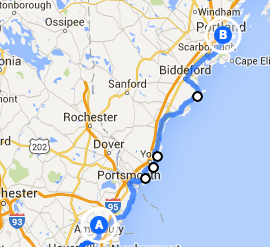
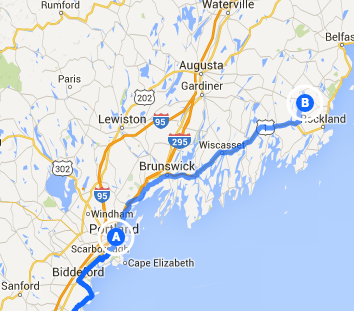
Screen Shot 2015-05-10 at 1.29.12 PMMiles Today: 30

Miles to Date: 272

May 9, 2015 – Cloudy, 55 degrees


IMG_1723I opened my eyes and greeted the domed skylight in the center of the yurt’s roof above me. Dozens of rafters splayed out of create this giant circle. The wind outside made the canvas roof pucker. I was cozy in my sleeping bag. My imagination spun at the thrill of adventure. I simultaneously felt far from home.

There is a consciousness to yurt living, Rose and Jeremy style. Jeremy set a fire in the wood stove. Rose chopped piles of fresh vegetables for a frittata. I took a bath in their deep tub. The long bath was luxurious, but like so much of conscious living, it would be time consuming on a daily basis. The yurt sits on a square concrete walkout basement, which creates odd foundation geometries were round meets square. Rose and Jeremy plan to move the yurt to another plot and construct a more conventional house; divided into rooms, including a bathroom with a shower.

IMG_1718 Being round, the yurt invites interaction, which is well suited to Rose’s work. Two days ago she called me on the road. “Can I do a workshop Saturday morning based on your question?” I was planning a short travel day, so decided linger in Union and participate. Ten people gathered beneath the yurt’s dome and Rose led us through a series of explorations that touched on the individual and community, where we are today, where we’d like to be tomorrow, and how to get there. I must confess being a bit skeptic of group process exercises, but the morning was insightful and emotionally powerful.

IMG_1728When I rode away about one o’clock, I needed a few hours of solitude to process the intensity. The ride from Union to Belfast goes through beautiful countryside, forests and farms. The topography is hill after hill after hill. Long, low gear climbs followed by fast, all to quick, descents. I spent my mid-afternoon break at the Hope General Store with a Diet Coke and Whoopie Pie, a ridiculously sweet Maine staple.


IMG_1731The side of the rod was littered with fiddlehead ferns. I rolled into Belfast about 5 p.m. Belfast is a picturesque coastal town that has transitioned out of manufacturing with great spirit. I crossed the Passagasawakeag River on the high bridge on Route 1. Then I turned off the Atlantic Highway for one final time, and climbed the hill on opposite rise to spend the night with Jim Merkel, long-distance cyclist, environmental education, and author of Radical Simplicity, and his family.

IMG_1736

Posted in Uncategorized | Leave a comment

Screen Shot 2015-05-09 at 3.06.10 PMMiles Today: 88

Miles to Date: 242

May 8, 2015 – Sunny, windy, 55 degrees


The reality of this trip hit me hard in the face today, in the form of a 30-mile head wind. I started the day with a group discussion of how will we live tomorrow at SMRT, the Portland architecture firm with whom I worked a few years ago. After a stimulating conversation, I walked out of their waterfront offices to a hard wind shift.

IMG_1706I pedaled 15 miles along Casco Bay to Yarmouth, where I met with folks from DeLorme, the mapping company, to discuss trends in mapping and satellite location systems. I was mesmerized by Eartha, the largest globe in the world (42’ diameter). When we hold a globe in our hands, the earth seems manageable. A three-story tall planet revolving on its axis is both inspiring and humbling.

It was well past noon when I climbed back on the bike for a 66 mile trek to Union. Two friends of my cousin Andy heard about my trip and invited me to their yurt. I knew it would be a long haul, but their invitation was so genuine, I told them I’d shoot to arrive by seven. Immediately, I knew I was overly optimistic. The wind was steady, fierce and spot on. I alternated between being on Route 1 and side road spurs, but no matter where I went, the wind found me out.

After a terrific lunch at Wild Oats Bakery in Brunswick, I did thirty miles without a break – earning my bikes namesake of Long Haul Trucker. Twenty more miles brought me within shooting distance of Union. I was up in hills now, away from the coat. The horizontal sun streamed through the trees, but I wanted to get there before dark. Somehow, I missed the road and needed to call – twice – to find the dirt road that led to the cozy yurt.

IMG_1694IMG_1716IMG_1710IMG_1717

It was after eight when I arrived, but my road woes evaporated in a moment. Rose and Jeremy had invited friends for potluck. A dozen of us spent the evening eating chicken with apples, bow-tie pasta in pesto and berry cobbler, while discussing how will we live tomorrow. By the time I crawled into my sleeping bag under the moonlit skylight in the middle of their circular home, I was exhausted by satisfied.

Posted in How Will We Live Tomorrow? | Leave a comment

Trip Log – Day 2 – Seabrook, NH to Portland, ME

Day Two Screen ShotMiles Today: 89

Miles to Date: 154

May 7, 2015


IMG_1647I rolled north with the spring, a notoriously swift and fickle season in New England.

The morning was crisp, the breeze on Rye Beach chilly.


IMG_1655In the thrill of Day One I forgot two important aspects of bicycle travel: to ask my question to a stranger and to eat audacious food. I rectified both shortcomings today. First, I devoured an incredible cinnamon bun at Lil’s in Kittery, ME (Yeah – already in state number three).


Second, I stopped along the road in York and asked a woman painting on a lawn ‘How will we live tomorrow?’ Marcye Newton responded, and invited me to visit the York Art Association, where they had a great show of Art in Bloom in honor of spring. Marcye’s thick, brilliant flowers resonated with me. They were almost as bright as the forsythia that is abundant, unruly, and at peak color as I move north.

IMG_1663IMG_1668IMG_1660

IMG_1679More than nature is changing fast. I spent several stints along U.S.1, where a few local attractions are open, but many more will within the next two weeks. Road construction abounds, landscaping is being turned, and every inn is being scrubbed in preparation for the summer onslaught. At my noon Diet Coke break (Circle K, 75 cents for 32 ounces of energy) a long line of landscape men and housekeeping women – excuse the gender reality – also refueled.

I took a long detour to ride by Kennebunkport. I wanted to ask the Bushes my question. I didn’t see them in town, but I did find this lovely church, and incredible overlook.

IMG_1682unnamed

The last ten miles up Route 1, through Scarborough and South Portland were not much fun, but I landed ay Dry Dock in Portland by 4 p.m. for beers with my friend Chris, then pedaled up to the East End for my first stay with a Warm Shower’s host. Rich and Sarah and their daughter Cedar set a high bar. They fed me well on a roof deck with a sliver of a sea view. They answered my question. But mostly we talked about cycling routes we have traveled, and those still imagined.


Posted in How Will We Live Tomorrow? | Tagged , , , , , , , , | Leave a comment

Trip Log – Day 1 – Cambridge, MA to Seabrook, NH

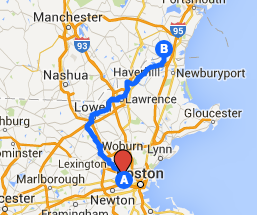
Screen Shot 2015-05-07 at 9.14.00 AMMiles Today: 65

Miles to Date: 65

May 6, 2015

As I pedaled away from the Alewife T station, against the flow of commuters filing into the subway, I murmured, ‘one mile down, 20,000 more to go.’ A fellow cyclist passed me along the Minuteman Rail Trail, asked about my shirt, and told me he’d cycled the lower 48 over a three-year period after college. When he waved goodbye as he turned out, I didn’t feel required to tell him I was only three miles into my epic journey. My ‘48 States*2 Wheels*1000 Possibilities’ shirt may be presumptuous at this point, but I have finally started.

IMG_1604Conditions are perfect; sixty-eight degrees and sunny. I ride 25 miles to Lowell for my first visit – to the Cambodian Mutual Assistance Association (CMAA) to talk with refugee immigrants about how we will live tomorrow. There are several bikeways, including one along the Bedford/Billerica railroad – the oldest 2-foot gauge railroad in America.


IMG_1617By noon I am back on the bike marveling at Lowell’s tenacity. The has-been mill city powered by Merrimac River thrives by cobbling together an eclectic array of economic activity: artist lofts, an urban National Park around the old mills, light industry, UMass Lowell and Middlesex Community College, as well as accommodating, and finally embracing, a huge influx of Cambodians since 1980.


IMG_1627One unexpected delight is riding 30 miles along Route 110 East, which parallels the Merrimac River. My mind wanders to Thoreau’s Week on the Concord and Merrimac Rivers. There are still stretches where the majestically wide river and forested banks dimpled with springtime gold turning green must look quite similar to the river he navigated 176 years ago. However, he didn’t have to navigate five (yes, five) intersections with I-495.

IMG_1635Things I wonder about:

  1. Why do cyclists ride against the traffic once I’m 20 miles outside of Boston?
  2. Does any other state have as many ice cream stands as Massachusetts? They are all packed with customers mid-day, mid-week and it’s not even summer yet.
  3. I get cut off twice – both times by BMW’s.

IMG_1630If Lowell has many Cambodians, Lawrence feels completely Hispanic. The women wear brilliant skirts with layers of ruffles and the Catholic churches have busy mid-day masses. Haverhill doesn’t have such a clear ethnic definition, but is much larger and better restored than I imagined. Merrimac is quaint; Amesbury is picturesque as a movie set.


IMG_1641I arrive in Seabrook and have a relaxing evening visiting my good friend Harry Mears. He feeds me, introduces me to John Oliver’s comedic take on the news, and gives me a comfortable bed for the night.


Posted in How Will We Live Tomorrow? | Tagged , , , , , , , | 1 Comment

Trip Log T-1: Acknowledgements

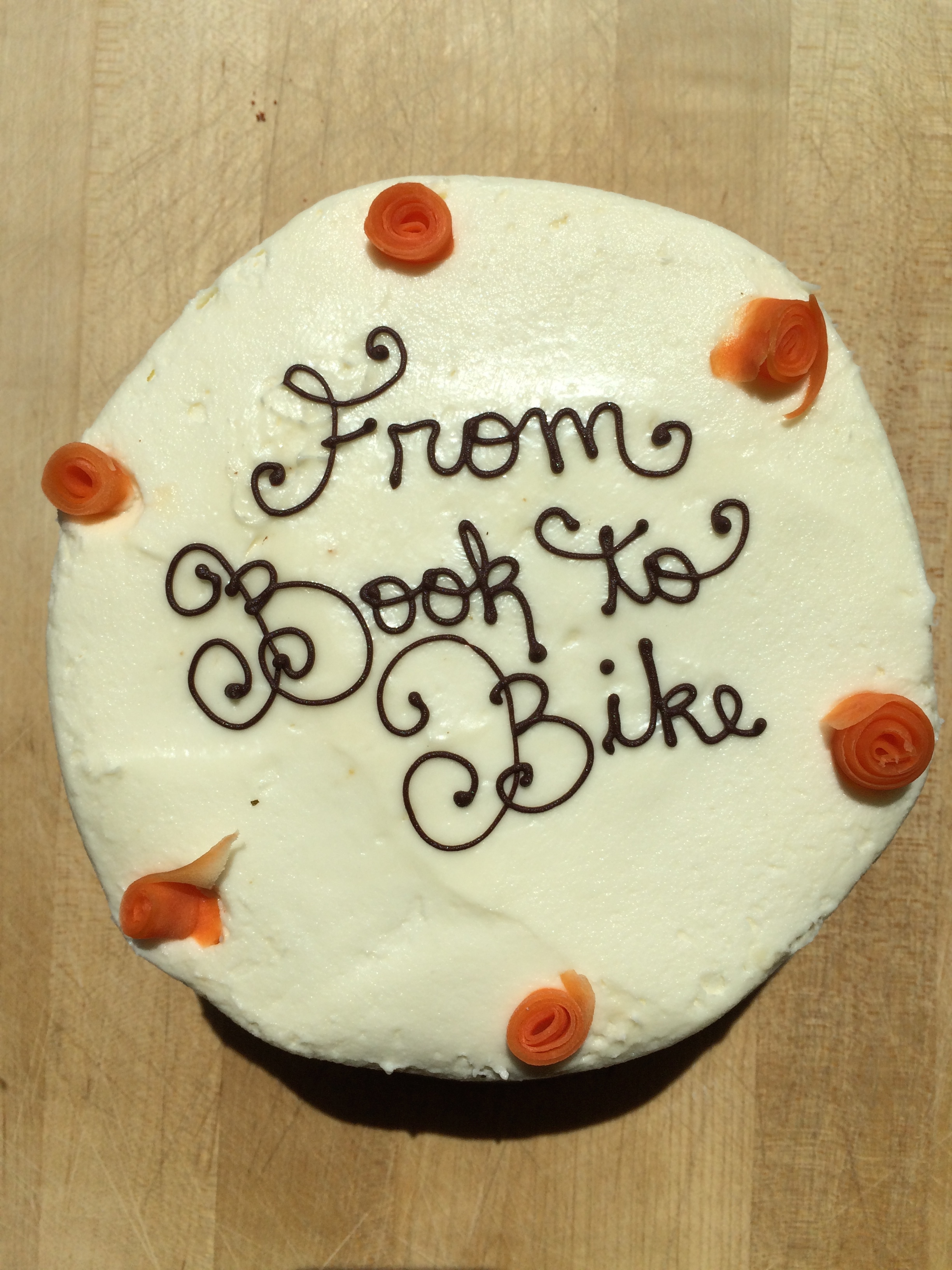
HWWLT Logo on yellowI want to thank everyone who has tried to fatten me up. Larry gave an amazing send-off dinner with four courses that culminated in me staring at the biggest piece of tres leche cake I’ve ever seen, until I ate it all. My penchant for sweets is well known; two days ago our refrigerator was blessed with a red velvet cake plus two carrot cakes, thanks to Joe, Jeffrey and Paul. Still, the scale this morning registered my usual weight.

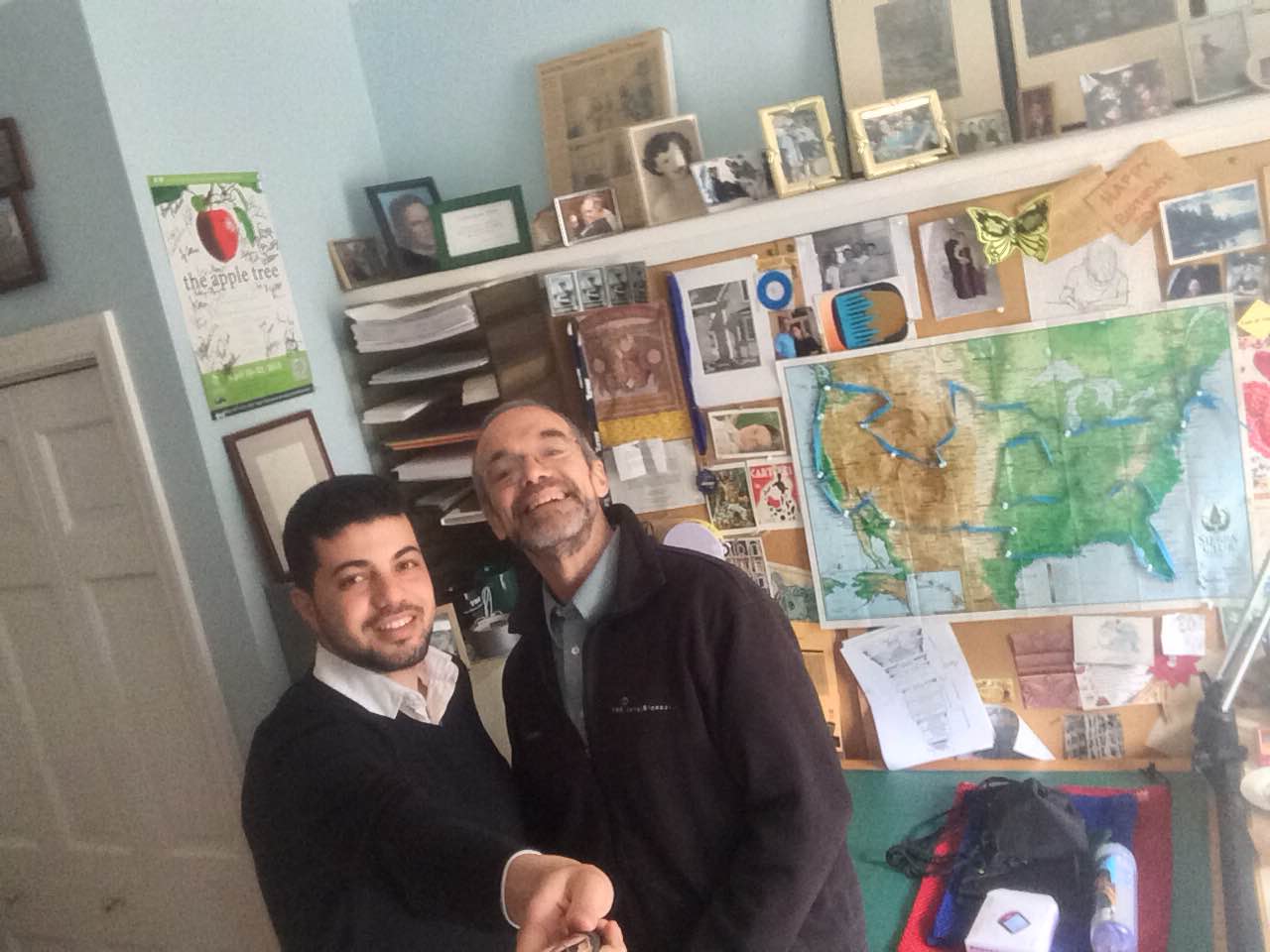
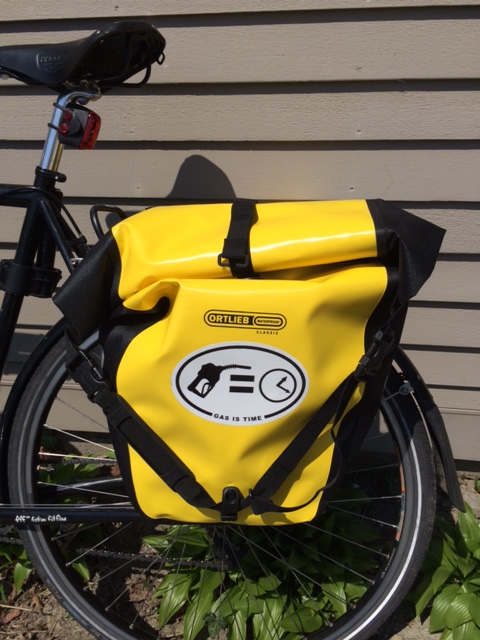
My panniers, however, are already getting heavier. Rida gave me a selfie stick, and though I vowed not to carry one, I’m going to give it a try. Cousin Andrew gave me a ‘gas = time’ sticker for my vehicle, which is as light in ounces as it is in meaning.

IMG_1589

IMG_3609IMG_1593


My friend and fellow architect Dave Deininger gave me a truly meaningful departure note. Dave rode his bike across our country 34 years ago. He reminded me why we undertake such journeys:

I found that my trip reconfirmed my faith in human nature. You will find that the bike will be an easy conversation piece to begin informal interactions with folks along the way. I found that people were kind, open, and generous to me, a perfect stranger “not from around these parts”. 

The other piece that was wonderful was the meditative quality of biking itself; slowly pushing through all the various landscapes and weather conditions. I found that it allowed my mind to clear and I could ruminate about all sorts of unrelated topics; sort of a stream of consciousness existence. 

My biggest debt of thanks goes to my beloved housemate, Paul, who enables my adventures in spirit and in so many practical ways every day.

More from the road…


Posted in How Will We Live Tomorrow? | Tagged , , , , , | 2 Comments

The Fine Print

HWWLT Logo on yellow‘Awesome’ is the most common response I get from people when I describe my upcoming trip. ‘Crazy’ runs a distant second, and ‘Dangerous’ a close third. Though I prefer to focus on the awesome aspects of my journey – the physical exhilaration and mental hejira – I cannot ignore the truth of concerned friends who think I’m crazy and what I am doing is dangerous. And so, in the spirit of full disclosure and the covenant I feel between my readers and me, here is the fine print of my odyssey. Just like when you buy a car or take out a mortgage, its time to acknowledge the gruesome details of what can go wrong immediately before signing the irrevocable commitment. Since my second favorite quote is Susan Jeffers, “Feel the fear and do it anyway”, this is where I own the fear. Because I am doing this anyway.

The day before I launched my blog, How will we live tomorrow?’ my friend Joe’s brother suffered a heart attack while riding his mountain bike, fell, hit his head, and was unconscious for some period before he was resuscitated. After two weeks of complicated medical intervention, he died. He was 53. Joe’s brother could have had a heart attack surfing the web, just as I could have a heart attack on my way to the library. But realistically, I am more likely to get hurt – and less likely to get prompt medical attention – riding my bike across America than if I stayed in Cambridge. I know that. I accept that. I have decided the experience is worth the risk. I am doing everything I can to be safe; I’m a cautious cyclist decked out in bright yellow with reflective panniers and bright lights. But none of that will matter if even one driver behind the wheel of a two-ton vehicle steers a few feet wrong.

images-7I’ve attended to all the messy details so many of us put off until tomorrow: my will, my medical proxy, my organ donor card. If I get taken out short and quick, the world might as well use what’s still valuable, and tidying up after me ought to be easy for those left behind. If I get taken out short and quick, find solace in knowing I quit the earth doing what I love.

Writing these words will make me safer by making me more cognizant of the dangers I’m inviting into my life. We cannot control the future. But if we have a vision of what it might be, we can work toward that vision. I cannot control my fate on the road. But if I’m aware of what a fragile yellow speck I am on the face of this continent, I can be doubly careful to navigate well.

imgres-3That’s all the doom and gloom I wish to share. Get ready for pedaling out on Wednesday. You will be safer than me, in the comfort of your bedroom or your office. But rest assured, I’ll be having more fun.

Posted in How Will We Live Tomorrow? | Tagged , , | Leave a comment

The Money: Not for Charity, Not for Profit

HWWLT Logo on yellowI’m happy to report that no sooner did I announce my bicycle adventure than people began positing unexpected responses. Just as I hoped!

Many people asked what charity I was raising money for; a few asked whether I was crowd-sourcing my adventure. Each question baffled me until I grasped their intent. Money defines so much of our lives; folks naturally assumed there must be a money angle to my enterprise.

There is not. I am not raising money for any charity, nor would I ask anyone to underwrite this journey. If my adventure has anything to do with money, it’s exploring how much life I can squeeze out of prudent resources. I have enough money. Not because I have so much, but because my wants are few. Besides, I’m seeking the most authentic aspects of America, which are often inexpensive.

images-6So read on, give me suggestions, answer my question, and offer me your couch along the way. I promise I won’t hit you up for money, either for a worthy cause or for myself.

Posted in How Will We Live Tomorrow? | Tagged , , | Leave a comment

Ayn Rand & Altruism

usa-001

This essay was recently published in WBUR Cognoscenti, where it generated more comments than all my previous Cognoscenti articles combined. Ayn Rand is still a polarizing character.


April is National Volunteer Month. Over the past forty years I’ve donated time in dozens of ways, but since I retired, providing services without compensation has become even more commonplace. This commemorative month seems an appropriate time to reflect upon why I enjoy unpaid activities. It’s also got me thinking about Ayn Rand.

images-3Ayn Rand was all the rage when I came of age in the 1960’s. The libertarian darling authored the hedonistic novels Altas Shrugged and The Fountainhead as well as a philosophical manifesto titled The Virtue of Selfishness. She once said, “If any civilization is to survive, it is the morality of altruism that men have to reject.” What light could the originator of Objectivism possibly shed on volunteering?

Merriam-Webster defines altruism as “unselfish regard for, or devotion to, the welfare of others.” Since Ms. Rand champions selfishness, it follows that she regards altruism as antithetical to human nature and an obstacle to progress. But if Ayn Rand’s perspective is knife-edge sharp, Merriam-Webster’s is too rosy. People do not give away their time and skills because we’re selfless. People volunteer because our self-interests are broader than pecuniary measures. We may not receive money for our effort, but we receive other rewards.

For most of my life, my volunteer pursuits mirrored my architectural career. There was logic to my 1978 Vista stint renovating houses in West Texas, designing The Boston Living Center pro bono in the 1990’s, building Musician’s Village in New Orleans post-Katrina, and constructing a school in Haiti after the 2010 earthquake. Though I’ve stopped working for money, I continue to provide architectural services for projects in the developing world. But more recent volunteer gigs are unrelated to design and construction. After a lifetime focused on analysis and technology, I enjoy connecting with individuals: teaching, mentoring, sometimes even touching. I tutor an immigrant from Morocco through YMCA International; Rida is preparing to take his TOEFL exam. I give individual yoga and stretching sessions to middle aged men with bad backs, sciatica, even Parkinson’s. I spend one morning a month at Career Collaborative, a Boston-based program that teaches job-getting skills to adults with challenging work histories.

images-4Ayn Rand would be flummoxed. Why decipher gerunds and participles, ease an aging man into pigeon pose, or suggest how an Ethiopian immigrant can leverage 7-11 experience into a job with benefits? I should be getting paid real money for doing what I know best. Howard Roark, the architect protagonist of The Fountainhead, never took an afternoon off from conceiving bold structures to dabble in community service.

Yet, I don’t call what I do altruism, a somewhat paternalistic word with elitist overtones. I enjoy doing these things. My daily life doesn’t provide opportunities to meet African immigrants or Parkinson’s patients; my interactions with minimum wage workers are typically limited to check-out counters. Getting to know such different people broadens my experience, deepens my empathy, and makes me more appreciative of the privileges I enjoy. Being an architect shapes the world in a concrete yet detached way. Direct interactions through volunteering generate other satisfactions.

Self-interest is not fixed, it expands and restricts as our circumstances ebb and flow. When we’re poor, hungry and destitute, our self-interest is focused on survival. But when we reach a place where life’s essentials are met, we seek more complex satisfaction, working our way up Maslow’s Hierarchy of Needs in search of self-actualization. Unleashed from mere survival, self-interest extends beyond the limits of our skin. It becomes entangled with the well-being of others until, ultimately, we acknowledge that our self-interest depends on others having what they need as well. Once we have enough, true security results from contributing and sharing rather than hoarding.

I am in accord with Ayn Rand; no one acts except in his self-interest. But I am fortunate to be in a position where my self-interest transcends dollars and cents. If altruism means selfless, don’t call me that. But I’ll continue to volunteer, in the hope that I might offer value to someone else, and the certainty that I will receive benefit.


Posted in Personal | Tagged , , , , , , , | 5 Comments

Cambridge Science Festival!

HWWLT Logo on yellowApril is prep month for “How will we live tomorrow?” I’m preparing for the trip and asking locals my question. The only official training I am doing is that I now ride my bike everywhere, in all weather. That’s no easy feat given the terrible weather we’ve had this spring. Dastardly potholes lurking beneath puddles caused back-to-back blowouts during downpours. However, I have learned that my Marmot parka is truly waterproof.

This week was the Cambridge Science Festival, and, since so much of science is focused on the possibilities of tomorrow, I participated in several events. Not all communities engage science with the fervor of Cambridge. Although Seattle may be have the highest proportion of college graduates of anyimages-3 major city (53%), Cambridge leaves the majors in the dust.Seventy-four percent of adult Cantabridgians have at least a four-year degree (which may be how we get away using terms like ‘Cantabridgian’). Still, the Cambridge Science Festival is an excellent indicator that our community is diverse and our thirst for knowledge strong,

David H. Koch Institute for Integrated Cancer Research at MIT – Open House

imgresThe Koch Institute’s slick new building with generous galleries makes a great place for demonstration tables staffed by eager graduate students and technicians in blue T-shirts with swirling DNA logos. The place was flooded with kids eager for science and the presenters focused on making cancer research accessible to all. A mouse trap game illustrated how cancer cells absorb more glucose and bypass the Krebs cycle, a Lego construction site showed how radiation breaks the DNA strand, Velcro attached to ping pong balls became ‘target cells’ when stuck to cotton balls, and children strained DNA from strawberries.

IMG_1575The real appeal of this open house, from the perspective of interesting children in science, was how each child could identify with the presenters. More than half were women, at least half people of color. MIT graduate students today look nothing like that did when I was there 40 years ago, and school children look nothing like my classmates of fifty years ago.

Sustainability unConference – Earth Day at District Hall in Boston

This was my first experience with an unConference. I was intrigued by both the concept and the subject matter. I wore my “How will we live tomorrow?” bike shirt for the first time. Cocktail hours are uncomfortable for me, especially when I am wearing bright yellow.

IMG_1572I wandered into the hall where organizers posted topics on a wall. “Write down what you’d like to talk about” a volunteer said. I added a note about how Boston might prepare to mitigate rising tides. I didn’t realize that my scribbling constituted offering to facilitate a workshop. Sure enough I got a bunch of votes and, in the spirit of an unCOnference, led a session. I drew a giant wave and some cool lettering on the white board, had people guess their home’s elevation above sea level as an ice breaker, led a brainstorm of the issues rising tides present to Boston, and outlined opportunities we could use to combat them.

Facilitating a workshop, even on the fly, is easier for me than cocktail party mingling. I know how to curb the inevitable monopolizer and make sure everyone gets to talk. Next time I attend an unConference, I’ll know what I am in for in advance.

Harvard Observatory – Open House

It seemed odd to visit an observatory in the middle of the afternoon, but throngs of people climbed Observatory Hill on a sunny afternoon. The parking area was littered with solar telescopes, each stIMG_1556affed by T-shirted scientists keen explain the mysteries of sunspots and solar flares. People from 3 to 83 fixed their eyes into viewfinders to observe the wild choreography that was just another day on the sun. I arrived too late to take any of the tours offered, but wandered through ‘Ask an Astronomer’ hall, teeming with children and parents quizzing geeks about black holes and dark matter.

In one classroom, three different volunteers demonstrated Microsoft’s Worldwide Telescope on immense screens. This is a free program anyone can download. It turns your laptop into a telescope, Goggle Earth for the stars. The clarity is amazing; the scale and scope of the program is phenomenal. It enlarged my understanding of what it means when we say the Internet puts the world at our fingertips. The children in the audience, mostly eight to ten year olds, a good mix of boys and girls but more heavily Asian than the population as a whole, asked question after question. The adults sat on the sidelines, dumbstruck.

images-2One little boy asked, “Does the Universe ever end? Mary Patterson, the Harvard Observatory Ambassador replied, “Well, these images are three billion light years away. At the speed of light, it would take us three billion years to reach them. And nothing in this image indicates it will end. So, realistically, the universe is infinite.”

That may be true, but Microsoft Worldwide Telescope illustrates that the universe is also intimate; that we each carry it around with us in our laptop; that we can view it at our leisure and manipulate our relationship to it. Science teaches us that the universe is vast, but science also makes us feel powerful within it.

Posted in How Will We Live Tomorrow? | Tagged , , , | Leave a comment

The Gear: A Year’s worth of Stuff in Two Bags

HWWLT Logo on yellowWhen you plan to travel by bicycle for a year, you think hard about what to carry, because your feet have to propel every ounce thousands of miles. Although it’s possible to hang four, five, even six bags on the front, back, or sides of a bike, I want only one pair of panniers plus accessories that clip directly to the frame. Everything has to be compact, light, and essential.

I addressed the challenge, as I do most problems, by creating a spreadsheet. The main categories: bike-mounted items, clothing, communications, toiletries, repairs, and miscellaneous. I vetted the list through my son Andy. Since he hiked the Appalachian Trail a few years back, he’s expert at packing.

The bike-mounted items are easy: front and rear light, air pump, two water bottles, lock, helmet, and odometer. Whenever I lock the bike, the helmet stays with it. A pair of Ortlieb panniers will hang on either side of the back rack. My Surly Long Haul trucker has already aced a 3,000-mile junket. I know its dual brakes, 21 gears, and Brooks saddle are up for the challenge of pedaling five times that distance.

Although it seems counterintuitive, going from a ten-room house to a pair of panniers required more shopping than I’d done in years.

Clothes. My big splurge was three custom cycling jerseys (Pactimo) advertising my question. Bright yellow, of course. I layer on a yellow down jacket (North Face), and/or yellow shIMG_1554ell (Marmot) as the weather requires. Yellow is my fundamental color- I want to be seen. Add two pair of cycling pants (EMS), and five pairs of socks (iQ). I’ve never liked clip-on shoes, so I purchased a new pair of New Balance 856’s, my only footwear for the journey. Although one pair of shoes is sufficient, one pair of gloves is not. I have three variations of palm-padded bike gloves: fingerless for warm weather, Gore-Tex for the cold and wet, with insert liners for when it’s even colder.

IMG_1553For off-bike wear I’m packing two black Technic shirts (EMS), one collared sun-protection shirt (Columbia) a pair of black microfiber paints (REI), a pair of microfiber shorts (Columbia), a swimsuit / yoga short (City Sports), three pairs of nylon underwear (Underarmour), a wool hat for cold days, a baseball hat to shade my noggin, and an ancient pair of scrubs (Yale-New Haven Medical Center laundry, but don’t report me on that). That’s it. Everything can be rinsed and hung to dry for the next day, except for scrubs and the socks. That’s why I need so many pairs.

Communications. I am going all Apple: an iPhone 5S and 11” Macbook Air. Considering I did my last long trip with a cellular flip phone, paper maps, and a Dell Notebook, it’s a welcome upgrade. But I’m still old school in liking to use a mouse so I’ll tote one along with my chargers.

Toiletries. If there is anyone in the world with simpler toiletry needs, I have yet to meet him. A toothbrush, floss, and toothpaste (sorry dentist, leaving the Sonicare at home); first aid kit; soap with covered dish; microfiber towel; sunscreen; razor; Carmex; and Abreva. After having a short beard for over twenty years, I’ve decided it will be easier to shave regularly than carry my electric trimmer.

Repairs. This is not the place to scrimp. I am not particularly mechanical, but have to be able to keep my bike rolling. I’ll carry an extra tire, three tubes, Allen wrench set, three plastic tire levers and lubricant. I’ll need a tune-up and new chain every 2,000 to 3,000 miles. That will require a layover in Minneapolis, Denver, Seattle, and other cities along the route.

IMG_1547Miscellaneous. Every list needs a miscellaneous column. There’s the lightweight sleeping bag I’ll carry for particularly gorgeous nights. I’ll haul my already tattered personal copy of Architecture by Moonlight for reading events along the way. I’ll begin the journey with unread NY Times Magazines, but once they are consumed and recycled, I’ll pick up paperbacks along the way for casual reading and leave them for others. I’ll pack two additional water bottles just to claim the space, but won’t need to fill them until I get west of the Mississippi where water sources grow scarce. I’ll carry a portfolio with paper, tiny pads from Staples that fit in my bike shirt pockets, and several pens, as well as a 250-box of Vistaprint calling cards. I’ll have subsequent boxes mailed to me along the route. I’ll also carry three power bars to start, and add more snacks as the towns grow farther apart.

IMG_1550I laid everything out on my bed. A lot of stuff, a lot of yellow. Then, I organized groups of items into plastic bags. Finally, I put everything in my two panniers. One for dry stuff (computer, book, clothes), the other for wet stuff (water, repair supplies, toiletries).


The good news – everytIMG_1552hing fit! The plastic bags were too flimsy, so I got an assortment of mesh bags to help organize the bags. Now my only worry is, what did I forget?

Posted in How Will We Live Tomorrow? | Tagged , , , , , , , , , , , , , , , , , , | 3 Comments