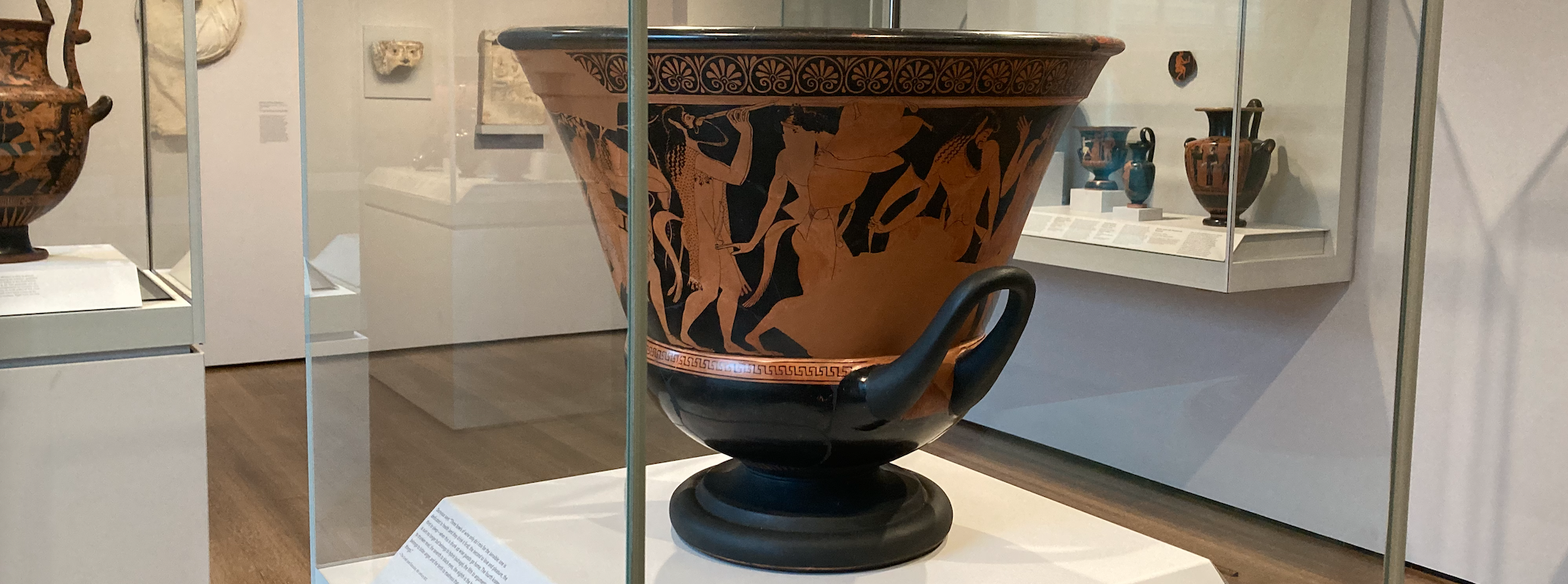
I discovered this quotation, attributed to the Greek Poet Euboulos, 4th century BCE, beneath the display of a humongous drinking vessel at the Harvard Art Museum. It is too pithy, too exact, not to have its own dedicated blog post:
“Three bowls of wine only do I mix for the sensible: one is dedicated to health (and they drink first), the second to love and pleasure, the third to sleep—when this is drunk up wise guests go home.
“The fourth krater is ours no longer but belongs to hybris (outrage), the fifth to arguments, the sixth to drunken revel, the seventh to black eyes, the eight to the bailiff’s, the ninth belongs to bitter anger, and the tenth to madness that makes people throw things.”
“Let Us make man in Our image, according to Our likeness; let them have dominion over the fish of the sea, over the birds of the air, and over the cattle, over all the earth and over every creeping thing that creeps on the earth.” – Genesis 1:26, New King James Version
I’ve always considered it the height of vanity to think that god made us in its image, and an utter lack of imagination to think that god looks like us. But then, I suppose the essence of all religion is the juxtaposition of hubris and ignorance. Creators of religions make authoritative pronouncements about where we come from, why we are here, and where we’re going based on fable and fictions, and then coerce their followers into venerating their vision as sacred truth.
Thus we wind up with passages like Genesis 1:26, proclaiming man’s dominion over the entire earth. By 2023, this impudence is leading directly to man pretty much destroying the gift we’ve been given, under the pretext that we have a god-given right to dominate this place, even if it destroys us.
Back up a few months to a quotation in The New York Times Morning Newsletter, November 22, 2022 about rejuvenated efforts to take us—once again—to the moon:
“If there is water on the moon, you can split off hydrogen from oxygen and make rocket fuel. Such a prospect would be transformative because the moon could be used as a base for deep-space missions without the cost and burden of lifting heavy rocket fuel off the Earth, which has six times the gravity of the moon. “Scientifically, that’s a cool possibility…and so people started getting interested in the moon again.””
In other words, when we’ve exhausted our capacity to inhabit this planet, we’ll move on to the next, extract what we can, and so on and so on. When does it stop?
The answer, of course, is that it doesn’t stop. And, even as I strive to make the smallest possible footprint upon the planet that nourishes us—not to mention the moons and the planets we’d like to deplete—I realize that it’s virtually impossible to live in balance with nature. The fundamental systems of our existence are based on extraction: taking from mother earth; taking from our fellow man.
And yet, although I strive, I don’t give in to despair. Because when our time is up, and man does himself in on this earth, and we follow the course of the dinosaurs before us, we will have had a good run. Once we’re gone, the earth will be able to repair, new forms of life will emerge. Maybe they’ll be more successful than us because they’ll find a way to live in balance. Unshackled by Genesis’ hollow proclamation of dominance, or even The New York Times promoting unsustainable follies into space.
When the city revamped Huron Avenue, they sunk granite curbs level with the pavement to define the crosswalks, an expensive yet elegant bit of urban dressing. On my meditative walks home from the gym, I often find myself tracking the granite as if I were an Olympic gymnast, one foot in front of the other. A simple bit of balance with no risk, as there is no place to fall.
The Olympic analogy is short-lived; I can’t pretend to be an Olympian for even a few moments. So my mind spins to other feats of folly. I recall the child actor Matthew Garber, who played Michael Banks in Mary Poppins. In a movie-instant that few probably recall, as Mary, Jane, and Michael depart 17 Cherry Tree Lane for adventure, Michael snakes around the porch column, rather than simply trod down the front steps. The image of that round-faced boy in his shorts suit and cap pivoting off that column stuck with me for years. I credit it as the inspiration for the Master’s thesis I wrote almost twenty years later: Architecture that Affords Play.
I savored that time: studying the psychology of play; analyzing how people interact with the built environment in unanticipated ways; creating over two hundred free-hand drawings back in the pre-Photoshop days of cut and paste.
Then my mind turns a dark shadow as I flinch at a more recent memory. The director I’m collaborating with on a new play chastised my working process. “Loosen up, play with it!” I explained to him that, as a person of engineering temperament, I know how to play like an adult— manipulating something I’ve already mastered—but find it wicked difficult to play like a child—who seeks mastery through open-ended exploration. Even when I was a child, I don’t recall playing like one. I don’t know if he ‘hears’ me, or believes me, but his words sting deep because I know all too well how my creative impulses are stymied by a rigid constitution that simply won’t things fly.
By now I’m approaching the next crosswalk. A dozen steps ahead, I see a woman pursuing my own indulgence: balancing herself along the granite strip of crosswalk. She’s older than me, but simply from the way her body jostles as she steps, I can tell she’s jolly.
I Mary-Lou-Retton my way across the street and greet my fellow gymnast on the far side. “I’ve never seen anyone else left-right-left across the street on the granite strip.” “I do it all the time; it’s good for my balance.” We laugh with each other and move on. Grateful to live in a city that can afford the indulgence of granite curbs where none are required. Thankful that we can still toe the line.
Ten years ago this month I completed the first great adventure of my life: designing and supervising the construction of two buildings in Grand Goave, Haiti following the 2010 earthquake that devastated that country. My work on the Mission of Hope School and Be Like Brit orphanage were the epitome of my architectural career, fusing built form and community need in a more potent way than in any previous projects. My time in Haiti brought me a fresh, humbled, view of our reason for existing on this earth, slowed me down, and created important connections that remain dear to me today.
Me, in Haiti 2012
No matter how we might otherwise prefer, when we reach out to fellow humans in distress, the person who can extend themselves almost always benefits more than the person they try to lift up. Perhaps this is because the challenges of the needy are more complex than we suppose. Perhaps it’s because economics and politics are so complicated. Perhaps it’s because despite best intentions, the gratification of giving exceeds the humility of receiving. That the giver so often falls short of alleviating the plight of the receiver does not mean that we should not attend to fellows in distress. Rather it means we should accept that the fruits of our labor may be less, sometimes much less, than we desire.
After the Haiti earthquake, the world showered the impoverished nation with attention, relief supplies, and money. Billions of dollars in humanitarian assistance. My own contributions created two sturdy reinforced concrete buildings in a community that had none. The school is a place where hundreds of children learn; the orphanage a place where dozens of children live; and each provide community-wide refuges from the tropical storms that so often batter Haiti. However, any objective analysis of the hundreds of thousands of dollars these two projects consumed would show that money could have better addressed more fundamental Haitian needs like safe drinking water or sanitation. Alas, it is much easier to raise money for an orphanage and a school than a septic system.
The hope of Haiti, 2012
Ten years on I can reflect how my time in Haiti changed my life, positively, forever. Unfortunately, I can’t report that the decade produced similar positive change there. Recent articles in The New York Times (11/27/2022: Link) and The Boston Globe (12/23/2022: Link) report a country racked by political instability, gang violence, economic deprivation, and rampant disease. Today, Haiti is more unstable than at any time since the earth rumbled, yet this time round, there is little international will to intervene. In fact, the international community is pretty much washing our hands of the mess.
What that means for Mission of Hope is that the lifeblood of their operation is gone; Haiti is too dangerous to bring in missionaries. Mission of Hope continues to provide basic services and education in Grand Goave, but their direction of growth is actually in the Dominican Republic, where a flood of Haitian emigree’s has created refugee ghettos in need of services in a place where Mission of Hope can safely bring volunteers.
Meanwhile, some of Be Like Brit’s orphans are nearly grown, yet despite having many educational and health advantages, they have no place to graduate to, in a country with virtually no economic promise.
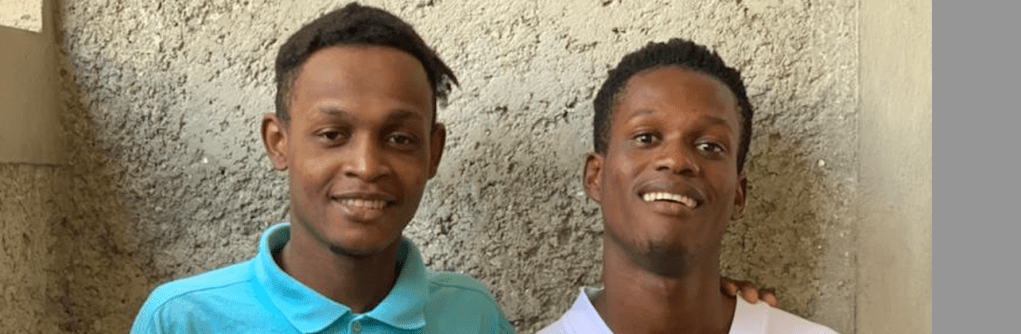
I am still in touch with several people affiliated with Mission of Hope; I still work with Renee and Lex and Gama and other central characters from Architecture by Moonlight on projects that maybe, someday, will become reality. I refuse to despair about Haiti, because one thing I learned from The Magic Island is the persistence of hope. Hope conquers all. And so I am happy to report that Dieurie, one of the boys I have sponsored for all of these years, is still making his way through school, and should actually graduate in two years’ time. Meanwhile, his younger brother, the mischievous Dieunison, who conquered my heart as a six-year-old, has been in and out of all kinds of trouble but at this moment is reunited with his brother and hopefully seeking a solid path to manhood.
Dieunison & Dieurie, 2022
I can’t say that Dieunison or Dieurie or Haiti as a whole are where I hoped they would be when I left ten years ago. But it’s not my position to pass judgment on any individual or nation. I must be content in believing that I made the place a little bit better, even if it seems I was the one who came out with the better deal.
Today Maura Healey is being sworn in as Governor of the Commonwealth of Massachusetts, and I am officially living in a one-party state. Nationally, I am represented by a Democratic President, two Democratic Senators (Warren and Markey), and a Democratic a Congressperson (Clark). At the state level we now have a Democratic Governor to work with our overwhelmingly Democratic legislature. Both my State Senator and State Representative are Democrats. Locally, Cambridge City Councilors don’t run with party affiliation, but every elected official in the People’s Republic is a Democrat, except for those who fly further left on the political spectrum.
Although I am registered Independent, my politics more closely align with Democrats than Republicans. So, I should be happy, right? I am…and I’m not.
I was weaned in a New Deal loving household under the mystique of JFK and bluster of LBJ. Of course we hated Nixon, but only because we always knew he was a crook. I didn’t truly appreciate Jimmy Carter until I lived in rural West Texas and saw him through the eyes of fellow farmers. Today, Jimmy’s the best ex-President we’ve ever had, and an important role model for me.
My real political education began during Ronald Reagan’s presidency, when I learned: beware of an ideologue at the helm. If they’re not your ideologue, you’re better off with a mere administrator. And if their ideology does align with yours, they will be sure to disappoint.
Massachusetts has a long progressive history. We also have a penchant for moderate Republican governors, who often serve as a kind of palate cleanser to our regular diet of Democratic largesse. Most recently, Charlie Baker, who served as governor for eight years, botched up the T and sold out on the prison moratorium, but he also notched up housing opportunities, kept his nose clean, and did an all-around credible job. Baker was consistently rated the most popular governor in America, and if he’d wanted a third term, he would most likely have won. But Charlie Baker was just as disenchanted with the direction of the Republican Party as those of us who have nothing into do with it, so he retired. The GOP nominated a Trump-clone who was rounded defeated. Thus, our state has no viable Republican voices; perhaps not even any moderate ones.
These days, Massachusetts is a great place for many, but not all. The economy is sound, mostly because our economic engine—brainpower—is in constant demand. The booms and bust of extraction, agriculture, or even defense spending hardly affect us. We are the best educated state by numerous metrics, yet we continually import more grey matter. People come here from all over the world to study, and many stay. I’m an example of that myself.
So, with all these progressive politicians, and this flush economy, we must be implementing all sorts of social changes, right? Livable wages, affordable housing, early education, racial accord, climate resistance, enlightened social programs. If only…
Although I am glad I live in Massachusetts over any other state, I am not ignorant of the blinders that constrict our potential. Yes, we have a $15 minimum wage, but that hardly matters in a place where the most basic apartment rents for $2000+ per month. Yes, we have great career opportunities, but we also have a hard underbelly of folks who cannot function in our job market. Yes, we have a tighter social net than most any other state, but we also have an expanding homeless crisis. Riding my bike through Mass & Cass reminds me of Port-au-Prince after the Haiti earthquake. No state that harbors such deprivation can call itself civilized, yet alone progressive.
After living in Massachusetts for over forty years I recognize that the most significant public policy advances have occurred under split administrations: where a Republican governor and the Democratic legislature had to hammer out hard stuff. That’s how Ed King managed to bend back the moniker, ‘Taxachusetts.’ It’s how Mitt Romney created the blueprint for affordable healthcare that eventually went viral. It’s how Charlie Baker crafted the first real change in zoning density in my lifetime, with actual teeth that are beginning to chomp down on cities and towns that don’t hop on the increased density bandwagon.
In theory, Governor Healey and her team will be able to work with the legislature to accomplish more. After all, they’re at the same party. Yet I fear that the Dems’ penchant for intra-party bickering, and the fat-and-happy idlement that comes with enjoying a supermajority, will actually yield fewer accomplishments then when we engage in opposing, yet civil discourse.
The opportunity for Governor Healy to make Massachusetts a more equitable place is tremendous. Yet every single-party state in the world—regardless of its ideological bent—must brace against the proclivity to stop listening, grow overconfident, and dance with tyranny.
Here’s hoping our new Governor flies above those temptations and turns the rhetoric of progress into meaningful change.
I want to live in a world where every baby is wanted.
I want to live in a world where every child is nurtured with love, self-control, and self-respect.
I want to live in a world where a parent who wishes, can stay home to rise their young child.
I want to live in a world where every child receives whatever they need to thrive.
I want to live in a world where children can just go outside and play.
I want to live in a world where the sound of ‘pop’ elicits wonder rather than fear.
I want to live in a world where every child attends a good, public school.
I want to live in a world where teenage imbroglios are addressed conscientiously in the moment and forgiven in the future.
I want to live in a world where gender expression and sexual expression are celebrated.
I want to live in a world where scholars are feted as athletes.
I want to live in a world that provides food and shelter, education and exercise, light and air to all.
I want to live in a world where opinions are voiced yet facts prevail.
I want to live in a world where every citizen votes.
I want to live in a world where human rights are universal, and individual rights require responsibility.
I want to live in a world where every young adult serves their nation in service.
I want to live in a world with universal basic income.
I want to live in a world in balance with nature, where we replenish whatever we extract.
I want to live in a world with more buses than cars; more trains than planes.
I want to live in a world with more bike lanes than motor lanes.
I want to live in a world in which building a family, a career, and a nest egg is spread out over longer, less frantic decades.
I want to live in a world where freedom of speech is coupled with responsibility for truth.
I want to live in a world where it’s easier to get nourishing food than debilitating drugs.
I want to live in a world where everyone can pursue the religion of their choice, or none at all.
I want to live in a world with an impenetrable wall between church and state.
I want to live in a world that promotes wellness rather than monetizes disease.
I want to live in a world that passes the mantle of power through generations, in peace.
I want to live in a world that engages its elders.
I want to live in a world that cherishes the memory of seven generations gone, and prepares for seven generations to come.
I will not live in that world in 2023, or 2323, or 23,023. Humans are the only species capable of shaping their own world, yet humans are also too selfish, short-sighted, and violent to ever create a truly just, equity and sustainable world.
Still, we must strive toward that vision. For though we may never achieve the world we want, we have the capability—and the responsibility—to improve the one we have.
Over the past two years I have enjoyed a unique relationship with a trans person. Let’s call them Burt. Burt is half my age; years marked by violence and isolation. What commonalities we share—each of us are fathers—are shattered by how those commonalities play out. I have an ongoing relationship with my two children; Burt has two children they’ve never seen. I am often at a loss in how to react to the conditions of Burt’s life, but since the winds of fate brought us together, I figure it’s my opportunity to try to understand someone so very different from me.
It is easy, natural, for humans to relate to their own kind. To find accord with those with whom we are already in accord. It’s more challenging to accept our opposites. And even more threatening, as in the case of transgender people, to acknowledge those who occupy some ambiguous, nebulous. nether world. Thus my overt wish to understand and connect with Burt is blocked by my evolutionary fear of that which we cannot fathom.
Then I recalled a story I wrote twenty years ago. Before trans-anything was a thing. The story is about a boy forty years even further back. A thinly veiled tale about: me. A pudgy boy, age eight, alone, locked in the bathroom, occupying himself in the mirror, with a towel.
The towel came undone.A roll of terry cloth fell down my back. It cascaded behind me like a cape. Or a veil. Or a train. I looked straight at the mirror. The swath of beige highlighted my glorious form. I bent my arms in without lowering my elbows. A sweeping arc in a horizontal plane. I tucked the towel across the top of my pale chest. The mirror offered an image I had seen before. A straight line rising slightly, across a field of snowy skin, tucked demurely under a pair of arms. I puffed my chest. I enhanced the reflection. The edge of the towel fell in a vertical line, just left of center. Falling over my nipple. Running through my heart. A detail of simple elegance flowing from my bosom, past the reality of the mirror, beyond the vanity. I stood before the glass, my skin bristling, stupefied by the beauty before me.
Hardly the words of a man fixed in his masculinity. I’m gay, but not fem. I’ve never wanted to be a woman. And yet…as a boy, standing before the mirror…I held a fascination.
That long-ago story I wrote about a longer-ago time offers me an arc of connection with Burt. Even more, it reveals how none of us are as simple as we suppose. No one is entirely straight, or gay, or cis, or trans, or libertarian, or socialist, or right, or wrong. Burt’s life is a history of chaos, and yet their hope for the future is unbounded. They refuse to be bound by simple definitions.
When our days are short and dark, humans need to be closer to each other. Thus, every tradition celebrates holidays this time of year. I hope we all celebrate by finding someone seemingly unlike us beyond the basic fact of human existence; our own personal Burt. I hope that each of us finds more commonality in our neighbors than we expect. Even more, I hope we celebrate each other despite our commonalities. Simply because we are all here, and all of us matter.
“Learning a new language is hard, connecting with other people is hard, leaving your homeland is hard, no matter where you are. Here, in the U.S., if you are not an English speaker, you are almost immediately stripped of your humanity, your ability to connect with others, your ability to be your full self.”
I read these program notes by Director Melory Mirashrafi while waiting for Speakeasy Stage’s production of English to begin. I already knew the premise of Sanaz Toossi’s play: four Iranian students and their teacher in a TOEFL (Test of English as a Foreign Language) class in Iran, circa 2008. Still, these notes clawed at my throat. Yes, learning a new language is hard. It is also revelatory. Connecting with other people is hard. Duh! Leaving your homeland is hard. True, yet a bit off, since the play is about Iranians in Iran; they may have left and returned or they may wish to leave, but in the play, they are in their homeland.
Then comes the clincher clause, “…in the U.S, if you are not an English speaker, you are almost immediately stripped of your humanity, your ability to connect with others, your ability to be your full self.” Hyperbole at best, provocation at worst. And…simply not true.
I have never been an immigrant, though I have lived in countries where I did not speak the language. I also tutor ESOL (English as a Second Language) to actual immigrants. When I was in Haiti, I had to communicate rudimentally, but the experience did not strip me of my humanity. On the contrary, it made me more appreciative of how challenging communication can be, and broadened my view of human possibility. Similarly, when I tutor Haitian immigrants in the States, the our language gaps force us to connect in a more conscious, direct way. As to how an immigrant compromises their ability to be their full self when they arrive in a foreign land with a foreign tongue, I might remind Ms. Mirashrafi that they were likely not able to be their full selves in their homelands. Thus, the decision to emigrate.
Perhaps it is not fair to pick apart Ms. Mirashrafi’s notes. After all, they are just one of so many examples of progressive ideals stated to a point so extreme that they negate the underlying good intention.
A digital notice at my gym the other day, sponsored by Bridge Over Troubled Water, stated that 1 in 13 children are homeless. A statistic so shocking, it is unbelievable. Bridge Over Troubled Water is a well-established and respected intervention program for runaway teens; and without doubt the homeless situation in our country is terrible, and getting worse. But I simply cannot believe that 1 in 13 children are homeless. That equates to two children in every classroom in America. When a statistic is so discordant from any perception, whether direct experience or indirect reading, the result is not to heighten awareness and concern for a problem. It results in us discounting the entire message.
Later the same day, I read an internet notice that 40% of all children in Massachusetts suffer food insecurity. To be sure, I do not suffer food insecurity. However, I work in a Food Bank, pack and deliver boxes to all sorts of folks in need. So I know that, despite living in one of the most affluent cities in America, hunger exists too often in too many places. But 40%—ten or twelve children in every classroom in America—is so incredible as to cast doubt. An internet search reveals that childhood hunger in America varies from 6% to 9% to 13% to 20%. Any of those percentages are too high for a nation that calls itself civilized, but none approach the 40% figure that was obviously heralded to capture attention.
I decided to explore the definition of ‘food insecurity” and discovered that, in many surveys, it is a self-described condition. A person with an empty pantry should surely describe themselves as food insecure. Then again, I met a person all agitated because Whole Foods did not have the array of lettuces she desired. Would they self-describe as food insecure?
Others may chide me that conservatives also exaggerate, often with even more outlandish statements and statistics. I totally agree. However, to quote my wondrous mother, “Two wrongs do not make a right.” Since I argue progressive points more often than conservative ones, I seek reasoning that’s valid rather than pumped up.
Each of these examples illustrate how progressives damage their own agenda through exaggeration, whether through inflated statistics of woe or by normalizing exceptions as the rule. When Bob Dylan sang, “I pity the poor immigrant who wished he’d stayed at home,” he connected with that particular immigrant for whom a new land, a new language, resulted in diminished humanity. He did not smatter that pathos over all immigrants. I wonder why Ms. Mirashrafi feels the need to do so when, to me, it dilutes her entire argument.
When the lights went down, I watched English. It’s a good play, though not as gripping as I hoped. Oddly, the play proved Ms. Mirashrafi’s notes even more inappropriate than my initial perception. On the surface, English may be a play about learning a foreign tongue. But it’s universal appeal is in five specific characters, striving to be their fullest selves, by making connection in their fullest humanity.
I came of age in the era of glamorous smoking. Forty-six percent of Americans—including nearly everyone that mattered—smoked cigarettes. I gave my parents curlicued ashtrays as birthday gifts. Their friends offered each other glittery lighters. And of course, everyone in the movies was cloaked in an alluring, smoky haze. When Lana Turner, or Bette Davis, or James Dean, or Dean Martin lit up, Joe Smoe in the mezzanine wanted to be just like them.
When the 1964 Surgeon General’s Report stated that smoking causes cancer, few even knew what a Surgeon General was. Suddenly, the title was on everyone’s lips. A few people stopped smoking immediately. Most tried and failed. Smoking cessation became a cottage industry. Habits die hard.
I can recall walking MIT’s infinite corridor in 1973 and seeing the American Cancer Society’s poster, “Smoking is Very Glamourous.” The impact of the slogan and its discordant image was immediate. Yet smoking remained socially acceptable and ubiquitous. As late as 1986, the guy at the desk across from me in a major architectural firm lit up all day long. But research on second-hand smoke rallied non-smokers to action. Within three years, the firm created to a ‘smoking lounge’ alternative that soon buckled into a full-on ‘no smoking’ policy. Smokers became pariahs, marooned on the bleak sidewalks of Boston winters.
More than fifty years since the Surgeon General’s report, our societal views on smoking have come full circle. Today, only 18% of Americans smoke, less than half as many as when I was a child.
What created this tidal change? Science. And publicity. In a consumer society, saturated with advertising messages, the fact that smoking causes cancer is not enough to change behavior. It took warnings on cigarette packages and decades of public service campaigns to change our understanding that “smoking is very glamourous” is an oxymoron, if not an outright lie.
Today, gun violence is killing too many of our fellow citizens, while stirring fear in the rest of us. No amount of dead Sandy Hook first graders, Columbine high schoolers, Orlando night club revelers, or Las Vegas concert goers can move the needle of gun control. Stats alone will not create the change demanded of this crisis. We need a public health campaign to change our collective perception of guns.
A recent article it the Boston Globe opened my eyes to how we are losing this PR campaign. Smith & Wesson used to target their ads to hunters and sportsmen. Now they focus on fear, and gun sales soar.
In 1964 people were shocked, shocked, to learn that a central element of our society was killing us. It took decades to turn the glamour of smoking on its head. In 2022 we know full well that a cornerstone of our democracy—the right to bear arms—has been contorted beyond reason. We witness the deaths caused by this violence, and are only beginning to understand the psychic toll all these guns are taking on our children and our communities.
Once upon a time we thought smoking was glamourous. Now we know it only causes cancer. Today we consume a steady diet of ads that proclaim guns make us safe, even as statistics show that owning a gun only makes you more likely to die by a gun. But humans are stubborn, irrational creatures, and facts alone won’t change our behavior. We need to counter the myths with a public health campaign and change our nation’s attitudes about guns. We know how to do it; we have done it before. We can do it again.