
I’m taking an autumn writing seminar sponsored by Mount Auburn Cemetery. Just for fun. Decided to share some of my assignments on the blog.
Assignment #2 – Write about a place that’s meaningful to you, and how it’s changed over time.
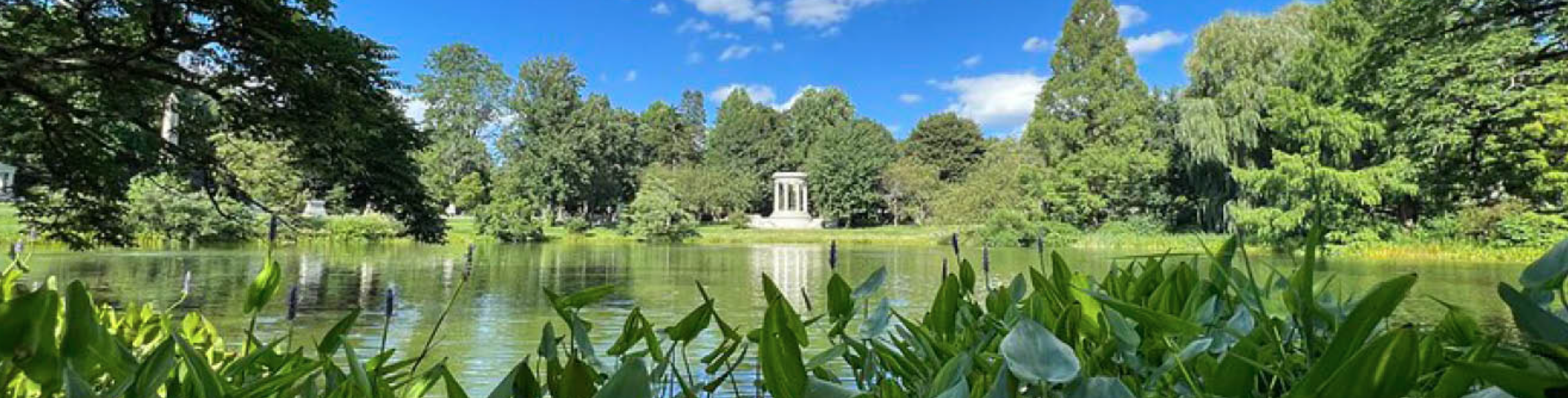
Mount Auburn Cemetery is man’s conception of nature: perfected. In 1831, a group of ‘founders’ (i.e. investors), purchased seventy-two acres of hinterland in Cambridge/Watertown with an Enlightenment vision to create a final resting place in harmony with nature. Instead of crowded burial grounds cramped in church shadows, Mount Auburn would a conscious landscape in which man would find eternal peace amidst purity, permanence, and abundance.
The original grounds, consecrated in 1833, were open to the public as a bucolic park. There were scenic buggy drives and serpentine walking paths, exotic plantings, an experimental farm, sculpted hills and contemplative ponds. Large plots, outlined by granite curbs, each featured a major monument and a dozen or more headstones.
Mount Auburn was an immediate success, and with success comes change. The experimental farm was abandoned for more burial space. A trolley line was built to accommodate throngs of visitors. A tower was built atop the highest peak, providing dramatic views back to Boston. The cemetery expanded to include 174 acres, more than double its original size.
When I first arrived to Boston in 1973, Mount Auburn Cemetery was a regional landmark which I occasionally visited. Twenty years later I moved only a few blocks away, and Mount Auburn became a regular refuge. My children and I enjoyed picnics under shady trees. We climbed the circular stairs of Washington Tower to be Lords of all we surveyed, pointing out our house, our school, our grocery store; in the foreground of the city beyond. I discovered the headstones of favorite citizens (Buckminster Fuller, McGeorge Bundy, Puzant Zildjian) and appreciated the architectural follies of Mary Baker Eddy and Isabella Stewart Gardner.
After I met my boyfriend Dave, our visits to Mount Auburn took on new dimensions. We loved creating backstories to the names, dates, and granite inscriptions. Who were brother and sister, husband, child, and wife? What happened to the dearly beloved who’s listed with a birthdate but no death? Is she still wandering the earth at age 147, or did she find other happiness in widowhood and lay down to rest elsewhere.
Dave, a botanist, helped me discriminate among the many varieties of shrubs and trees. We became ‘citizen scientists,’ tracking the bud/flower/leaf cycles of dozens of trees, some of which have been documented for over 150 years. Thus, this so-called permanent place becomes a gauge by which we measure climate change, as foliage seasons lengthen, and avian patterns reliant on that foliage adapt as well.
Although Mount Auburn does not change as dramatically as the surrounding cityscape, it’s a landscape in constant flux Over half its acreage is still available for burials, but Mount Auburn prohibits new individual markers, to help preserve greenery. New memorials are flush to the earth, or aggregated, or carved in natural features. As trees near two-hundred-year anniversaries, more become diseased. A mighty giant we documented through one growing season was gone the next. Sunlight now highlights gravestones long in its shadow.
Someday, Dave and I will lay side-by-side in this manicured ideal of nature. Perhaps my children will come and picnic with us there. The place will still be recognizable, though it will not be the same.


