Pool Paddle


A few years ago a friend of mine was minding his sister-in-law Adelaide’s son for the afternoon. The day was hot and sticky, so Mike took five-year-old Zach to a local pool. When it was time to go home, Zach ignored Mike and refused to get out of the water. Mike’s temper flared. In a pique of anger, he lifted Zach out of the pool and slapped the boy’s behind.

As quick as the impact landed, so too arrived Mike’s regret and remorse. They were not a family who hit their kids. Zach’s cry registered surprise as well as sting, though the sting was obvious: a red mark emerged beneath the boy’s bathing suit.

Mike told Zach he’d made a mistake. He apologized to Adelaide and her husband Tom when he took the boy home. Mike drove away, sincerely chastened.

The next day Mike was arrested. Zach’s parents had called the police and filed a complaint. Thus began the spiral of officers, attorneys, and social workers. Thus ceased civil contact between two segments of the family. As a white male without a previous record, Mike’s punishment was light: a fine; counseling; probation with the eventual possibility of a fully expunged record. Mike’s action prompted other changes. A long-time high school teacher, Mike decided to change careers for fear that his impulsive temper might flare in the classroom. And though Mike voiced consistent penitence, sometimes the consequences of that afternoon turned him belligerent, for however light his sentence might have been, it added up to a whole lot of wrath for a single slap.

At the time of the incident, my concern for my friend centered on his logistical challenges in navigating the criminal justice system. Mike completed the checklist of activities required for his punishment. By any objective measure the case is successfully closed: Mike will think twice before raising his hand again. Yet the rift between the two families has hardened.

The events chronicled here are true. Everyone’s name has been changed, even though no one is fully innocent.

Mike’s story came stampeding back into my head during a recent Zoom training about transformative justice. This summer’s agitation about police brutality has, belatedly, made me question how exactly police ‘protect and serve’ us. I’ve also begun to understand more deeply the structural flaws in a justice system premised on punishment. Under the guise of protecting the victim, we basically freeze the relationships of all parties to a crime at the worst possible moment. Restorative justice offers a positive direction; it seeks to bring parties together, address what transpired, and shape punishment in the form of amends. But transformative justice takes a step beyond. Transformative justice contends that the judicial system cannot address the root causes of criminality because it is rooted in a system that’s inherently unbalanced—the United States of America. Transformative justice empowers people to seek justice outside of existing systems. Not as vigilantes. As engaged neighbors and citizens, who mutually take care of one another.

As a white person living in a safe neighborhood, this idea is foreign to me. When we are harmed we call the police, and they ‘protect and serve’ us. However, that mindset does not apply to poor communities and communities of color. These sectors of our society don’t see police as a solution. Police represent the problem, and they represent it with guns on their belts.

As the ramifications of transformative justice sink into me, my friend’s tragedy has reemerged in my mind. Mike and I rarely talk about his abusive act and subsequent punishment anymore; or whether he misses teaching, hanging out with Adelaide and Tom, or watching Zach grow up. In Mike’s case, the police did the right thing: arrested a man who struck a child. They acted appropriate to their role from the moment they were called on the case.

But the precepts of transformative justice redirect the pertinent issue in this story. Why were the police called in the first place? Mike will never know what Zach told his parents when the boy returned from the pool; he will never see how bad that bruise turned, or why Adelaide and Tom decided to call the police. What he does know is that they chose to hand the situation over to the law rather than communicate directly with their brother-in-law.

Somewhere between the 1950’s and 2010’s we, as individuals and as a society, began offloading the difficult task of getting along and taking care of each other to government authorities. I pick the year 1950 only because there was no way, when this rather fat, clumsy, bullied boy was growing up, that my parents would call the police when a neighbor slapped my behind. No way. Yet in 2020 many Americans make a libertarian cry for less government and more individual freedom, and then defer a family dispute—serious, yet completely internal to the family—to the public arena.

We have grown to expect social agencies to provides services that families used to provide themselves. Our schools provide lunch, and breakfast, as well as a Friday backpack of weekend food for undernourished students; senior programs provide meals, social activities and rides to appointments. The same expectations apply more and more to our policing. Adelaide and Tom had every ‘right’ to call the police; their son had been struck. But what they did wasn’t right. It was safe, non-confrontational, even easy. In calling the police, they avoided the hard work of having to address a difficult problem within their own family. As a result, the family is permanently diminished.

Reshaping how the police protect and serve us—all of us—requires all of us to reconsider how we lean on the police. Call them less. Communicate amongst ourselves more. Even, especially, when it is difficult to do.

Posted in Uncategorized, United States | Tagged , , , | 1 Comment

Measuring Experience

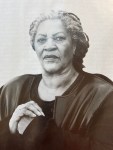
Toni Morrison once told Hilton Als that being a black woman writer is “…richer than being a white male writer because I know more and have more experience.” (The New Yorker, October 27, 2003).

Immediately upon reading that phrase, I recalled my grad school professor, Jack Myer, who had a penchant for expanding the contours of architectural education to encompass, well, everything. Jack once said, “The extent of any person’s experience is determined by only one thing: how long they have lived on this earth. The person who’s traveled wide has a certain kind of experience. The person who has lived quiet and constant has another. Each individual’s experience is different; there is no way to quantify or compare.”

Scott Fitzgerald’s antics informed a particular type of writing; Marcel Proust’s ruminations quite another. Can we say that F. Scott Fitzgerald had more experience? I don’t think so.

Most of us lead lives that ebb and flow between activity and contemplation. Marlene Dietrich was the world’s highest paid movie star, then a World War II heroine, then a Vegas chanteuse before spending the final twelve years of her life in isolation. Fading glamour may have been a factor in her decision to trade the experience of action for solitude, and her withdrawal from life was extreme; yet for many the trajectory of active youth and adulthood gives way to a natural slowing down and corresponding reflection.


When we experience periods of life lived intensely, our senses are more acute, time expands, we remember more specific detail. Fighting in war, demonstrating for peace, bearing a child, engaging in a foreign culture. Certain experiences etch deeper in our psyche. Four years have passed since I completed my year-long bicycle journey through the United States, yet I can still recall every day: who I met; where I slept; what I saw. But I’d be hard-pressed to tell you the specifics of three weeks ago Wednesday. That does mean I had ‘more’ experience then compared to now. The character of my days is completely different. Actually, the quietude of my present state allows me to continue to review and analyze that previous period of heightened sensation. Prior activity informs the passive state; the passive period graces the active with perspective.

At this moment, we are living through a collective time of diminished activity and interaction. The COVID-19 pandemic has lulled us into a pattern where every day seems the same. Many—most—of us are itching to get more active, more connected. Yet the experience of so much down time has intrinsic worth. For contemplation. For consideration. For every plant, animal, and ecosystem on our planet to breathe easier because we humans have slowed down.


It is presumptive of me to say that Toni Morrison chose a wrong word, but she did. Her writing is not richer than a white male’s because she knows more and has more experience. To proclaim to know more than another is elitist in its own peculiar way. Toni Morrison’s knowledge and experience is important because it’s singular, fresh. She delivers a voice not enough heard. A voice unencumbered by the assumptions and blinders of the dominant culture. Equivalent in experience and knowledge. Neither more than nor less than. Welcome and important. On par with every other human that carries the memory of how many years it’s inhabited this earth.

Posted in Uncategorized | Tagged , , , , | Leave a comment

August Recess

I received an email ripe with despair from an activist mentor the other day, her festering rage deflated by exhaustion and lost hope. Instead of rallying her to carry on, I took a different tack. Told her to take a break, relax, and reboot. There will be another day to sally forth, stronger.

The Awkward Poser, like most of us these days, is completely over sequestering and social distancing, hand washing and face masking—though he still does them all. He’s sweaty from a record hot summer—though it will likely seem cool compared to summer’s ahead. He’s fatigued from delving ever deeper into our nation’s systematic abuse of people of color, and frustrated by how difficult it is to change. And he’s totally over a country whose leaders teeter on autocracy while our morals plummet so far from mutual respect and caring, they dangle from a mere dollar sign.

If you share my exhaustion and that of my friend, take a break. Kick back and enjoy the joys of summer that come to all, regardless of virus-status or political inclination. Breath in all the good that nature provides. Sit in awe at an impressionistic full moon. Marvel at the sweet breeze. Appreciate the abundant daisies, warbling birds and howling coyotes. The earth is still a wondrous place, and humans are still its most wondrous creatures.

I wish everyone leisurely moments to bask in summer’s glory.

Posted in Uncategorized | 6 Comments

Let Equality Evolve into Equity

Equality is the foundation of a just society. In theory and in statute, everyone is equal in the eyes of the law even as, in practice, we often fall short. However, even if fully applied, strict equality will not deliver the optimal society.

Why? Because even though we may be equal under the law, no two of us are alike. What each of us can best offer—and what we most need—varies. Every person makes different economic, intellectual, and cultural contributions; each requires different benefits. Which is why, when I envision the world I’m working towards, I more often speak of equity. Equity is the foundation of a fair society: one in which everyone has the resources to become his or her best self.

The value of striving beyond equality—to equity—became clear to me while observing the most fair-minded humans I know: kindergarteners.

My two children are a rare breed; they actually grew up Cambridge. The city renowned for over 20,000 college students nurtures very few youngsters. Which is unfortunate, because I found their public-school experience excellent.

When my children were in grade school, I walked around the corner and picked them up from school three afternoons a week. Note the privilege of time, safety, and flexibility nested in that single sentence. Every time I entered the Haggerty School I was struck by the genial buzz of incipient chaos. The place bore no resemblance to the ordered silence of St. Joseph’s School, which I attended as a boy. I dismissed my incomprehension quick as it registered. I don’t pretend to know anything about progressive educational methods. What I did know was that my children seemed happy, curious, thriving. That seemed enough.

A quick chat with their teacher, greeting other parents, stopping at the mom-and-pop across the street for a snack. Collecting another child or two for afternoon play, or perhaps farming out mine own. Even at the time, our urban neighborhood seemed idyllic. In retrospect, it assumes the aura of dream.

It takes a lot of rules, discussion, and general gnashing of minds for a place like Cambridge to retain its progressive liberal chops. That’s particularly true in the public schools, which are integrated by race and socio-economic status. Every public grade school includes the same percentage of children of color and those who qualify for free lunch. This objective has led to a complicated system of magnet schools, neighborhood schools, and immersion schools. Before our eldest began kindergarten, we learned how the system worked, yet chose the simplest path: our neighborhood school.

The Haggerty School had a particular niche within the Cambridge system: a focus on mainstreaming that resulted in a high percentage of inclusion students. In the 1990’s, about quarter of Haggerty students had IEP’s (Individual Education Plans). From the start, my children’s classmates included autistic boys and Downs syndrome girls, as well as kids distributed by skin shade and household income. The great thing about this mélange of four- and five-year-old’s is that Kindergartener’s acute sense of fairness can figure out how to all get along much better than us jaded old folks.

Apropos of its inclusionary focus, the motto of the Haggerty School is: ‘Everyone is different. Everyone belongs.’ A simple statement that conveys that equity is more complex than equality. Even for kindergarteners, equity can be a tough sell. Everyone getting the same thing is clearly fair. Everyone getting what they need is fair in theory, but results in children getting different amounts: of attention, of latitude, of snack. Why Josie was allowed to behave in class differently than my son took a lot of explaining, on the part of his teacher, and me.

Which gets to the crux of why equity is so much more difficult to achieve than equality. If everyone’s inputs and outputs are not the same, who decides that they should be? If everyone’s needs are different, who decides who gets what?

This is the point where my ideology soars beyond the practical; where I transcend the history of human experience to reach beyond selfishness, avarice, insecurity, and fear. I believe that each person should be able to determine what they will contribute, as well as what they need. Rubbish? You say. Anarchy? Complete societal breakdown?

Possibly. Probably, in the short run. But consider this. If people truly believed there was enough to go around (which there clearly is) and that it would be distributed fairly (which it clearly is not), then we wouldn’t feel compelled to save and hoard. If we actually trusted that we’d take care of one another, we could stop reacting to each other in wary suspicion. If we could participate meaningfully in our society, we’d realize it’s healthier to be engaged than to be a passive consumer.

This is a distant dream. One that requires more than a complete overhaul of society as currently structured. It requires evolutionary rewiring to stop eyeballing each other in fear and instead abet each other in sympathy. It won’t happen in my lifetime, or in any of yours. But I’d rather strive toward a positive direction than capitulate to the divisive posturing of our current so-called leaders.

We live in a society that provides equality in theory, if too often in name only. Let’s work to lock that equality in and make it real for all. Then, let’s move beyond equality, and work towards equity.

Posted in United States | Tagged , , , , | Leave a comment

The Long Blue Line

“It shall not be lawful for any negroe or other slave to carry or arme himself with any club, staffe, gunn, sword or any other weapon of defense or offence, nor to goe or depart from his masters ground without a certificate from his master, mistris or overseer, and such permission not to be granted but upon perticuler and necessary occasions; and every negroe or slave soe offending not having a certificate as aforesaid shalbe sent to the next constable, who is hereby enjoyned and required to give the said negroe twenty lashes on his bare back well layd on, and soe sent home to his said master, mistris or overseer…that if any negroe or other slave shall absent himself from his masters service and lye hid and lurking in obscure places, committing injuries to the inhabitants, and shall resist any person or persons that shalby any lawfull authority be imployed to apprehend and take the said negroe, that then in case of such resistance, it shalbe lawfull for such person or persons to kill the said negroe or slave soe lying out and resisting.”

  • Virginia Slave Code, 1680

For over a hundred years now, the United States has fancied itself the standard bearer of freedom throughout the world, even as it maintained that illusion through military force.

At home, the land of the free—for some—was the built upon the oppression—of others.

The dichotomy between our ideals and how they’re practiced is at the core of historian Jill Lepore’s excellent article, “The Long Blue Line: Inventing the Police.” (The New Yorker, July 20, 2020).

The police’s stated objective is to protect and serve. Yet, how often they pursue that objective through violence against people—too often Black—who reside outside the dominant culture—defined by Whites.

It’s doubtful whether in protecting an elite subset of our population by inflicting violence on others, the police best serve any of us. Ms. Lepore’s article is necessary reading for anyone seeking to learn from, rather than repeat history. Because right now, events in 2020 too closely mirror Virginia’s Slave Code from 340 years ago.

Posted in Uncategorized, United States | Tagged , , , , | Leave a comment

STOP Trusting Polls

Independence Day is in the rear-view mirror. Labor Day looms, and with it, the final laps of this Presidential marathon.

Biden leads nationally by eight percentage points. Biden and Trump are tied in Wisconsin. Biden widens gap in crucial Pennsylvania. Biden ten points up in Texas. Every day the pollsters report more and more support for Biden. Do not believe a word of it.

Four years ago, as I bicycled the byroads of America, every poll indicated that Hillary Clinton would be elected our President. Right up until she wasn’t. The day after the election, Trump signs bloomed like dandelions on previously apolitical lawns.

What went wrong? The basic assumptions of American electoral politics, that’s all.

Consider the representative Trump supporter, circa 2016. All in for the guy who was going to Lock Her Up and Drain the Swamp. What do you tell a pollster who calls you on the phone, or pops up on your Internet feed? The most disruptive response you can conjure: “Hillary Clinton.” There was no upside in revealing the election booth truth, that you will pull the Donald’s lever. Much more effective to feed the media’s story line that Trump is a barely credible candidate, even as the media’s fixation on the man made him credible by dominantly covering him.

Hillary Clinton is not in prison, and unlikely to be there anytime soon. The swamp is still murky, even as the Trump International Hotel soaks in nefarious influence and greed. I don’t know what claims Donald Trump will make during his second Presidential campaign, though I suspect the man will do or say anything to succeed.

What I do know is, there’s still no reason for a Trump supporter would tell a pollster the truth about his or her vote. General disruption is better served in professing support for Biden.


Recent media stories describe how the ‘shy Trump’ effect was inaccurate, and that it does not apply this election cycle. As if, after misleading pollsters, Trump voters have any incentive to be more forthcoming to the social scientists who follow in their wake. More consistent stories report that soft-supporters of Hilary Clinton sat on their hands election day because her victory seemed a foregone conclusion. Thanks, in large part, to polls.

It’s time we ascribed polls to their quaint place in history. To a time when people accurately revealed their opinions and action. When speaking the truth was the default thing to do.

Posted in Uncategorized | Leave a comment

Painting Our Pandemic

““E pluribus unum,” a magnificent ideal, thuds on “unum” every day throughout the land.”

That sentence, in Peter Schjeldahl’s magnificent review of Edward Hopper: A Fresh Look at Landscape (The New Yorker, June 8&15 2020), stopped me short. Not just because it’s such a political statement for an art review. Also because it’s so true.

The review unfolds in a hop-scotch of art description and real-world bizarreness. Like when Mr. Schjeldahl confesses that he has not actually seen the exhibition he’s reviewing (due to COVID-19 lockdown). His review is based on the exhibit’s catalogue, and his memory of Hopper’s viewed past. “Once you’ve seen a Hopper, it stays seen, lodged in your mind’s eye.”

Of course, he’s correct. A photograph of a Jackson Pollack just conveys mess, while the tactile spread of actual, in person, paint unnervingly sucks you in. A reproduction of a Vermeer cannot convey the glistening quality of the real thing, hanging in the Rijksmuseum. But Hopper, flat and surrealistically accurate, maintains its power through the filter of page or screen.

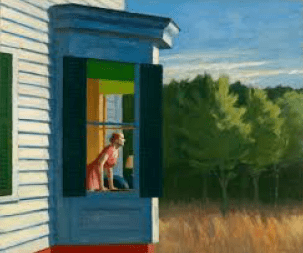
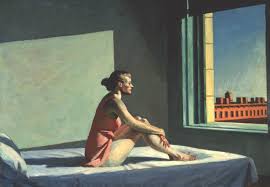
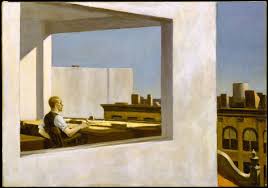
Often, Hopper paints us looking in on someone unaware of our intrusion. A person alone, so alone. A person made isolate by the fact of being so fully rendered. A person for whom the relative comforts of mid-twentieth-century American life leaves him or her exposed rather than comforted. Women liberated from their kitchens, ill at ease in broader habitats. Men equally awkward away from toil. Electric light so harsh, city structures so solid yet so constraining.

Even during the Depression, Hopper understood that solitude was the essential attribute of America life; an attribute that came into full flower only later in the twentieth century, when our unparalleled affluence made solitude available to so many. Stirred to autonomy and independence (in no small part by the corporate urgings of a consumer society) without regard for their consequence, we neglected to heed the aloneness inherent in Hopper’s paintings. We created the loneliest human society ever known.

“We are alone—together” is one of the many signs of hope we see taped to the inside of windows during this pandemic. I don’t buy it. If our uncoordinated, individualistic response to COVID-19 illustrates anything, it’s that we are not together. We are simply alone. With Edward Hopper, via catalogue, to illustrate that the mere comfort of shelter cannot salve the trauma of isolation

Posted in Uncategorized | 1 Comment

White Like Me

In 1993, at age 38, I came out to myself as a gay man. I know, I know, a long time coming. From then, things moved pretty quick. Within weeks I came out to my wife. After a month of raw hurt and private decisions, I began coming out to others. Once you’ve told your heterosexual spouse that you’re gay, all subsequent divulges are a cakewalk. However, I learned important lessons during my season of disclosure. Lessons pertinent to this period in which white people scour our relationships to people of color, our police, and our history. As we strive to be anti-racist.

The first thing I learned about coming out to anyone was: the coming out discussion was about them, not me. I had done the hard work, ripped out the screws in the floorboard of the particular closet I’d inhabited and figured out who I was. A few people were unsurprised, which made me wonder how convincing I’d ever been as a straight man. Some folks were accepting, which made me hopeful this redirection would not jeopardize our friendship. Others were immediately uncomfortable, and I knew I’d never see them again. Regardless the response, I was delivering a different picture of myself, one that skewed their perspective. I needed to be available to them.

The other thing I learned was, not to let others’ reaction sway you from known truth. It’s misleading to say I was in the closet. I was totally clueless about being gay. My good little Catholic boy blinders simply had never allowed me to consider it. Thus, the floorboard analogy to my closet. Still, when evangelically inclined family members suggested I attend conversion therapy, I did not follow their advice. Nor did I confront or condemn them. I chose to accept their advice as a gesture of love, however misguided, and let time tenderize their hearts toward me.

We are at a moment in this country where a good number of white people are inclined to hear, many for the first time, that we need to own our majority role in the oppression of people of color, and actively work to change the structure of the society oppression built. We need to listen to James Baldwin; we need to heed Ta-Nehisi Coates. We need to change our economic, education, judicial, and social systems to create equity. And we need to do it now.

It’s important—necessary—for people of color to be in our face. To confront and demand. To shock us out of our complacent illusion of control. Confrontation always attracts attention, but it may not always win hearts and minds. And so, once attention is paid, it can be prudent to discuss and persuade using messaging that aligns with the listener’s preferred receptors. Personally, I find James Baldwin’s arguments stirring, while Ta-Nehisi Coates more difficult to digest. Different styles resonate among different individuals. (Others might say, ‘different strokes for different folks,’ but that phrase is not authentically me.)

In this spirit, I recommend the documentary White Like Me to every white person who has begun to wonder if, just perhaps, the way we live and the benefits we enjoy are borne, even a little, on the back of people of color. The narrator, Tim Wise, is a white guy who analyzes how our society benefits white people, in a direct PBS-documentary style. There’s nothing confrontational about the program, almost no ranting. But the facts that it enumerates are clear and compelling.

Some may feel that it’s a cop-out to present the case against white dominance in a format that caters to whitebread sensibilities. I disagree. White Like Me does not illustrate the rage of Black experience. It possesses none of James Baldwin’s articulate anger. But it can be a starting point to shift white complacency into engagement.

The first book I read when I came out, Andrew Hollaran’s Dancer from the Dance, became my gay guide, my Gatsby, steeped in the excitement, possibility, and loneliness of gay experience. But it was not the book I recommended to friends and family who wanted to know more about being gay. To them, I recommended Robb Foreman Dew’s The Family Heart or perhaps Paul Monette’s Becoming a Man. Easier to digest, accessible, yet still accurate.

That’s how I view White Like Me. It is not the definitive answer. It does not convey the trauma of Black experience. But it is a bridge that leads in the right direction.

_______

White Like Me is a production of the Media Education Foundation. It is available to stream for free via Kanopy, through your local public library. White Like Me is also available for rent at this Vimeo link and for free through this Vialogue link.

Posted in United States | Tagged , , , , , , , | 4 Comments

The Pandemic We Deserve

It is a truth universally acknowledged that in a democracy, we get the government we deserve. Hence, our complacent, morally bankrupt, money dazzled, education-scorning, science-doubting electorate selects Donald Trump as our President.

Over the past few months I have considered the potentiality of another universal truth: that we get the pandemic we deserve. Given the latest increase in coronavirus cases in a nation whose leaders—and citizenry—refuse to acknowledge the rudimentary action required to flatten the curve, the analogy is even more apt.

Consider the granddaddy of all plagues. The Black Plague is said to have killed over half the population of Europe in its first eruption (1346-1353). Then, it kept cropping up with various permutations for the next 400 years, killing 100,000 or so in London in 1665-1666, another 100,000 in Marseilles in 1720-1723. For those who survived, society was drastically altered: the reduced population led to the end of serfdom; the lack of cheap labor spurred the drive for technical innovation.

The American plagues of the sixteenth century were grotesquely effective. European explorers handily killed up to ninety percent of the indigenous people of Central and South America simply by showing up and spreading their germs. Fire breathing dragons could hardly have been more effective conquerors.

The last plague with statistically epic deaths was the Spanish Flu of 1918, which infected about five hundred million people, and killed a hundred million of us. Many more people died from Spanish Flu than in the Great War. The flu’s scope was truly global thanks to returning soldiers, who brought home an unwanted souvenir.

More recent epidemics: AIDS, Swine Flu, Ebola, Zika have distinctly different, boutique flavors. Although they each has the potential for catastrophic spread, their singular means of transmission or particular origins of outbreak, enable many of us to differentiate ourselves from those most infected—gay, African, poor, whatever. The Plague of the Middle Ages brought contagion and death to all. Whereas folks who fall outside the demographic ‘risk groups’ of AIDS or Ebola can feel immune. Worse, they can draw a dividing line between ‘us’ and ‘them’, and stand in judgement of the infected.

Our current pandemic, COVID-19, is a fascinating hybrid of plagues past and present, with a few unique twists. Like The Plague, coronavirus is easily spread through a universal body function: all humans must breathe. Like the Spanish Flu, it spread with global speed, thanks to our interconnected world of air travel. Ironically, the first wave beyond China hit mainly affluent people: those with the means to fly. However, within a short time the virus settled in primarily among the poor, the aged, the vulnerable, the imprisoned, and the lowest paid among us: euphemistically relabeled ‘essential workers.’ The more you suffer the Twenty-first century diseases of poverty: obesity, diabetes, asthma; the more risk you bear for COVID.

The peculiar aspect of COVID-19 that I find most compelling as the pandemic of our time is that, compared to the great epidemics of the past, this is not a major killer. Cambridge, MA, where I live, was the site of one of the first major outbreaks on the East Coast—a conference at Biogen where a dozen or so people became infected. Three months later, about one percent of our city’s citizens have tested positive, about 10 percent of them have died. A plague that kills one/tenth of one percent of the population hardly registers on the scale of the great plagues’ past, yet it represents a significant increase in mortality in a society where people’s expectations of living long, healthy lives are magnitudes greater than those of our medieval ancestors.

In addition, this coronavirus has a relatively long incubation period, and asymptomatic carriers may transmit the virus. These attributes lend a heightened anxiety to the disease. Statistically, any individual is unlikely to contract COVID-19. And if I do, I am unlikely to die from it. However, two million infected Americans is a heck of a lot of people, and being one of them renders statistics irrelevant.

Thus, the novel symptom that coronavirus inflicts upon us more than almost any previous plague: anxiety. It’s difficult to weigh the benefits of precautions required to avoid catching the virus against the deprivations those precautions impose. I’m not talking about me, an affluent retiree who can just stay at home; or people going to bars and restaurants, baiting fate in exchange for a few laughs; or the inconsiderate guys who run around Fresh Pond without a mask. In a country with a threadbare safety net, too many folks have to choose between work and safety. For the people who already have the meanest opportunities in our country, coronavirus presents a new level of ugly choices.

Misinformation, the hallmark of America’s divided society, fuels our coronavirus anxiety. If half of us were dying, as during the Black Death, even Republicans might be forced to take notice. If only a despised demographic caught the disease, President Trump would find a way to simply sidestep it, as President Reagan did throughout years of AIDS.

But COVID-19 is an awkward, middle-ground plague. The virus kills a high number of people across a disproportionately marginalized demographic, while it also spreads enough dread and death throughout the entire population to demand notice. A pandemic whose impact on our physical health is notable, whose impact on our mental health is huge, and whose ability to bridge the chasm our divided, self-involved nation is—apparently—nil.

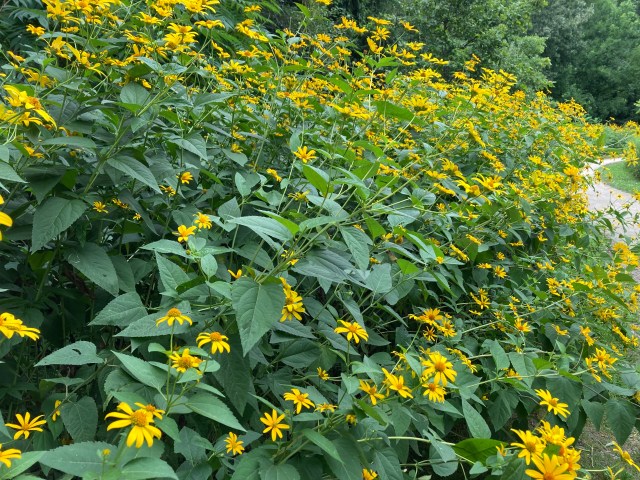
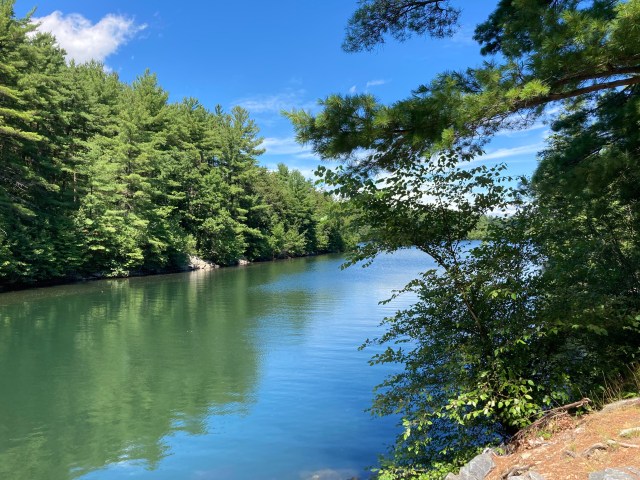
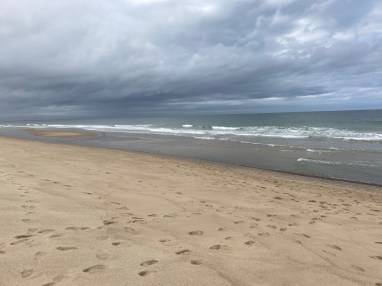
Note: Photo images are from Cape Cod MA; Miami, Florida; Galveston, Texas; and Southern California, in that order.

Posted in United States | Tagged , , , , | 4 Comments

The Optics of Equity

First thought when I learned that Boston University is planning to reopen its campus this fall with an intensive COVID-19 testing policy that includes testing students as often as twice a week was: WOW! BU is handing one juicy plum to folks who thrive on needling the educated elite.

Is there any group, no matter how much direct COVID contact they have or how essential to our society they might be, that gets tested that often? I am hard pressed to consider college students in any essential or high-risk category, except maybe due to dangerous behaviors undergraduates have been known to inflict upon themselves.

Second thought was to check my reaction. Instead of projecting the reactionary spin BU’s effort could trigger, maybe I should actually learn about the plan. So, I did something atypical in our current media environment: I went to the source and read articles in BU Today that describe BU’s plan.

Boston University is trying to open its campus in the fall, which is a positive desire, if it can be done safely. To that end, they are creating a huge COVID-19 Center, where BUs 30,000 students and 10,000 faculty and staff can be tested, contact traced, and quarantined as necessary. The plan seems well-thought out; it might even be effective. It certainly will be expensive. But a school whose tuition and fees are well north of $50,000 per year, and whose average student cost, after aid, is over $37,000, must be willing to spend money to keep that income flowing. And they must demonstrate their advanced state-of-the-art precautions will protect Jill or Johnny, or face the wrath of parents who folk over big change only to find their kid gets sick.

Unfortunately, learning more about BUs plan did not make me any more comfortable with its optics. Higher education is, by definition, elitist. Hence the adjective ‘higher’. So when a university decides to invest in a level of protection for its students and staff that is far beyond the (rather pathetic) norms of our society, it would do well to unveil the plan with at least a nod to equity.

First, BU needs to acknowledge the fact: what it is proposing is well beyond the norm. Then, BU could convince us that their program is valid for reasons beyond the unstated (that BU students and staff are somehow better…more worthy…than others). Perhaps BU could use this as a research project—a laboratory to understand the effectiveness of intense testing and scrutiny. Perhaps BU could announce it’s establishing similar testing and tracing endeavors to serve other segments of our society: meat packers; housekeepers; low-income communities of color. Perhaps it could do both: set up COVID centers to serve various communities, including BU, and compare/contrast the results.


If BU led with the idea that it’s going to use its capacity as a deep-pocket research institution to implement and analyze COVID investigation and testing strategies, (and, oh, by-the-way our own students will be included in the study), the optics of college students getting tested as often as twice a week in a society where some struggle to be tested at all might not sting quite so bad.

I realize that BU is not an isolated example, colleges and institutions all over are looking out for their own before others. But in a state where people with lower income, darker skin, and less education contract COVID-19 at three to five times the rate of affluent white people, it’s time to start calling out inequities wherever they occur.

In an ideal world, the resources and capacities of a place like Boston University would be available to all. Anyone who wanted a COVID-19 test could get one, and we’d do enough broad-based testing to infer useful attributes of the disease. Unfortunately, that’s not the world we live in. For too long, universities have espoused the notion that as aspirational institutions they are apart, but not above, everyone else. But in this era of optical scrutiny, that perspective does not hold steady. BU needs to put forth a message that transcends protecting its own students (and income stream). It needs to find a way to spread what it does and what it learns across a broader spectrum of society. By taking such intensive care of its own—and only its own—BU justifies claims that higher education serves only the elite.


Posted in United States | Tagged , , , | Leave a comment