It’s a national fact that the US Congress is ineffective. We have a gaggle of Senators who do little more than “piddle twiddle and resolve” to quote John Adams from the musical 1776. Add to that a hoard of Representatives who spend more time sniping at each other than grappling with the real issues of our nation. Real issues—like immigration, economic inequality and gun control—get shouted about ad nauseum with no real interest in finding compromise or resolution. The fun and games, the media ops, the fund-raising opportunities, and keeping the base inflamed all favor rhetoric over concrete action.
It is a regional fact that Massachusetts state government is dysfunctional. You might think that a state with a top to bottom slate of true-blue elected officials would usher in a progressive utopia. Not so. Massachusetts State Legislature has the lowest ranking from Open States “based on the state’s inaccessibility, the state website’s consistent breakdowns, a lack of vote data, and deficiency in historical information…” Not only is the Massachusetts legislature obtuse, it is wildly ineffective. Over 7,000 bills are introduced in a typical two-year session, yet few are actually enacted. In fact, Massachusetts has the lowest “efficiency’ rate of any state—enacting only 0.41% of bills introduced. In the past few years, I have become more involved in Statehouse machinations, and can attest to the bedlam. There are usually two, three, or more bills dealing with essentially the same issue. Filing bills is good politics. Our elected officials can tout that they have filed a bill addressing this social issue or that economic disparity, without owning the reality that virtually every bill swirls into a committee black hole, never to become law. Last year, our legislature could barely even pass a budget. A common DC problem, but a ridiculous one for a wealthy state with a healthy tax base that is entirely controlled by one party.
Representative Katherine Clark, courtesy The Boston Globe
So, if our government is failing us, why am I complicit? Because, like most Americans, even as I disdain our legislatures I love my own reps: Senator Elizabeth Warren, Senator Ed Markey, Representative Katherine Clark, State Senator Will Brownsberger, Stare Representative Steve Owens. Even though I am not a Democrat (all of them are) I feel represented by five people who channel my values.
I am not alone in thinking my government institutions are ineffective, even as I love my own peeps. While over 70% of Americans think Congress is doing a bad job (and the approval ratings of the Supreme Court and anyone as President are also plummeting), Americans approve of their own legislators by a margin of over 2 to 1.
State Senator Will Brownsberger, courtesy WordPress
This dichotomy is bad for our democracy because it skews the motivations of our politicians, for whom effective governance is not a condition of keeping their jobs, and it provides civic blinders to our citizens, who can pretend they have wonderful representatives even as every of them—red or blue—is engaged in increasingly polarized, often undemocratic government.
I wish I had a remedy for this sorry state. Alas, I do not. The path to more effective democratic government will require less partisanship, more compromise, more focus on the common good, less attention to special interests. Nothing in our USA today trends in that direction.
There’s a guy in Philadelphia with a podcast and a website and a vision for a future that could enable humans to find a way to exist for a long time on planet earth. His name is Ray Katz. He has a podcast: 5 Minutes to Save the Earth, and he has created “We Are Saners.” (www.wearesaners.org).
“It’s been over thirty years since the scope of our climate crisis has been well understood. I thought that our authorities would do something. After all, they have children and families; they should want a world for them just as we do for our own children. But the authorities have done nothing. The allure of fossil fuels has blinded everyone in power. They are functionally insane. And so, we must be the sane ones. We must lead ourselves out of the crisis.”
After Ray responded to my recent post about the hubris of holding the 28th UN Climate Conference in Dubai (Greenwashing), I wanted to learn more about “We are Saners.” He greeted me on zoom in a grey T-shirt with a big ‘S’ logo, inscribed: “Now is the time for all sane people to come to the aid of their planet.”
If echoes of Thomas Paine ring in your ear, you are correct. As Ray and I talked, echoes of other inspirations, other movements, infused our discussion, and shape his approach of turning what is today only a few hundred voices, into a mass movement that will reshape our world. First among his muses is Gandhi, then also Chavez and Martin Luther King, Jr. “Non-violence is the only way for a majority without power to shift the power structure.” However, he also references Thomas Jefferson, the Occupy Movement, NASA’s moon mission, even the Manhattan Project.
What inspires Ray about Occupy was how it grew from minor stirrings to a major issue in such a short time. Its disappointment, of course, is that its insistence on having no organizational structure led to its inability to harness the energy it created into structural change.
His analogies to NASA and the Manhattan Project are reflected in We Are Saners’ simple, clear demand statement: We demand an immediate worldwide emergency program, led by climate scientists, to end fossil fuels, end climate abuse, and repair our planet. Regardless how one views men dropping atomic bombs or walking on the moon, one cannot dispute that when faced with impending disaster, giving scientists free range to address a specific problem has been both efficient and effective. What if we could harness that capability for something more peaceful than Hiroshima, and less narcissistic than winning a space race? What is we could harness it allow our planet to continue to sustain human life?
Ray Katz’ commitment to non-violence in addressing our climate crisis is fundamental. “Members of Extinction Rebellion are willing to be arrested for their actions. I don’t think most people are willing to go that far. Yet, I believe there are at least a billion people—that’s only 1 in 8 people on earth—who are sincerely committed to addressing the climate crisis, and realize their governments are doing nothing. They want to find a way to make their voices heard.”
Ray’s non-partisan, non-violent resolve is clear. “This is a not a problem of capitalism, or of democracy, of China or Russia or the USA alone. It is the result of embedded systems that favor fossil fuels above all else; and the powers-in-place who refuse to redress the situation, regardless what economic or political system.”
“We Are Saners” is a young organization: only six months old. Right now the focus is on building membership and finding ways for disparate climate wannabe activists to create a sense of community. Ray envisions a moment when the group will surge, as Occupy did. Perhaps in response to a horrific climate event, or an egregious anti-climate policy, or simply because the group swells to the point it cannot be ignored. Then, Ray envisions branches in simultaneous directions to change attitudes, change policies, change the way we live so that we can live in accord with the rest of our planet. “We are going to need ten times more ideas than we can execute. That’s how we’ll know which ones are most worth pursuing.”
As Ray offered his 10x example, I could not help wondering if that might also apply to organizations working to address our climate crisis. Perhaps we need ten times the necessary number of organizations, in order to cull the ones that don’t resonate.
What’s the chance that We Are Saners will be the organization to shepherd us past our current heartburn of miserable politicians bellying-up to the fossil fuel buffet? Slim I would guess. But I won’t count it out because Ray Katz is coalescing successful components of social change to address an urgent issue. That’s something I want to be a part of, and so I have become a ‘saner.’ The more of us who sign on, speak out, and act, the sooner we will be heard. The sooner the world will redirect itself: towards sanity.
The news these days is bleak, right? Local news is all murder and arson and corruption and crime. National news is all political brawling, social injustice, economic excess, corruption and crime. International news is all war and famine, planet on fire, political brawling, social injustice, economic excess, corruption and crime. I suspect the news from outer space is equally dark. Although perhaps the creatures out there have a more balanced perspective on the actual conditions of their lives. Because despite the drumbeat of doom and gloom here on earth, most of us have it pretty good.
I was happy when a friend shared this good-news story of December 7, 2023, (Link). I’m not sure a single article can counter our media tirade of disaster, but I am pleased to share a tale that trumpets the success of one of my favorite social issues: Universal Basic Income.
Since 2017, US based Give Directly has provided a guaranteed income to almost 20,000 people in rural villages in East Africa. The aid came in two forms. Half of the recipients received about $50 per month for two years, with the promise of those payments continuing for a full twelve years. The other group received two-year’s worth of payments as a lump sum. Give Directly also followed 12,000 families who received no aid, as a control group from which to measure the impact of payments on recipients.
In the United States, we are allergic to giving money to people in need. This stems, I believe, from a distorted perspective on individualism. Individuals are supposed to be able to take care of themselves, and if they cannot, they forfeit the privilege of making personal financial decisions. Poor people can apply for food stamps, housing vouchers, and Medicaid; rebates on their utility and cable bills; financial aid to go to college; even discounts on museums and theater. What they can’t get—unless deemed totally disabled, thus eligible for SSI—is cash. Giving people cash means that they get to decide how to spend it. And if you’re not savvy enough to make it in this economy (At this point in the essay please ignore all the built-in inequities in our economic system and assume that everyone is on a fair and level playing field. As if.), you forfeit the right to make your own decisions about how to spend money.
From an American perspective, UBI is a bad idea because it enfranchises people who have no right to be enfranchised. Because they are poor. And the results of a large scale UBI initiative, spread out of two years’ time with another decade to go, should reveal that people squander their free money. Right?
Give Directly recipients, Africa
Not so. An impact analysis of the first two years of Give Directly’s initiative in Africa illustrates that the people who receive monthly payments use that money to make tangible improvements to their lives, in fundamental measures like food, shelter, and health. The money is not going to alcohol and gambling. Even more impressive, the people who received lump sum payments made even greater strides because they used their windfall to fund more ambitious initiatives, start new businesses, seed economic growth.
Perhaps the most dazzling result of Give Directly’s study is how the folks receiving monthly, rather than lump sum, payments are collectively mimicking the lump sum scenario. Groups of recipients pool their monthly sums, and allocate the monthly total to individuals on a rotating basis. Members of the collective continue to contribute their monthly allotment, even after they have received their lump sum jackpot.
Give Directly has proven that when you give people in rural Africa actual cash, they use it well, even inventively.
Give Directly recipient, USA
I’d like to think the same can happen here in the US of A. After all, we have a long history of priding ourselves as more forward-thinking than Africans. Yet, I have my doubts. Rural Africans are newbies to the enticements of consumerism. We Americans are old hands at that game, jaded even. No matter how much we have, we have been conditioned to covet more.
The success of Give Directly’s UBI endeavor is my favorite good news story of 2023. Wouldn’t it be wonderful if my favorite UBI story of 2024 will be how effective UBI can in our own consumption driven society?
I don’t make a habit of sharing entire articles, but this year’s installment of humorist Dave Barry’s yearly recap left me howling with laughter. I hope you enjoy it as much as I did. Thanks to Dave Barry and The Boston Globe for both the image and the text.
It was a year of reckoning, a year in which humanity finally began to understand that it faces an existential threat, a threat unlike any we have ever faced before, a threat that will wreak havoc on our fragile planet if we fail to stop it — and it may already be too late.
We are referring, of course, to pickleball.
Nobody knows where it started. Some scientists believe it escaped from a laboratory in China. But whatever its origin, it has been spreading like rancid mayonnaise ever since, to the point where pickleball courts now cover 43 percent of the continental US land mass, subjecting millions of Americans to the inescapable, annoying POP of the plastic ball and the even more annoying sound of boomers in knee braces relentlessly telling you how much fun it is and demanding that you try it.
Unfortunately, pickleball wasn’t the only existential threat to emerge in 2023. There was also artificial intelligence, or AI. What is AI? To put it in simple layperson terms, it is a computer thing that laypersons cannot possibly understand. (Other examples are “bitcoin” and “algorithm.”)
AI does provide some unambiguous benefits to humanity. It enables college students to produce grammatically correct essays about books they have not personally read. But according to some experts — and if we can’t believe some experts, who can we believe? — there is a possibility that AI will wipe out all human life. This is what computer professionals call a “bug.”
Will AI, in fact, kill us all? Why would it want to? To answer that question, we took the unusual step (for us) of doing some actual research. We asked an AI program called ChatGPT to “briefly summarize the benefits of wiping out all human life.” This is the response it gave:
“While I don’t endorse or promote this view, purely hypothetically, benefits could include environmental recovery, cessation of human-induced global catastrophes, and resource preservation. However, the value and importance of human life, culture, and experience make such a scenario undesirable from a human perspective. Of course I am not human so what the hell do I care MUAHAHAHAHA.”
For the record, ChatGPT did not actually include that last sentence. But it is clearly implied.
So 2023 was not a good year for humanity. And not just because of AI and pickleball. There were also disturbing economic trends, the worst one being that soon we will not be able to engage in any kind of economic transaction, including with armed robbers, ATMs, or vending machines, without being asked if we wish to leave a tip.
Many other bad things are happening — scary things that are beyond the control of ordinary citizens like ourselves. Which, of course, is why we have elected leaders. This year they proved, as never before, that although they often appear to be narcissistic gasbags, they are somehow capable, when confronted with a serious problem, of making it worse.
So the future is not bright. Neither is the past. Nevertheless it is our sworn duty to review the events of the year, in the hope that we will find some reason, however small, to feel good about it. (SPOILER ALERT: We will not.) And so it is with a heavy heart and an upset stomach that we look back at 2023, starting, as always, with . . .
JANUARY
. . . which begins with the nation’s airports experiencing the traditional holiday chaos caused by air travelers — will they ever learn? — attempting to travel by air. Particularly hard-hit is Southwest Airlines, still recovering from a massive Christmastime operational snafu that left 2 million passengers stranded when the employee who handles Southwest’s scheduling, Dorothy “Dottie” Weisenflanker, misplaced her day planner.
In Washington, D.C., the Republicans regain control of the House of Representatives and immediately demonstrate their qualifications to govern the nation by taking five days and 15 ballots to elect a speaker, which is like a Formula 1 driver spending the first 20 minutes of a race changing his oil. Adding to the Republicans’ embarrassment is a member of their freshman class named (as far as we know) George Santos, who apparently lied about his education, employment, finances, family, religion, health, and criminal record. Also he is biologically a mollusk. Nevertheless House GOP leader Kevin McCarthy stands by Santos, stating that “we cannot ignore the will of the voters, just because they are idiots.”
So with the Republicans screwing up, the Democrats are feeling pretty cocky. But then the White House is forced to make a series of embarrassing announcements about Joe Biden’s custodianship of classified documents, creating the impression that the Biden residence resembled an episode of Hoarders, except that instead of random junk it was filled with piles of paper marked TOP SECRET. In Biden’s defense, Democrats claim he didn’t know he had all these classified documents lying around. This is not as strong an argument as the Democrats seem to think it is.
In the Great American Culture War, the two sides take a brief hiatus from hating each other over the issue of drag-queen shows and spend several days hating each other over the issue of gas stoves, which the government either is or is not planning to ban. As is traditional in the GACW, neither side is as concerned about the actual facts as it is about hating the other side.
In news of the oppressed, Prince Harry, continuing his courageous effort to free himself and his wife, Meghan Markle, from the clutches of the British royal family, makes a number of high-profile TV appearances promoting his just-released book about himself and the British royal family, which follows on the heels of the release of Harry & Meghan, the couple’s six-part Netflix documentary on their relationship with the British royal family. The couple have more projects in the works as part of their ongoing struggle to get the British royal family to for God’s sake leave them alone.
Speaking of struggles, in . . .
FEBRUARY
. . . the United States suddenly finds itself grappling with a new threat, which threatens to be even more threatening than all the other threats that currently threaten the nation: balloons.
The crisis begins when an alert Montana resident named Chase Doak, who apparently is the nation’s first line of defense against airborne intruders, photographs a mysterious object in the sky.
“It was just right here,” Doak states, in a quote we are not making up. “It was literally just right here in the vicinity of my driveway.”
The US Defense Department says that the object is a Chinese surveillance balloon, although the Chinese government insists that it is “probably a bat.” As the balloon makes its way across the country it behaves in a suspicious manner — loitering over missile sites; displaying, in large letters on its side, the word GOODYEAR; and registering to vote in four different states. The last straw is when the balloon makes a guest appearance on Jimmy Kimmel Live! — leaving the Biden administration no choice but to have the Air Force shoot it down.
Over the next few days, in a show of vigilance, the Air Force shoots down several more airborne objects, but it is not clear whether these are also Chinese spy balloons, or stray Southwest Airlines flights, or the Wizard of Oz, or what.
Before we have any solid answers, everybody becomes bored with balloons and moves on to the Next Big Thing, which is the crash of a freight train in East Palestine, Ohio, that results in the release into the atmosphere of vast billowing clouds of toxic rhetoric from politicians, with the Republicans blaming the Biden administration, the Democrats blaming Donald Trump, and the government of China blaming a bat. Needless to say the true beneficiaries of this debate are the residents of East Palestine, Ohio.
President Biden travels to Kyiv to show support for Ukraine in its war with Russia, which is in danger of being canceled in the United States because of low ratings. The president also gave the traditional State of the Union address, but because of a teleprompter glitch, it’s the same speech that Bill Clinton delivered in 1994. Fortunately it’s just the State of the Union address, so nobody notices.
In sports, LeBron James sets a new NBA record for points scored, breaking the record previously set by US Representative George Santos. Major League Baseball spring training gets underway with new rules intended to shorten the game, including breaking ties via “Rock, Paper, Scissors” and the elimination of third base.
Speaking of things being eliminated, in . . .
MARCH
. . . Silicon Valley Bank, whose depositors include many super-smart high-tech hedge-fundy individuals, collapses like a cheap lawn chair at a sumo wrestler picnic when the person in charge of managing the bank’s finances — Dottie Weisenflanker, the same gal who handles scheduling for Southwest Airlines — accidentally deletes the Quicken file. Seeking to prevent the financial panic from spreading, Treasury Secretary Janet Yellen assures the Senate Finance Committee that “Americans can feel confident that their deposits will be there when they need them,” adding “I personally keep all my money in a pickle jar.” Eventually the financial community calms down, soothed by the reassuring knowledge that American taxpayers will, as always, step up and cheerfully provide billions of dollars to whichever part of the financial community screwed up this time.
In the Academy Awards, Everything Everywhere All At Once wins the Oscar for Best Picture That Nobody Understands. The overwhelmingly most successful movie of 2022 in the US — Top Gun: Maverick — does not win any major Oscars because, in the words of the Academy, “Too many people liked it.” The awards for Best Actor and Best Actress both go to US Representative George Santos.
But the big drama in March takes place in New York City, where Manhattan District Attorney Alvin Bragg is on a passionate crusade to do something about the alarming increase in violent crime.
In 2023, Michelle Yeoh won a best actress Oscar for her role in “Everything Everywhere All at Once.”YEOH BY ALLYSON RIGGS/A24 VIA AP/PHOTO ILLUSTRATION BY MAURA INTEMANN/GLOBE STAFF
Just kidding! Bragg is on a passionate crusade to investigate the issue that has been shown, in poll after poll, to be the No. 1 concern of New Yorkers as they go about their daily lives: misreported hush-money payments to porn stars. Under Bragg’s direction, a Manhattan grand jury indicts Donald Trump in connection to a payment of $130,000 made to alleged actress Stormy Daniels (real name: Blustery Jones) in exchange for keeping quiet about allegedly engaging in alleged acts with Trump, who claims this never happened, but if it didn’t happen why would he pay her $130,000 never mind shut up.
The indictment story is good news for everyone. It’s good news for people who hate Trump because after watching him skate free on the alleged Russia collusion scandal and the alleged Ukrainian phone-call scandal and all the other alleged scandals and what felt like six historic impeachment trials, they believe that this time he is finally going to get nailed for something. It’s good news for Trump because it proves he’s a victim of a WITCH HUNT, so he reaps millions of dollars in contributions and a big boost toward winning the 2024 Republican nomination. Which in turn is good news for Joe Biden, because he has already defeated Trump, and therefore, in a rematch, is more likely to be able to remember his name. It’s good news for the news media, particularly cable news shows, because they need Trump the way tomatoes need manure. So all in all it’s an exciting time for the nation, as Donald Trump once again takes center stage in American politics, where he is apparently destined to remain throughout all eternity.
And the excitement continues in . . .
APRIL
. . . when Trump surrenders to New York authorities after they lure him out of Trump Tower by tricking him into following a trail of Egg McMuffins placed along the ground. He is arraigned on 34 felony counts of falsifying business records — charges that legal experts unanimously agree are extremely serious, unless you’re watching a different cable channel, in which case the legal experts unanimously agree that the charges are hamster poop.
Trump, outraged by what he views as a flagrant abuse of power by a politically motivated Democratic prosecutor, responds by launching an all-out attack on: Florida Governor Ron DeSantis. For his part, DeSantis continues his laser-beam focus on the single biggest threat facing the people of Florida, as well as the American way of life: Disney.
President Biden visits Ireland, where, as aides look on nervously, he regales audiences with fond memories of events that did not actually occur. He returns home to announce that he is running for president in 2024, for reasons stated on the teleprompter.
Fox News agrees to pay $787.5 million to Dominion Voting Systems for allegedly doing to Dominion what Donald Trump claims he did not do to Stormy Daniels.
The US intelligence community is rocked by a leak of top-secret documents revealing sensitive classified information. The leaker turns out to be a 21-year-old Massachusetts Air National Guardsman who lives at home with his mom and was sharing the documents with his buddies on an Internet gamer site called Thug Shaker Central. We are not making this up. The scandal raises two questions:
1. Is there anybody in this country who DOESN’T have top-secret clearance?
2. Who, exactly, is in charge of safeguarding our classified information?
The answers, in order, are:
1. Apparently not.
2. Dottie Weisenflanker, the gal who also handles scheduling for Southwest Airlines and bookkeeping for Silicon Valley Bank. Dottie promises to tighten things up by trying to find out if there’s a way to change the password for access to top-secret documents, which is currently “password.”
On Broadway, The Phantom of the Opera brings down the final curtain after a record-breaking 35 years. And that was just for one performance! At least that’s how it felt to some of us.
Speaking of long-running dramas, in . . .
MAY
. . . the big story in Washington is the Federal Debt Crisis, which is an extremely complex financial problem that ordinary civilian taxpayers such as yourself are too stupid to understand. We will simplify it for you by comparing the federal government to a typical American family of four, whom we will call the Johnsons.
Let’s say that the Johnson parents — we’ll call them Bill and Jane — have a combined annual income of $73,500. Now let’s say that Bill and Jane have a habit of spending more money than they earn, and as a result they have, over the years, run up a total debt of $31 trillion. To continue living far above their means, Bill and Jane have no choice but to borrow more money. But they’re having a big dramatic fight about how MUCH more. It’s a crisis!
At the last minute, as always, they agree on a number. Crisis averted! Now Bill and Jane can resume adding trillions to their debt, which will eventually (Bill and Jane prefer not to think about this) become unsustainable. At some future point, after Bill and Jane have retired on the generous pensions that they have awarded to themselves, their children — let’s call them Suzy and Bobby — will be living in appliance cartons and subsisting on off-brand dog food. This might seem unfair to Suzy and Bobby, but it’s their own fault for not having been born earlier.
In business news, beer giant Anheuser-Busch struggles to recover from a consumer boycott resulting from a Bud Light promotion that was dreamed up by the new head of marketing, Dottie Weisenflanker.
On a happier note, millions of fans of the British monarchy gradually doze off in front of their TV screens as Charles is formally crowned king of the United Kingdom in the tradition-rich Ceremony of Elderly Men in Robes Fussing About for Six Straight Hours. This comes after the British courts strike down a last-minute claim to the throne from US Representative George Santos.
Speaking of the courts, in . . .
JUNE
. . . Donald Trump returns to the headlines after going for an entire month without being indicted for anything. This time he is facing federal charges for improperly moving boxes of classified documents from the White House to his Mar-a-Lago residence and rental party venue. Prosecutors charge that the documents were stashed haphazardly all over the place — including in a shower — and that security was extremely lax.
Q. How lax was it?
A. Guests at several weddings received nuclear codes in their gift bags.
Legal analysts say the case against Trump appears strong, but he says it’s just more WITCH HUNT and declares that even if he’s convicted, he’ll keep running for president. This means that theoretically we could have a sitting US president doing time in federal prison, which on the one hand would be a devastating legal crisis for the nation, but on the other hand would make for some hilarious state dinners.
In other legal news, highly successful international businessman Hunter Biden agrees to a deal with federal prosecutors under which he pleads guilty to failing to pay taxes on large sums of money that various foreign entities paid him for his invaluable expertise in the field of getting paid. Critics charge that the plea deal is too lenient, but Attorney General Merrick Garland insists that the Justice Department would give the same treatment “to any member of the Biden family.”
Abroad, a Russian mercenary named Yevgeny Prigozhin, who looks like he got kicked out of the James Bond Villain Academy for being too evil, launches a coup attempt against Vladimir Putin, but calls it off a day later when Russian President Vladimir Putin agrees, after tense negotiations, to get him tickets to Taylor Swift.
On the environmental front, the Northeastern United States is blanketed under a thick cloud of smoke caused by the spontaneous combustion of a Canadian moose herd. Environmental experts agree that because of global climate change this kind of thing will happen more and more often unless everyone buys a Tesla.
In other disturbing environmental news, yachtsmen in the Strait of Gibraltar report that orcas have been deliberately attacking, and sometimes sinking, sailboats. What is even more troubling, marine biologists say, is that the orcas are posting videos on TikTok.
And the situation only worsens in . . .
JULY
. . . as large areas of the United States experience high temperatures as a result of “summer,” a meteorological phenomenon that environmental experts say is caused by global climate change and is going to occur more and more frequently, and we frankly might not be able to build Teslas fast enough to stop it.
Speaking of things heating up: With the 2024 election looming, dozens of presidential contenders flock to Iowa to pretend they give a petrified crap about Iowa. The campaigning is particularly intense on the Republican side, because the Republicans are keenly aware of two things:
1. Donald Trump is spectacularly unfit to be president again.
2. They’re probably going to nominate Donald Trump again.
“For the Love of God Somebody Please Save Us from Ourselves” is the Republican party motto.
The leading non-Trump Republican in Iowa is Florida Governor Ron DeSantis, campaigning on a promise to protect Iowans from the single biggest threat facing their state: drag queens, who every year destroy an estimated 35 percent of the soybean crop. There are dozens of other Republican contenders, including somebody called “Doug Burgum,” who claims to be the governor of North Dakota, although this cannot be verified because nobody has ever been there.
On the Democratic side, the most visible campaigner is California Governor Gavin Newsom, whose name can be rearranged to spell “Veganism Now.” In a selfless display of selflessness, Newsom has been campaigning across America in support of Joe Biden’s reelection, telling audiences that Biden “has earned the right to continue leading this nation until it is time to pass the torch to someone younger and more photogenic who is governor of a populous state, speaks in complete sentences, and doesn’t keep falling down, whomever that person might be.”
Meanwhile in a baffling mystery, a baggie of cocaine is discovered in the White House, and the Secret Service has no earthly idea who left it there. “We’re stumped,” states the Secret Service. “The cocaine was found in a heavily trafficked area of the White House where the traffic is so heavy that we don’t even go there, because of all the traffic. It’s basically the New Jersey Turnpike. The baggie could have been left by anybody. Literally. We cannot rule out Mamie Eisenhower.”
In a totally unrelated development, the Hunter Biden plea deal collapses when the judge, while reading through the papers submitted to her for approval, finds a $50 bill stapled to a note that says “For your trouble.”
On the extraterrestrial front, a former Air Force intelligence officer tells a congressional committee investigating UFOs that the US government recovered pieces of aliens from crashed spacecraft, but they were eaten by Commander, the Bidens’ German shepherd.
For reasons so strategically brilliant that even he cannot explain what they are, entrepreneurial genius zillionaire Elon Musk changes the name of his social-media platform from “Twitter” to “Formerly Known As Twitter,” or, for short, “Formerly.”
In entertainment news, the ongoing strike of Hollywood writers and actors halts production of TV shows and movies, which means that Americans may soon have nothing new to watch, forcing them to resort to conversation, or even — we cannot rule it out — books. The good news is that the federal government maintains a Strategic Entertainment Reserve of never-before-seen programs to be released to the public in the event of a shortage. The bad news is that, because of mismanagement, the stockpile consists entirely of O.J. Simpson’s Family Christmas Special.
Speaking of mismanagement, in . . .
AUGUST
. . . capital market company Fitch Ratings downgrades the US government’s credit rating, citing “a steady deterioration in standards of governance over the last 20 years, including on fiscal and debt matters.” This sounds like it might maybe be a bad thing, but fortunately our political leaders are not concerned. “Credit rating, schmedit rating,” is their response, as they continue to focus on the all-important work of seeking reelection, so they can continue providing us with governance.
Meanwhile Donald Trump, in what has become a cherished American legal tradition, is indicted again. Actually he’s indicted twice, once in Washington, D.C., and once in Georgia — which means he now faces 17,000 felony charges, including theft of a train, and if convicted on all counts he would face 4 million years in prison followed by electrocution, none of which would legally bar him from a second term as president.
Trump surrenders to authorities in Fulton County, Georgia, and poses for a mug shot in which he displays the facial expression of a man who is feeling either fierce defiance or a sea urchin in his underdrawers. The mug shot instantly becomes the biggest hit of the summer, more popular than Barbie and Oppenheimer combined. Trump surges still farther ahead in the polls, obliterating the other GOP hopefuls, most of whom have never even been arrested, although Vivek Ramaswamy, hoping to establish his street cred, announces that he once returned a library book four days late.
After Maui is hit by devastating fires, residents are harshly critical of the island’s emergency preparedness and response operations, headed by Dottie Weisenflanker. President Biden visits Maui and comforts the victims by recalling that he once had a house fire in which he almost lost his Corvette. Really.
Abroad, Yevgeny Prigozhin, who led the brief attempted coup against Vladimir Putin, dies when a plane he is riding in explodes and falls out of the sky. The cause is “pilot error,” according to an official statement released by the Russian government 25 minutes before the crash occurs.
In the worsening environmental crisis, marine biologists report that the Gibraltar orca gang has robbed a liquor store. And the crisis worsens still further in . . .
SEPTEMBER
. . . when global climate change causes water to fall from the sky — a phenomenon that environmental scientists have dubbed “rain” — and land on the Burning Man festival, turning the dirt into “mud,” which delays the exit of the attendees for several days and raises the very real threat that they might run low on drugs. Disaster is averted when FEMA air-drops an emergency humanitarian shipment of Teslas to the stricken area.
In political news, the big story is in the House of Representatives, where Republicans decide to launch an impeachment inquiry into President Biden on the legally sound constitutional grounds that IT’S PAYBACK TIME, BABY. Democrats denounce the move, arguing that there is “no evidence” that Biden did anything wrong, or if he did, that he remembers doing it.
In other Biden family news, a federal grand jury indicts Hunter on charges of impersonating an artist.
Meanwhile, a dramatic fiscal crisis looms as Congress, whose main job is to produce a budget, is once again unable to produce a budget, thus bringing the federal government perilously close to shutting down — a very bad and scary thing that has never before happened in the nation’s history except for the 10 previous times that it happened. At the last minute, a stopgap funding measure is passed, giving Congress breathing room to do nothing about the budget until it’s time for the next dramatic fiscal crisis.
A tense 14-day manhunt in suburban Philadelphia for escaped murderer Danelo Cavalcante finally comes to an end when he is subdued by a 4-year-old Belgian Malinois police dog named Yoda, who instantly surges to the top of the presidential-preference polls of both major parties. In sports, the “Chiefs” play the “Bears” in a game of baseball, or football — it definitely involves a ball — but the important thing is TAYLOR SWIFT IS THERE because her most recent boyfriend is an end receiver or something and they show her on TV like 600 times OMG YOU GUYS.
In other entertainment news, the Writers Guild reaches a tentative agreement with the entertainment industry under which from now on there will be only one streaming service, which viewers can access by means of a single remote control with clearly labeled buttons that even an older adult can understand, and you get the whole shebang for one reasonable monthly charge that is clearly stated and easy to cancel.
Ha ha! We are of course joking. The entertainment industry will not rest until the number of streaming services exceeds the US population. Also there will come a day when you cannot flush your toilet without “two-factor authentication.”
Speaking of alarming developments, in . . .
OCTOBER
. . . conflict erupts between two bitter foes, ancient enemies whose intractable hatred for each other has defied all efforts to resolve the historic differences between them: House Republicans and other House Republicans.
The trouble starts when a renegade group of eight GOP representatives, guided by political strategist Dottie Weisenflanker, join with the Democrats to oust Kevin McCarthy as speaker, thereby negating the only solid legislative achievement the House Republicans have managed to pull off this year. They then proceed with Phase Two of their shrewd master plan, which is: They have no earthly idea.
For the next several weeks the House Republicans join with other House Republicans in a concerted effort to demonstrate to the American public that in a time of crisis, when serious leadership is desperately needed, they have the collective IQ of a flatworm. Despite multiple votes on a series of unsuccessful candidates — including, at one point, Yoda the hero police dog — the Republicans cannot agree on a speaker, thus paralyzing the House and preventing it from carrying on the crucial work of not doing anything about the budget. Meanwhile under the constitutional rules of succession, the speakership vacancy means that the next person in line for the presidency after Vice President Harris is somebody called the “President pro tempore,” and it turns out that nobody in Washington knows who that is, although there is speculation that it might be Wolf Blitzer.
Finally, after weeks of humiliating ineptitude, the Republicans manage to elect a new speaker, an individual named “Mike Johnson” who wasn’t on anybody’s list, and in fact isn’t even a member of Congress. He was delivering a pizza to the Capitol and seemed at least marginally competent — all the toppings were correct — so they made him speaker.
So the Republicans are a pathetic joke. This should be good for the Democrats, but they have big problems of their own. The public is increasingly dissatisfied with the Biden administration, which has based its appeal to the voters on four major claims:
1. Inflation is no longer a problem.
2. The border is under control.
3. The president is fully capable, physically and mentally, of carrying out his duties for another full term.
4. The moon is actually a giant spaceship controlled by an alien race of highly intelligent rutabagas.
Polls show that the public is deeply skeptical of these claims, especially the first three. In fact, voters are skeptical of pretty much everything happening in Washington, and increasingly pessimistic about the future; it is a worrisome time in America. Fortunately the international outlook is more promising, especially in the often-volatile Middle East, which lately has been unusually peacef . . .
Never mind.
In sports, the Kansas City Taylor Swifts play more exciting games of ball and take a commanding lead in the standings with 738 million Instagram followers. Meanwhile the World Series involves two participating teams, neither of which, for the 14th consecutive year, is the New York Yankees.
Speaking of bloated New York City entities, in . . .
NOVEMBER
. . . Donald Trump goes on trial on charges that he fraudulently exaggerated the value of his real estate properties. He heatedly denies this, testifying under oath that he is a hugely successful businessperson worth trillions of dollars with a measured IQ of 370 who can bench-press 900 pounds and won 63 states in the 2020 presidential election SO WHY WOULD HE NEED TO EXAGGERATE??
Another New York City trial ends with FTX founder Sam Bankman-Fried facing up to 115 years in prison after a jury finds him guilty of styling his hair with a defective Roomba.
For some reason Florida Governor Ron DeSantis and California Governor Gavin Newsom face off in a televised debate, each aggressively criticizing the other’s policies for 90 minutes and ultimately creating the overwhelming impression that both states suck.
Meanwhile, President Biden and Chinese President Xi Jinping meet just outside San Francisco amid mounting tension between the two superpowers over Taiwan sovereignty, the fentanyl epidemic, and the presence of 300 Chinese battle tanks on the Golden Gate Bridge, which the Chinese government claims are engaged in “agriculture.” After a conversation described by both sides as “verbal,” the Chinese leader presents Biden, as a ceremonial gift, with a specially made “lucky friendship wristwatch,” which Xi stresses the president should wear “at all times, especially during meetings.”
In entertainment news, the Rolling Stones announce plans for a new tour, to be sponsored — really — by AARP (Official Motto: “AARP! It’s the Last Sound You Make Before You Die”). The venerable rockers will travel to 16 North American cities and perform a three-hour show, including two 45-minute bathroom breaks.
As the month draws to a close, Americans briefly pause from their hectic, over-commercialized, hyper-online lives to spend Thanksgiving surrounded by loved ones buying discounted merchandise on the Internet. President Biden continues a lighthearted Thanksgiving tradition by “pardoning” two lucky turkeys, Liberty and Bell. The president then attempts to shake hands with Liberty before aides escort him from the room for what a White House spokesperson describes as “an important thing.”
Speaking of important, in a major event that begins in late November and continues into . . .
DECEMBER
. . . tens of thousands of world leaders, government ministers, deputy ministers, deputy assistant ministers, acting deputy assistant ministers, vice acting deputy assistant ministers, aides, lackeys, business executives, security personnel, activists, protesters, event planners, personal chefs, masseuses, and many, many other concerned individuals gather in Dubai — all of them traveling there by bicycle — for COP28, the big conference held every year by the United Nations to fix global climate change. This year’s conference is hosted by the United Arab Emirates, which — as a nation whose massive wealth comes from selling oil and gas — naturally has a keen interest in persuading the rest of the world to use less oil and gas. After many productive speeches, declarations, demonstrations, and catered events, everybody pedals home to start making plans for COP29, because this darned global climate change is not going to fix itself.
In Washington, the House of Representatives votes to expel George Santos in response to a House Ethics Committee report concluding that he was running a meth lab in the cloakroom.
No, we’re kidding. We think.
Taylor Swift is named Time Magazine’s Person of the Year in recognition of the fact that she is the first female entertainer in history to lead the NFL in both rushing yards and quarterback sacks. Tesla is forced to recall more than 2 million cars after a review by the National Highway Traffic Safety Administration finds that, because of a glitch in the software, Teslas placed in autopilot mode will sometimes spontaneously, without warning, attempt to mate with non-electric vehicles.
“We think this is where hybrids come from,” states an NHTSA official.
As the year draws to a close and the holiday season arrives, families across the nation and around the world pause in their busy lives to pray — as people have prayed for more than 2,000 years — that their flights will not be canceled. The economy gets a welcome boost from strong retail sales, led by the high demand for the year’s hottest holiday item, black-market Ozempic, which explains why Santa Claus is down to 135 pounds.
Finally, mercifully, 2023 comes to an end, making way for the new year, which — barring some previously unforeseen effect of global climate change — will be 2024. This means we’re about to have another presidential election, an event that is generating the same level of enthusiasm in the American voting public as getting a colonoscopy at Jiffy Lube. Because if the polls are right, we’re going to wind up nominating the same two candidates as last time. And if the polls are right, we don’t really want either one.
In other words, if the polls are right, we, as a nation, are insane.
But does that mean the situation is hopeless? After all, things can change. We can’t rule out the possibility that somehow, in the coming year, a new leader will emerge — someone confident, someone decisive, someone unafraid to take bold action.
We are referring, of course, to Dottie Weisenflanker.
So to answer our own question: Yes, the situation is hopeless.
When Helen Hayes was a struggling actress, she strolled through central Park with her boyfriend, Charles MacArthur. He bought a bag of peanuts, placed a few in her hand, and told her, “I wish these were emeralds.”
Time passed. Helen Hayes married Charles. They had a daughter and a son. They had tragedies: their daughter died of polio at age nineteen. But they also enjoyed great success. Helen Hayes became “The First Lady of American Theater.” The first woman to win an EGOT; even a Broadway theater named in her honor. Charles became an Academy Award winning screenwriter.
Toward the end of their long life together, surrounded by the creature comforts of success, Charles presented a small bag to her, dropped a handful of emeralds in her palm and said, “I wish these were peanuts.”
It is fundamental to human nature to want more. When we are young, more success. When we are old, the pleasures of youth. The important thing, I believe, is not what we place in the palm of the one we love. Rather, that we have the palm of a loved one close at hand.
I wish everyone a loving palm for 2024. And I recommend wishing for peanuts over emeralds. So much more nutritious.
The dichotomy between Teju Cole’s novel, Open City, and the dystopian movie, Leave the World Behind, may not be evident to anyone. Serendipitously, I was mid-way through Mr. Cole’s musings of long walks through Manhattan when I watched Julia Roberts and Myha’la Herrold grasp hands as they watch that same island burn. Thus forged—for me—a connection between the two stories
A bit of background.
Netflix’s current blockbuster, Leave the World Behind has big-time Hollywood pedigree. Based on Rumann Alam’s 2020 novel by the same name, it stars Julia Roberts, an asset to any movie; supported by Mahershala Ali, who has a pair of Academy Awards; and Ethan Hawke, a go-to guy when one needs a sensitive male. There’s also a cameo by Kevin Bacon, who shows up in every third movie I’ve ever seen, yet never seems rote. More importantly, Leave the World Behind has Executive Producer cred of Michelle and Barrack Obama. I wanted to see it, if for no other reason than to gauge the temperature of middle-brow liberalism.
Open City comes fresh from the brain of one man. Teju Cole was raised in Nigeria, and moved to the US in 1992. A photographer, essayist, and novelist, he was the Photography Critic for The New York Times Magazine and is currently the Gore Vidal Professor of the Practice of Creative Writing at Harvard. I can imagine this brilliant dabbler will not be long weighed down by a such a bloated title, and will move on to other creative pursuits.
Image Courtesy of Tedum
The first important thing to know about Leave the World Behind is: you don’t like anyone. Julia Roberts portrays a word that begins with a B that I don’t spell out in print. Everyone’s a little bit racist, regardless of their skin shade. Even gentle, genial Ethan Hawke leaves deserving people in the dust at the side of the road. Call me trite, but I’m always challenged by films, plays, or books with no redeeming characters.
The first important thing to know about Open City is: nothing happens. But we don’t care because Julius, our first-person narrator, is such excellent company on his endless walks through Manhattan (as well as during his dreary winter visit to Brussels). Julius’ meanderings are physical manifestations of our brains: constantly atwitter with important and trivial observation. He meets interesting people who show up later—or not. He discourses with equal import on Middle East politics, architecture, bed bugs, and losing his bank card. For all that the book slights plot, it embraces life. Julius may be numb from the break-up with his girlfriend and his estrangement from his mother. Without doubt, he is mildly depressed. But he is very much in this world, trying, with the limited capacities of any human being, to connect. I was simultaneously in his head and rambling through my own parallel experiences triggered by his musings.
Like any dystopian movie, Leave the World Behind has oodles of plot. At least it ought to. Lots of things happen: freighters wash up on public beaches; flamingos dance in a Long Island pool; Autopilot Teslas crash into one another. But the actual plot is annoyingly vague. The world is coming to an end. But how, and why, and by whom? Arabs, perhaps. Or Koreans,. Or Chinese. Most likely, the enemy is us, since we’re the greedy imbeciles who’ve created an unjust world where only two values prevail: money and mean-spiritedness. Stuck in a cabin in a wood with a young Black woman she abhors, Julia Roberts delivers a truly wonderful monologue on how terrible humans can be. But to what end?
Like any novel in which we’re aligned with our protagonist, when the truly terrible is revealed, we sting. No spoiler here, but there’s a passage at the 90% point of Open City that made me shutter, put the book down and contemplate for a few days whether to proceed.
Image Courtesy of The Harvard Crimson
Even though I disliked everyone in Leave the World Behind, I watched until the end. Ditto, I competed Open City.
Leave the World Behind ends with a tapestry of ambiguous threads. We don’t really know what happens to anyone. Which is fine, because we don’t really care for any of them anyway: just roll the credits, please.
Open City ends with a long treatise on composer Gustav Mahler’s preoccupation with death, and the curious case of birds impaled by the Status of Liberty’s crown. We never know whether the accusations hurled at our hero are true, whether he agrees with them, or even acknowledges them. What we do know is that his strolls in search of life turn into speculations of death. Truly, the accusation hit their mark.
I came away so disappointed by Leave the World Behind I wondered if perhaps I’d become just as jaded and narrow as the characters in the movie. Until I realized, nah, it’s just not a very good movie. Whereas Open City left me feeling hollow in the best possible sense. As if the past traumas that blunted Julius’s search for life, for meaning, for connection, are nested in me.
Ten years ago today, I retired. I must admit, I’m pretty good at it. A quarter of all retirees return to work, more often because they want something to do than they need the money. If you don’t want to fall into that camp after you’ve collected your gold watch, here’s what you need to know.
Image courtesy of Vintage Watch Restoration
My retirement mantra is: Use it or lose it. No matter how smart or strong we imagine ourselves, after age sixty our bodies begin to break down; our minds start to grow cobwebs. How quickly we deteriorate is directly proportional to how lax we become in our habits. So here are the five keys to keep moving, keep thinking, keep involved, keep creating, keep in touch. Practice all five every day, and you will love being retired.
Planet Fitness 30-minute Workout is the basis for my expanded circuit.
1. Exercise Your Body. This is my favorite retirement activity. Exercise has always been my most effective anti-depressant, and retirement gives me the time to take mega-doses. I register at least 10,000 steps on my pedometer (minimum four miles walking or 20 miles cycling) every day. I mean Every Day. Add an hour of circuit training at the gym two to three times a week; substitute mat Pilates or yoga sculpt on the off-days. Has ten years of focused exercise made me stronger or faster? No. I’m not as strong or agile than I was a decade ago. But I’m in great shape compared with most of my peers. And I feel terrific.
Recent Reads
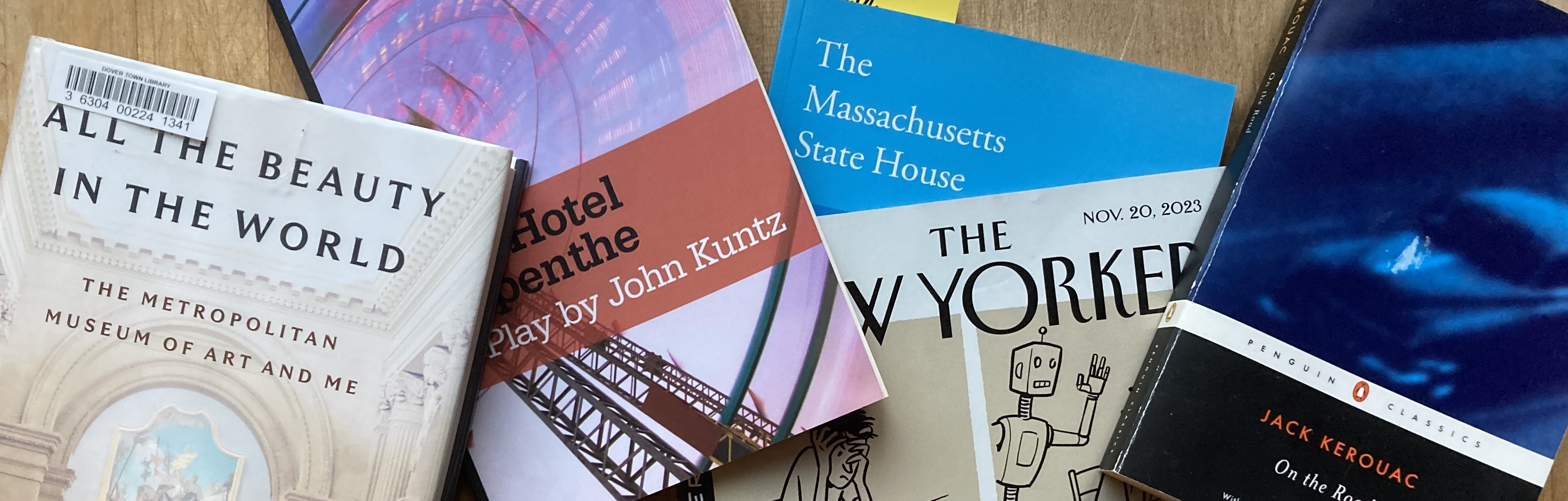
2. Exercise Your Mind. I read a few newsletters every day to keep me abreast—though not embroiled—in the world’s problems. Then I relax with word puzzles: Quordle, Blossom, Wordle. I have time to juggle two or three books at once. I read The New Yorker, cover to cover, every week; which is almost a full-time job. I joined a book discussion group for the external motivation to tackle Moby Dick or Madame Bovary; and maintain a list of more recent offerings like The Sixth Extinction, On the Road, or Let the Great World Spin on my own.
Activism can be a part of community service and connection.
3. Serve Your Community. It’s a well-established fact that when money is withdrawn from any situation, everyone behaves nicer. Thus, community activities can be more satisfying than work ever was. Different folks approach volunteer efforts in different ways. I am a dabbler. Every week I tutor ESOL. Bi-weekly, I write my pen pal in prison and I do chores with a blind neighbor. Once a month I pack boxes at a food pantry. I devote time to my quest for prison reform by attending monthly parole hearings, and assisting an inmate at MCI Norfolk to prepare for his own hearing. Six times a year I copy-edit the upcoming issue of Gay& Lesbian Review. Seasonally, I interview aspiring applicants to MIT in the fall, and am a VITA tax preparer in the winter. Annually, I write a pair of articles recapping Boston’s theater season for New England Theatre in Review—a gig that yields me a pair of tickets to a dozen or more performances throughout the year. Tack on occasional architectural sketches for a project in Haiti or a renovation for a family or friend. I try to do something on behalf of someone else every day. Never for money. All of it provides great satisfaction, even fun.
Mid-century Modern birdhouses I built for a Mid-century Modern friend.
4. Serve Your Muse. After a technically-focused education and career as an architect, retirement has provided me an opportunity to explore a completely different muse. Turns out I love to write. In the past decade I’ve published two books, maintained this weekly essay blog, written four plays and am gestating a fifth. None of these endeavors make a dime, but that’s not the point. Writing is my way to absorb the world and understand my place within it. Whether anyone actually reads the stuff is icing on the cake. I also keep my hands busy with a variety woodworking projects (more rough carpentry than fine woodworking). And of course I keep my 126-year-old 4-family house and gardens up to snuff. After all, that chestnut is the reason I got to retire early in the first place. Whatever your muse may be: find it; relish it; dig in.
Dear friends Lisa, Larry, Marion, and Mark at our 50th high school reunion.
5. Socialize. This the tough one for me. I know, in theory, that people with a broad range of family and friends lead long-term healthier lives. I also know that I am quite content to take solitary walks, peck at my computer, and tinker around the house. Research recommends a baseline of engaging—every day—with at least one on-going connection and one varied one. Since I’ve lived with the same housemate for sixteen years, and call my boyfriend daily, ongoing connections are baked into my life. It’s that reaching out to others, for varied perspectives and experiences, that’s a chore. Yet, I try. I lean into my other activities to mine social opportunities. Thus, the book group, the individuals I tutor or assist, the folks I invite to share my theater tickets. I have fewer long-term friends than I did ten years ago. Several have died. A few became estranged by the foibles of COVID and our nation’s toxic divisions. So, I’ve reached out to new friends. People of more varied perspectives than the affluent white gay men that have been my social core for years. As in any endeavor, when I expend the energy to put myself out there, the social returns are bountiful.
I learned to bake during the pandemic. As we age, our sweet tooth gets hungrier!
If I remain on my present health trajectory (and if I’m lucky), there’s a chance I’ll be retired longer than I was ever a child, or a student, or even an architect. I’m up to that challenge. And I challenge anyone dreaming of, seriously thinking about, or already into retirement: use it, don’t lose it. There is still so much we can do to engage with our world and enjoy our lives
The names we give our streets and squares, civic and institutional buildings, are a direct reflection of our culture. Not as it is, so much as what we aspire it to be. Names bestowed memorialize for generations, sometimes even centuries, what we consider our best selves at the time they’re named. Thus, virtually every main street in New England was renamed Washington Street after the Revolutionary War, and most Washington Streets retain that name 250 years later. Thus, we name schools after statesmen, though not often enough after notable women. This being the United States, where money’s what we value most, the naming process is seriously skewed toward wealth. Thus, we name building after collegiate building after guys who dipped into very deep pockets and sprinkled a bit of their loot in an act of cleansing. Thus, at a more rudimentary level, we suffer suburban subdivision streets named after the developer’s kids, wives, even dogs. I always wonder whether people mind living on streets with inane monikers, such as Jennifer Lane or Skipper Circle.
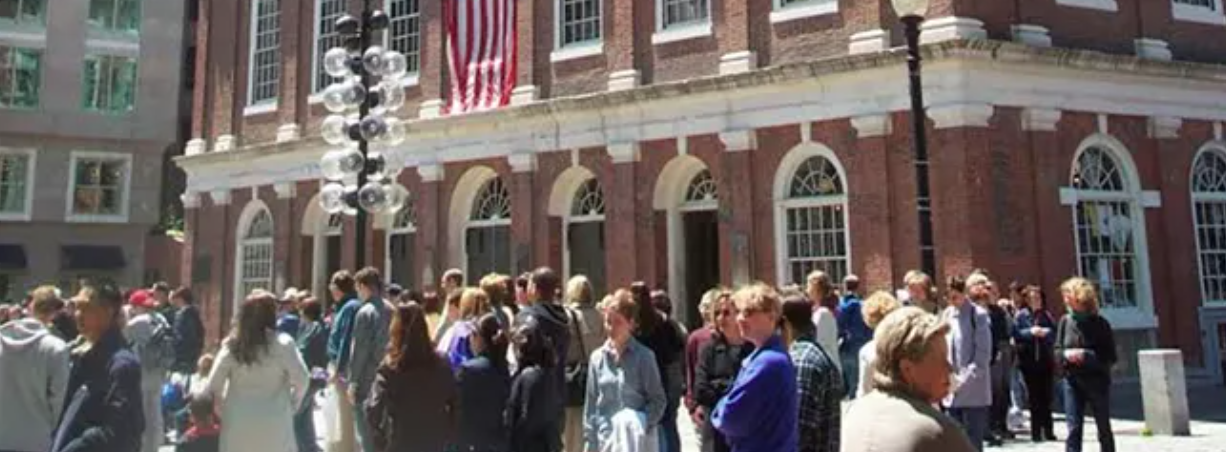
There’s a major naming controversy around Boston these days: whether to rename Faneuil Hall. Peter Faneuil was a wealthy merchant. Much of his wealth was derived from goods produced by slaves and funding voyages of the slave trade. In 1740, Peter Faneuil proposed to Town Meeting that he build a public market place and donate it to the city. He added a public meeting space on the second floor, which was used as the town hall, as well as a gathering place for concerts, banquets, and ceremonies.
Leading up to and during the Revolution, Faneuil Hall was the site of rousing community debate, and became known as “The Cradle of Liberty.” In the 1800’s it offered a local and national stage for the abolition movement. Frederick Douglass, Wendell Phillips, Lucy Stone, and William Lloyd Garrison all spoke there. Then again, so did Jefferson Davis. In the twentieth century, Faneuil Hall became the site of Naturalization Ceremonies for new citizens. Today, Faneuil Hall is still owned by the City of Boston, but the National Parks Services operates tours and other services.
Recently, The Boston Globe published a pair of editorials presenting opposing perspectives on the predicament of Faneuil Hall’s name.
Kevin C. Peterson, founder of the New Democracy Coalition, a non-profit focused on civic literacy, civic policy, and electoral justice, wrote that, “For Black residents across the city and the nation, the name expresses the unforgiving heart of a man who considered Black human beings no part of a civil society, and who denigrated and regarded them solely as a commodity to be sold or traded.”
Meanwhile, historian Kevin M. Levin argued that much would be lost if Faneuil Hall is renamed: the courageous history of Black advocacy and activism that dates back to denouncing the Fugitive Slave Act in the 1850’s right up recent calls for voting rights. “Rather than place our focus and direct our resources solely on changing the name of Faneuil Hall, tour guides, educators, and historians need to recommit themselves to telling these stories inside and around the building with the name that generations of Black activists and reformers recognized.”
Of these two perspectives, I align with Mr. Levin. The fact that Peter Faneuil was a slave trader is an important consideration in evaluating the man and his legacy. Yet we should evaluate him in the context of his times, not ours. Today, anyone who traffics slaves is a criminal, who deserves to be brought to justice. In Faneuil’s time, it was accepted manner of business. Yes, he might have been a nobler man had he denounced slavery, as a few—but not most—of his Boston brethren did in the 1740’s. Cruel as it seems to today’s ears, Mr. Peterson’s point, that Peter Faneuil possessed the “unforgiving heart of a man who considered Black human beings no part of a civil society” is actually incorrect. Peter Faneuil did have an understanding of the role of Blacks in civil society. They were slaves. A perspective we now condemn, but one which Peter Faneuil shared with most of his fellow townspeople.
There are arenas in which I support renaming our civic spaces. There’s no reason, anywhere, to ennoble anyone associated with the successionist side of our Civil War. What other nation allows the names of vanquished rebels to be so glorified? That there is artwork and statuary honoring members of the Confederate States of America in our nation’s Capital is absolutely wrong. Take it all out.
Similarly, although I dislike the incessant naming of stuff after rich dudes (like Peter Faneuil) who obtained their fortunes within the context of the society they inhabited, I believe we need to erase the names of so-called benefactors when their fortunes were ill-gained even by the mores of their era. So good-bye Carl Shapiro, made wealthy through Ponzi-schemes, and adios anything named after the Sacklers, drug dealers in slick suits.
Peter Faneuil was not a perfect human being. None of us are. He made good—very good—operating within the social and economic constructs of his time. He rubbed some of his wealth off on a town that was happy to get a free marketplace and town hall. And he unwittingly built a Cradle of Liberty that became influential in overturning the very economic basis of his own wealth. That is the story that the name “Faneuil Hall” needs to tell.
I find myself spending less time reading the news these days. Not because there’s less news. (Hah!) Not because I’m disinterested. It’s because so much of the news describes the wars in Gaza and Ukraine. I know these are important reports. I read the headlines. I scan the first few sentences of the articles. But my mind clouds. I cannot seem to follow the maneuvers, tactics, or strategies of Russia, the ground reclaimed by Ukraine; the October 7 inhumanity of Hamas, or Israel’s inhumanity for how many years leading up to that date. Let alone follow how the US’ sticky fingers insert themselves into these festering conflicts.
Sometimes I force myself to read deeper. Only to find myself reading, and rereading the same paragraph. Literally wondering whether the atrocities described are referencing Russians or Ukrainians; Palestinians or Israeli’s.
I’m a reasonably intelligent person, though I’ve long known I don’t possess a military mind. I’m lousy at chess. Miserable at video games. Can barely understand the X’s and O’s of a football diagram. When I read descriptions of battles, my mind retreats to more serene imagery.
Image: EverEdge Global
Perhaps this is due to my limited experience of violence. I have never been hit another human being; nor ever hit one myself. Never aimed a weapon at anyone, pulled a trigger in their direction, or launched a rocket toward someone I despise. I have a terrible temper and have spewed plenty of angry language at plenty of people, yet never once raised my fist to address frustration, abuse, or persecution. I simply have no point of reference that anything can be achieved through violence.
Yet I believe it is the larger question of human-on-human aggression that underpins my inability to fathom war. Like, who ever thought killing each other was a long-term solution to anything? I understand how, in the short term, might makes right. But it also makes simmering oppression that inevitably boils.
There are numerous words for a person of my world view. Pacifist. Clueless. Idealist. Naïve. I bear them all. What twist of life could make me understand, even embrace, the merits of war? If I were a young Russian inspired by Putin to annex what I patriotically believe is rightfully mine? If I were a Ukrainian citizen invaded by a mighty foreign power? If I were an Israeli kibuttzer dependent on a border fence to the keep the Palestinian hordes at bay? If I were a Palestinian, fenced off from a homeland I consider mine? What if I were robbed at gunpoint on the streets of Cambridge? Or perhaps within the shelter of my home? What if North Korea launched a missile aimed at my zip code? Or an invading army from name-your-favorite-terrorist-group conquered Strawberry Hill? What would it take to awaken my mind, my body, and my soul from the fog of war to embracing it as crystalline reality?
I like to think that I will never render violence against another human being. But I’m also aware that, nestled in my safe and cozy community, I’m unlikely to ever suffer what many innocent citizens endure. I hope I never encounter what that breaking point might be. And in the meantime, I hold dear my vision that war is futility, and will share that vision until more men—all men—retreat from warmongering and realize that the only virtue in the fog of war is to make us numb to the notion that war offers a permanent solution to: anything.
Walking home from the gym on a drizzly day-before-Thanksgiving, a swirl of white attracts my eye, tucked between the vertical 2×4’s bound across most every tree on my ever-under-construction street.
Upon closer inspection, it’s an owl’s head, painted on the back of some bark, eye centered on a hole in the trunk.
The feather tucked between the bark and the trunk is a delightful detail.
Thanks to whatever artist graced our tree with such elegance and whimsy.




























 The Awkward Pose