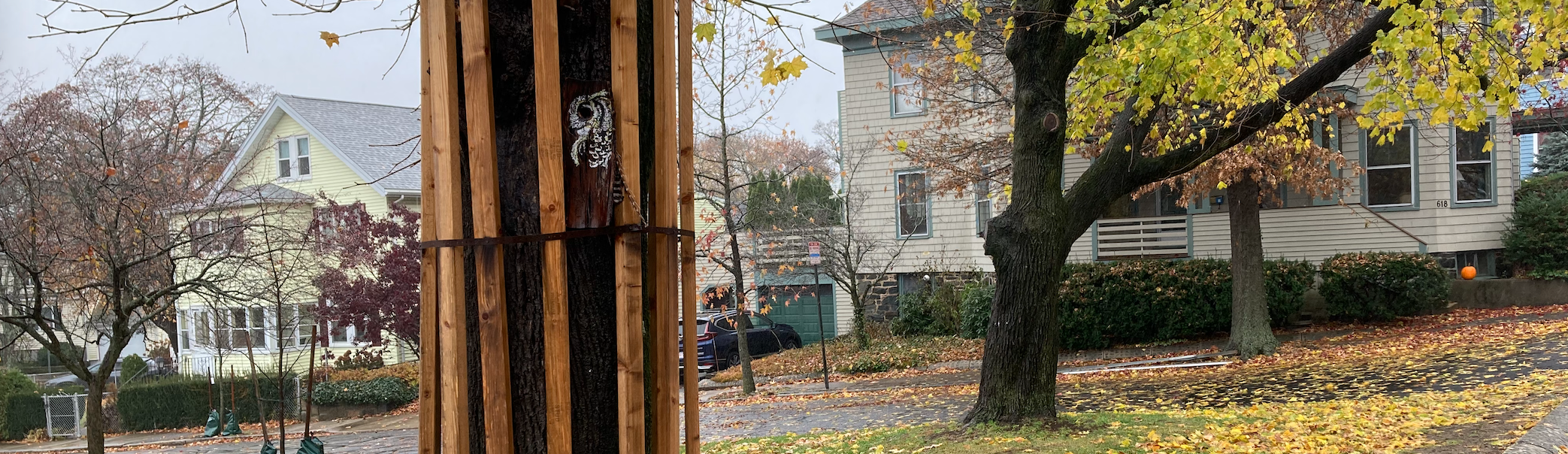
Walking home from the gym on a drizzly day-before-Thanksgiving, a swirl of white attracts my eye, tucked between the vertical 2×4’s bound across most every tree on my ever-under-construction street.
Upon closer inspection, it’s an owl’s head, painted on the back of some bark, eye centered on a hole in the trunk.
The feather tucked between the bark and the trunk is a delightful detail.
Thanks to whatever artist graced our tree with such elegance and whimsy.
Two facts that encapsulate the callous—maybe even downright cynical—attitude that humans have toward actually addressing business-as-usual in the face of climate change.
Photo Credit: David Rodrigo
Dubai is hosting the 2023 UN Climate Change Conference this month. The same Dubai with an annual average daily high temperature of 91 degrees F, that boasts the world’s tallest building, man-made islands in the shape of palm trees, an indoor ski slope, and a Trump golf course in the desert. Dubai was recently named one of the top five sustainable cities by EuroNews, in large part because of a snazzy new development called, “Sustainable City.” The endorsement does not mention that “Sustainable City” actually encompasses less than 1% of the area of Dubai. The rest of the place is still a fossil-fuel playground.
The Chair of the UN Climate Change Conference is Sultan Al Jaber, Minister of Industry and Advanced Technology for United Arab Emirates; also, by the way, CEO of Abu Dhabi National Oil Company.
If you think this UN flight-fest of talking heads to a place unfit for human habitation has anything to do with actually making our planet more resilient, or our ways of living more sustainable, you are a sucker for greenwashing. Or a fool. Maybe both.
You’re tripping over the stuff on the bedroom, there’s boxes lining the hall, the attic is cluttered, the basement’s full, the garage hasn’t sheltered a car in twenty years, and both storage buildings are maxed out. You eye that plastic fountain that created a cascade of water and marveled your toddler for all of ten minutes, three years ago, and you decide: someone else’s life will be made better by this great toy. Can’t seem to find all the pieces? No problem. Folks in this nifty neighborhood love to improvise.
So you pick it up as best you can. Shuttle it out the door and down the steps. Walk it two houses down to the corner and set it on the sidewalk. Try to get it to stand in some semblance of playful intent. Then skedaddle before anyone can pinpoint you as the (former) owner.
Or maybe you open the kitchen cupboard and a mug falls out. You have a mug for every day of the month, but others must be in need. So you grab a cardboard box (got plenty of those, thanks to Amazon), and deposit eight mugs. Toss in your great-aunt’s cut glass pitcher and pair of chipped vases while you’re at it. Lug is down and out. Place it on the curb. Feel benevolent that you have enriched the life of some stranger you’ll never meet.
On any given sunny Saturday in Cambridge, the sidewalks are littered with folk’s junk.
Sometimes they put out useful, pricey items that have outlived their usefulness. Even with some thought involved. The Nordic Track with the sign that shouts, “Free! It works!” The stroller that bears a heart and a motto: “I hope that your child loves it as much as mine did.” With just a bit more effort these folks could post on Craigslist FreeStuff and connect with a viable user without creating a public tripping hazard.
But who am I to quibble, when the really bothersome stuff are the cartons of, frankly, junk. Broken glass, out-of-date textbooks (it is Cambridge, after all), entangled baby mobiles, the complete paperback collection of Danielle Steele, cracked bindings and all. Inevitably, it rains overnight, leaving soggy Sunday morning seconds. Pick up that damp cardboard at your peril.
The trash collectors, god bless their souls, must pick up the mess on Monday, because even the most worthless junk never lasts into a second weekend.
I don’t know who was ballsy or drunk enough to start the trend, but it is in full swing. And I wish it would stop.
Actually, what I really wish is that folks would just say no to all the crap in the first place.
That will never happen, for reasons beyond my comprehension. When the good lord hoisted me into the stork’s bundle, they left out the shopping gene. I’ve never met an object so magical that it triggered, “I’ve got to have that.” But most humans are thus infected. Which is why storage units are such a great investment.
And so, I maneuver around the sidewalks and bypass other people’s junk. Thankful to the core, that it never was, and never will be: mine.
I read Ta-Nehisi Coates’ Between the World and Me. It made me uncomfortable. I felt his anger and frustration. I realized that I never would, could, experience such alienation. I live in a world that’s powered by people like me, for people like me. I’ve never considered that fair, though I’ve always tried to be grateful for the benefits arbitrarily bestowed upon me. Tried to use them to raise up others. My conscience allows me to sleep at night, though I imagine that Te-Nehisi Coates would find me lacking.
I read John McWhorter’s Woke Racism. It made me even more uncomfortable. His rebuttal of systematic oppression by labelling it as a religion of the Elect—with all the intolerance that religion encompasses—is an appropriate metaphor for our divisive culture. He defines our current moment as an ‘ideological reign of terror’ that ignores the reality of racial progress we’ve made since slavery, Jim Crow, and the era of Civil Rights. He believes that the religion of structural oppression and anti-racism, like all religions, can never be satisfied. It will just spin into ever more minute pressure points. But McWhorter’s tone is haughty, snide. And from my perspective, defining—and damning—yet another subset of self-appointed-all-knowing ‘others’ doesn’t do anything to help bring us together.
Between the World and Me (2015) was the first of a trio of books (White Fragility by Robin DiAngelo (2108) and How to Be an Antiracist by Ibram X. Kendi (2019)) that have become the defining texts of the perspective that the United States is a nation steeped in white supremacy that’s structurally baked into every aspect of our lives. Woke Racism (2020) is a quick and strident denunciation of those ideas.
In the world of structural racism, every aspect of our society is girded by oppression by whites against others. In particular, Blacks. I find this perspective useful. We had a Civil War and emancipated our slaves. Then we backpedaled into allowing the rebellious states to reassert their power, thus enabling Jim Crow throughout the South and less obvious forms of racism beyond. The Federal government was complicit. How else to explain that the New Deal’s signature program—Social Security—exempted farmworkers and domestics. Is it coincidence that these jobs are predominantly done by Black people? Or did FDR cave to Southern democrats? Is it a Catch-22 that WWII’s GI Bill provided low-interest mortgages for returning soldiers, but not within red-lined neighborhoods, most often the only places Blacks were ‘allowed’ to live? One can argue that those restrictions no longer apply, but they are the roots of the racial wealth gap that thrives to this day. (According to the Federal Reserve, the wealth gap between Black American families and white American families in 2023 is a whopping $986,000.)
But wait a second, chimes in McWhorter. Haven’t we made great progress? The vast majority of Americans are less prejudiced than in decades past, opportunities for Blacks have never been greater. To damn a society as structurally racist when we have achieved so much (albeit not enough) is to conflate current conditions with the reality of slavery and the misery of Jim Crow. It dismisses the achievements of the Civil Rights movement. McWhorter equates our nation’s current preoccupation with race as a sort of religion that lays a burden of guilt on white people and actually diminishes the potential—and accomplishments—of Blacks.
Which view our society is correct? Neither, and both.
What they share in common is our current penchant for driving a singular point of view without regard for, dare I say, nuance. Each remains strict to its doctrine, and therefore fuels division.
We don’t need any more division. We need antiracist folks to acknowledge that while structural racism is a valid and accurate construct from which we should improve our society, that when they extend it to proclaim that being punctual is a ‘white’ thing, doing well at school is a ‘white; thing; and striving for perfection is a form of oppression, the application has gone too far. We are more than simply cogs in larger systems. We are individuals, hindered by biology and environment, boosted by unique talents. We have agency. We have the ability, and responsibility, to make our mark on this world.
Meanwhile, McWhorter’s supporters need to acknowledge that people are born to very real differences of opportunity. People will always be born with disabilities; others will be athletes, others geniuses. We will never be able to create a truly level playing field. But we must strive toward that goal, especially regarding race, since those are arbitrary definitions we humans created ourselves, and which we have the ability to erase. That doesn’t mean I’m burdened by white guilt. It means I embrace the opportunity to rise above how my forefathers acted.
Antiracists and antiwokes each stake extreme, strident positions. It’s time for them to loosen up, acknowledge the limits of their world view, and embrace some of the other guy’s perspective. Time to stop shouting at each. Time to talk, and listen.
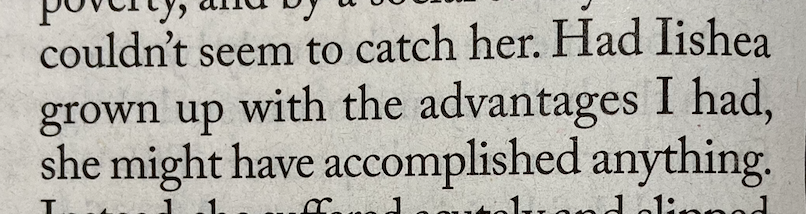
“In a broader sense, I know what happened to Iishea Stone: a luminous and extraordinary woman was failed repeatedly—by her family’s pathologies, by poverty, and by a social safety net that couldn’t seem to catch her, Had Iishea grown up with the advantages I had, she might have accomplished anything. Instead, she suffered acutely and slipped away so invisibly that, thus far, the Kelly [the last place she was known to live] does not know what was done with her body. How many Americans are we losing this way? How can we—the wealthiest nation in human history—tolerate those losses? The fact that we can, and do, despite knowing that it is wrong, is what is meant by the moral cost of homelessness.”
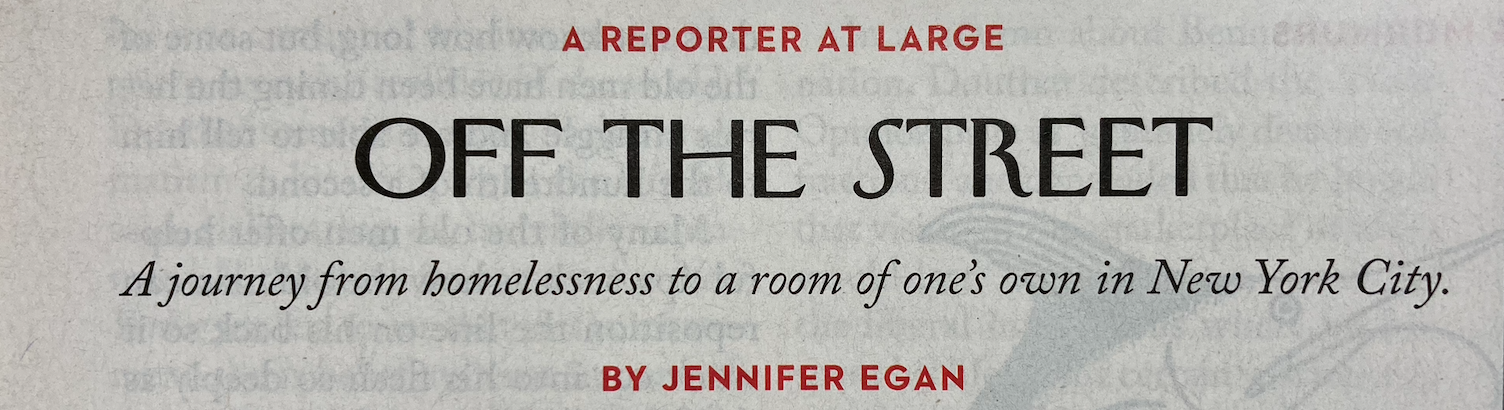
That is a paragraph from page 16 of Jennifer Egan’s seventeen-page exploration of homelessness, “Off the Street,” published in The New Yorker, September 18. 2023. I likely would have read the paragraph as just another representation of The New Yorker style, articulate and insightful with an accent on the personal. Except that I was also in the middle of reading John McWhorter’s Woke Realism. And this passage speaks directly to his criticisms of our current state of cultural affairs.
The lush adjectives—luminous and extraordinary—bestowed upon the downtrodden. The past perfect tense that places a distance between the author, reader, and actual person in question (Iishea…was failed by…). The parallels between author and subject (had Iishea grown up with the advantages I had) that postulate the differences between a renowned author and a homeless person as circumstance. All of which concludes with one person’s tragedy becoming a stand-in for national failure.
Woke Realism is a difficult book to read. I don’t agree with many of Mr. McWhorter’s points. Actually, I choke on many. He writes in a broad, preacher-like voice that makes more proclamations than it fully justifies. I understand his reasoning: John McWhorter is a black author (and linguistics professor at Columbia University who refuses to capitalize the word, black) battling what has become the prescribed world-view of the liberal left. He has to be loud and dogmatic to be heard over the din. It is a point of view, in 2023, that can only be expressed by a respected black intellectual: anyone else would immediately be cancelled.
McWhorter argues that to insist that systemic oppression still exists in this country is folly, considering the tremendous advances and increased opportunities available to all. To be sure, he acknowledges that advantages are not equally distributed, and that blacks more often begin life with fewer. But measuring the relative privilege each of us enters this world with is not the point. The point is, what do you do with the advantages you are bestowed.
Basically, he advocates agency. In McWhorter’s world, being born black presents surmountable hurdles, and lamenting systemic racism is a cop out. Not unlike being diagnosed with ADHD, and appreciating the insight to help you better navigate the world rather than use it as an excuse to do poorly in school. He argues a very-much minority point of view. Then again, it’s always easier to be the victim than the agent, to let things happen to you rather than to attempt to direct events, to complain rather than accept whatever consequences befall.
But McWhorter’s argument goes deeper. He criticizes the so-called equalization that occurs when we see ourselves as cogs in cosmic systems of oppression and privilege. Who benefits when we trumpet solidarity with the oppressed? Does it provide food or shelter or opportunity to those in need? Or does it simply salve the conscience of those who have decided to wear guilt?
I am a huge fan of Jennifer Egan. She is an insightful writer of elegant prose and well-conceived stories. I don’t know what privilege she enjoyed growing up, only that she measures it as more than Iishea Stone’s. Regardless, not everyone with Jennifer Egan’s privilege grows up to write compelling novels and wins a Pulitzer Prize. Her privilege did not deliver that accolade. She earned it. Comparing herself to Iishea Stone does nothing to change her accomplishments. Nor does it elevate Iishea Stone.
Iishea’s Stone’s life and death is a tragedy. The way we treat people living on the streets is a national horror. Jennifer Egan’s well-researched and thorough report about how one Brooklyn facility is trying to counter this tragedy provides useful insight that can help guide better solutions. There is no need for Ms. Egan to place herself in the article. Except that to do so is the language of our times. A language that linguist McWhorter warns us to cleanse.
I received a message in today’s email: New Rep is closing its doors. This time for good. Forty years is a good long run for a theatre company. Still, I am so sorry to see the New Rep go.
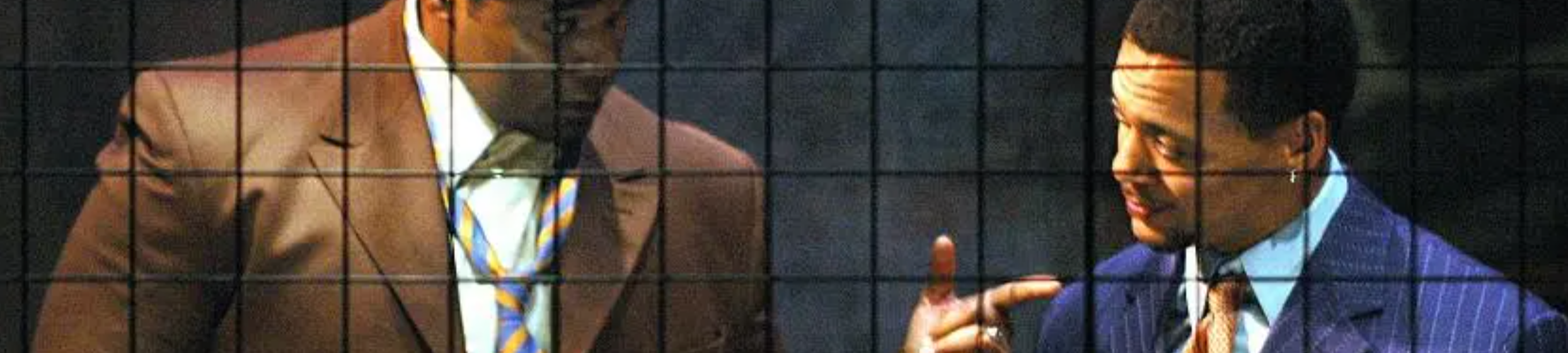
The New Repertory Theatre was founded by Larry Lane in 1984. Early seasons (1985-2005) were staged in a church in West Newton, where New Rep tackled challenging material in an unconventional space. We sat our hard chairs on a flat floor and looked up at the tiny stage where actors tore into one another. American Buffalo. Topdog/Underdog. Audiences used our imaginations to fill in so-called production values: the signature quality of New Rep was always the acting; What I experienced in that claustrophobic space remains with me to this day. Perhaps the rawest theater I’ve ever seen.
Topdog/Underdog at New Rep 2005 – Photo from New Rep website
In the fall of 2005 New Rep ‘graduated’ to become the resident company at the Charles Mosesian Theater in Watertown’s revitalized Arsenal Yards. A spacious 339-seat theater with excellent rake and large stage. As with any step up in the world, the advantage of becoming established came with unique challenges. Watertown isn’t uber-liberal as Newton, so the company polished its edginess to attract bigger audiences to its larger space. Also, the Arsenal didn’t boast the array of downtown dining spots theatre-goers crave. New Rep had to hope that free parking would compensate for slimmer dinner options
I subscribed for several years. Gritty shows, like The Pillowman (Fall 2006) featured high caliber acting, but its intensity diminished in the voluminous space. The company rose to the challenge of larger productions, such as Ragtime (Spring 2006), but other theatres in the Boston area offered similar fare.
Ragtime at New Rep 2006 – Photo from New Rep website
When longtime Artistic Director Jim Petosa left in 2019, Michael Bobbitt’s short stint in that job coincided with the pandemic, leaving New Rep in a vulnerable state. The company closed.
And then, nine months later, New Rep attempted a phoenix-like resurrection, with an ambitious vision: a complete focus on inclusion and diversity; a collaborative process centered on new work by new voices; and a creative approach to programming. Instead of a sole Artistic Director, Angelica Potter became Director of Organizational Transition, working with an array of BIPOC Resident Artists. Instead of a traditional season of four to six plays running three to four weeks each, New Rep produced a buffet of musical events, readings, and community programming.
What would be an ambitious agenda for any arts organization, proved a Herculean effort for a company coming out of the pandemic with a vision that didn’t particularly match its community. Watertown is a vibrant, progressive, rapidly growing town, the next ring of urban Boston. Still, Watertown’s population is over 75% white, and less than 4% African-American. I can’t help but wonder that the New Rep’s vision was shaped more by its board’s commitment to under-represented voices than an assessment of what the community would support. When a company commits to producing only BIPOC work, it can lose patrons who seek a broader theatrical experience.
New Rep’s 2023 season included three plays: Larry Kramer’s The Normal Heart; Lorraine Hanbury’s A Raisin in the Sun, and Diaspora! a new play by Phaedra Michelle Scott; each produced in the intimate black box rather on the Mosenian Main Stage. The productions reminded me of New Rep’s early days: simple sets, lighting that highlighted the actors, all of whom were remarkable. An actor friend of mine who was in The Normal Heart told me that New Rep actually paid the cast above scale, such was their commitment to the craft.
New Rep 2023 Season – photo from New Rep website
Thus, the 2023 season brought New Rep back to its roots: revealing difficult stories in a dark space through exquisite acting. It is unlikely that New Rep will rise yet again. But let’s hope there is always a place in our community for companies like it: people who come together to express the tragedy and glory of the human condition, and bring it into the light.
Adrienne LaFrance’ cover story “The New Anarchy” (The Atlantic, April 2023) provides an historical perspective on the nature of violence in our country and how it cycles through history. This particular passage, centered on the early 20th century anarchist Luigi Galleani, resonated with me:
The conditions that make a society vulnerable to political violence are complex but well established: highly visible wealth disparity, declining trust in democratic institutions, a perceived sense of victimhood, intense partisan estrangement based on identity, rapid demographic change, flourishing conspiracy theories, violent and dehumanizing rhetoric against the “other,” a sharply divided electorate, and a belief among those who flirt with violence that they can get away with it. All of those conditions were present at the turn of the last century. All of them are present today.
Three of my favorite stories these days fall under the label ‘YA:’ Young Adult. Perhaps I’m regressing. Perhaps I’m catching up to a genre that did not own a label back when I was age-appropriate. Regardless, I love the exuberance, the freshness, the ‘everything is critically important’ intensity that YA captures. The essence of being a teenager. When the world unspools before us in endless possibility, and our mercurial feelings sizzle within our changing bodies; and we lay the foundation of the human beings we will become.
If you want a good read, I suggest It’s Kind of a Funny Story by Ned Vizzini. I’d never heard of this book which I selected from the Little Library in front of my house because I rather liked the cover. Our hero, Craig, is an over-focused junior high student who studies methodically to win a spot in a coveted NYC high school. Once there, he flounders. His floundering spirals into depression, which leads to suicidal ideation, Zoloft, ignoring Zoloft, too much pot, and an extended stay at the local psych hospital. The book is depressing, but also not. The characters on the psych ward are more eccentric and lovable than those in One Flew Over the Cuckoo’s Nest. The staff are human and caring. Craig’s parents are pillars of understanding. You know from the first page (the title, really) that everything is going to work out, but finding out just how satisfactorily it does is worth the journey. The lovely novel takes a notable twist after the last page, where the publisher reveals that the teenage author spent five days in an adult psych ward and wrote the book in just five weeks upon his release. What is truth and what is fiction?
If you prefer movies, one of my recent favorites is The Hate U Give (2018). I know, I know, it was a book first. But I did not read the book; only saw the movie. Perhaps the most balanced portrayal of the police violence against Black people I have seen. The story is told from the perspective of a Black girl, Starr, whose aspirational parents send her to an almost-entirely-white prep school. When a childhood (unarmed) friend is killed by a police officer during a dubious traffic stop—and Starr is the sole witness—the tension between the two communities she inhabits provide the opportunity to explore/expose every facet of the situation.
If streaming is your route, watch Heartstopper, now in its second season on Netflix. It’s kinda corny, very queer, and utterly enchanting. Nick and Charlie are the premier couple in the show, but there’s also Tara and Darcy; Tao and Elle; and even a glimmer of romance for chubby bookworm Isaac. The setting is a pair of gendered British public schools (which in the USofA means private school). Many blazers, ties, and plaids. Much kissing and never anything beyond first base. But isn’t that where all the tensions reside—in those first kisses? I can’t be sure how Heartstopper appeals to a straight audience, though I imagine it translates well. Among gay men of my age, we all watch, appalled still at the struggles young queer people must endure, even as we yearn for how these teenagers can express themselves in ways denied to us. On top of that, Olivia Coleman plays Nick’s ever supportive, ever tender mother. Where was she in 1973?
None of these YA offerings are great art. They’re something more immediate, more essential to everyday life. They each reflect the world as it exists, and illuminate positive paths to move forward in ways that always entertain, but also inform and challenge.
A few years ago my sister, who is both straightforward and accurate, called me a curmudgeon. It smarted for a moment, until I realized the truth in the label.
Since then, whenever I careen in the direction of being another eccentric old fogie, I catch myself for a moment. Then I usually yield to whatever offbeat opinion or socially dubious behavior washes over me. I’m coming around to the reality that my take on most things is simply different from others. The world’s a mess and no one listens to the cornucopia of remedies I know would make it a better place. Still, I try to stay positive. But how did I get so out of step with my fellow humans? Where does this streak of alternative logic come from?
Recently, my same sister moved from her lifelong house; downsizing being all the rage among my set. She sent a group text to all the sibs, “Would anyone want dad’s book?” “Sure” I replied, as I embraced the opportunity to welcome our father’s archives into my still ample home.
My sister and my father in 1979
Throughout much of our childhood, we heard about the book our dad was writing, The Irishman Who Discovered America. He would occasionally reveal snippets of his peculiar take on history, much of which takes place in Alaska, narrated by the lead Husky of a dogsled team. Dad was a guy who often left things unfinished; we never got to read the entire tale. The book, like so many aspects of my upbringing, just drifted away.
Apparently, when our father died, back in the ‘90’s, my sister got his book.
A week after our text exchange, a box appeared on my porch. Dad’s book! Actually, the box contained more than that: a five-inch stack of unbound, typewritten pages plus a Marble Composition Notebook. The kind we carried to school with in fourth grade.
First, I thumbed through the notebook: a novella disguised as a letter to the Manager of Johnson & Johnson’s North Brunswick, New Jersey plant. The plot centers on a large skein of geese near the J&J facility, and envisions them as an air force. The manuscript is rich in references to World War II, the pivotal experience of my father’s life of which he never spoke. The narrator encourages J&J to engage in aerial offense against their pharmaceutical competitors. I didn’t understand it, which I took to be confirmation of my sanity, but I appreciated Dad’s beautiful cursive hand, and his affection for the exclamation point. As a man who lost my ability to write cursive two broken wrists ago, I was mesmerized by the beautiful flow of my father’s fantasy.
On to the five-inch stack. Most of the paper is yellow (the actual color, not because it’s old), a few leaves are pink, hardly any boring old white. The heading on the top sheet reads, “PART II.” Here I am on Page 1 and already behind! The typed sheets, with manual corrections, are not as elegant as the composition book, but what they lack in grace they make up for in volume.
In the opening scene (of PART II) Charlie, Mr. Guanare, Vito, and Soria discuss going to Spain. Apparently they are in Columbia. Apparently I am in the wrong book, as no one seems remotely Irish, or interested in discovering America.
Next scene takes place in a gin mill in North Jersey. Aha! My father finally writes from what he knows. Still, nothing makes any sense. Chalk it up to the whiskey.
At that point, I realize that conveying logical meaning to my father’s meanderings is not the essence of this pile of papers. Rather, I let his bizarre imagination wash over me. Although by and large a functioning human being, my dad was often teetering on some precipice: lewdness, or madness, or drunkenness, or brilliance. The man’s diffuse borders seep onto every page.
I will not bother revealing the plot or characters of the remaining several hundred pages. Only reflect that somewhere in the pile is the woefully underreported history that an Irishman and his Husky sled across the Aleutians and discovered America. Take that in the chops, Mr. Columbus.
As the son who writes, it’s fitting that I am now the keeper of the manuscript. Like my father, my writing is incisive and important—in my head—even as it sometimes counters conventional logic and rarely aligns with our collective consciousness. My prose may be more lucid; my transitions more easily traced, but I can only hope to possess a kernel of my father’s eclectic genius.
I recall my father, buoyant and jovial, whenever he was engrossed in writing his book. I now possess the evidence that he wrote a whole lot more. Which makes me happy. I’m pretty sure every page of his weighty oeuvre provided great satisfaction as well as comprehensive meaning that, a generation on, eludes me. Or anyone else who might wade into his pile. Much in the same way that my own writing vitalizes me, and provides an elevated alternative to our humdrum world.
My father and I both write principally for ourselves, a pair of offbeat curmudgeons creating the world as we choose to see it.
Did you know that the Sierra Club has a handbook called the “Equity Language Guide?” They are not alone. The American Cancer Society, the American Heart Association, the American Psychological Association, the AMA, National Recreations and Parks Association, and University of Washington all have similar guides on what to say when your primary objective appears less to convey a truth, than to avoid any possibility of offending any one in any way.
George Packer is a staff writer for The Atlantic. He’s one of those delightful writers: like Jill Lepore; Elizabeth Kolbert; and Adam Gopnick, whose prose is so sharp, and observations so clear, that I read any article that lists his byline. All of these writers are direct descendants of America’s godfather of non-fiction essays: John McPhee. But I digress…
Dispatches, The Atlantic’s Opening Statement, April 2023: “The Moral Case Against Euphemism,” is a witty yet unsettling exposé on the politically correct (a term no longer correct) language police. We all probably know better than to use the word “Oriental” to describe anything that’s not a rug, or “welfare queen” to describe anyone at all. Yet, the hamstrung writers for Sierra Club cannot use “urban,” “vibrant,” “hardworking,” or “brown bag” because, I gather, each connotes racism. Who knew that all those years I was a hardworking architect living in a vibrant urban community, brown bagging my lunch each day, I was inadvertently offending.
Everyone would benefit by reading the entire article, but are the Cliff Notes:
– banning words won’t make the world more just
– censorship in the name of progressive ideals is still censorship
– the careful tiptoeing of equity language actually distances the speaker/writer from reality
– it is a symbolic gesture that pretends to be a concrete action
“Prison does not become a less brutal place by calling someone locked up in one ‘a person experiencing the criminal justice system.’”
As an example, Mr. Packer offers an equity language translation of a passage from Katherine Boo’s Behind the Beautiful Forevers, a story of Mumbai slum dwellers. The original passage:
The One Leg’s given name was Sita. She had fair skin, usually an asset, but the runt leg had smacked down her bride price. Her Hindu parents had taken the single offer they got: poor, unattractive, hardworking, Muslim, old—“half-dead, but who else wanted her,” as her mother once said with a frown.
Mr. Packer’s equity language translation:
Sita was a person living with a disability. Because she lived in a system that centered whiteness while producing inequities among racial and ethnic groups, her physical appearance conferred an unearned set of privileges and benefits, but her disability lowered her status to potential partners. Her parents, who were Hindu persons, accepted a marriage proposal from a member of a community with limited financial resources, a person whose physical appearance was defined as being different from the traits of the dominant group and resulted in his being set apart for unequal treatment, a person who was considered in the dominant discourse to be “hardworking,” a Muslim person, an older person. In referring to him, Sita’s mother used language that is considered harmful by representatives of historically marginalized communities.
Now, which passage gives us more insight—and empathy—into Sita?