
Humans are wanderers by nature. Our innate drive to explore—and conquer—has driven us to invade every corner of our earth, adapt to inhospitable environments, and now that we’ve run out of earth-bound frontiers, dive deep into the sea and reach out to the stars. The success of the human species, often referred to as ‘progress,’ is rooted in our curiosity. We’re always wanting to get away from where we are, and experience someplace new.

The dispiriting reality of the 21st century is that, so much of what used to be considered ‘good’ for us is now considered ‘bad.’ We realize that the highly-mobile, creature comfort driven culture we have created in the pursuit of so-called ‘progress’ will likely spell our doom. Maybe even soon.
But what’s a 21st century American, evolutionarily imprinted to explore, supposed to do on a glorious end-of-summer holiday weekend? We travel!
More than half of all Americans travelled over this past Labor Day Weekend. More than a third took car trips, fourteen percent of us travelled by plane; a measly three percent took public transportation. Most of us took day trips to visit the beach, relatives, or friends, but the number of longer trips increased beyond pre-pandemic years, evidenced by the bump-up in hotel reservations. Legions of TSA officers processed over 14 million people for this, our last summer fling. By the weary end of the weekend, our various travel modes had burned over 500,000,000 gallons of gasoline in our pursuit of leisure.
By and large our travel was successful. Hurricane Idalia petered out beyond urban areas. The National Safety Council figures on traffic fatalities over the weekend fell below 500. A degree of collateral damage we’ve long calculated into our comfort range. I couldn’t find any figures on how public transit fared during the holiday—who would bother to track that?
I don’t often think about travel statistics. As an unconventional traveler, the stats rarely apply to me. And they’re most often reported as estimates in advance rather than facts after the fact: on Tuesday after Labor Day the news cycle stokes new anxieties.
But this Labor Day I couldn’t help but think about the millions of Americans belted into their cars and planes, while my boyfriend Dave and I took a simple hike.
Holden is 44 miles from Cambridge, so I might have been counted as a travelling American. But everyone knows bicycles are just for fun and any who actually uses one to go from A to B is just loony. He doesn’t count.
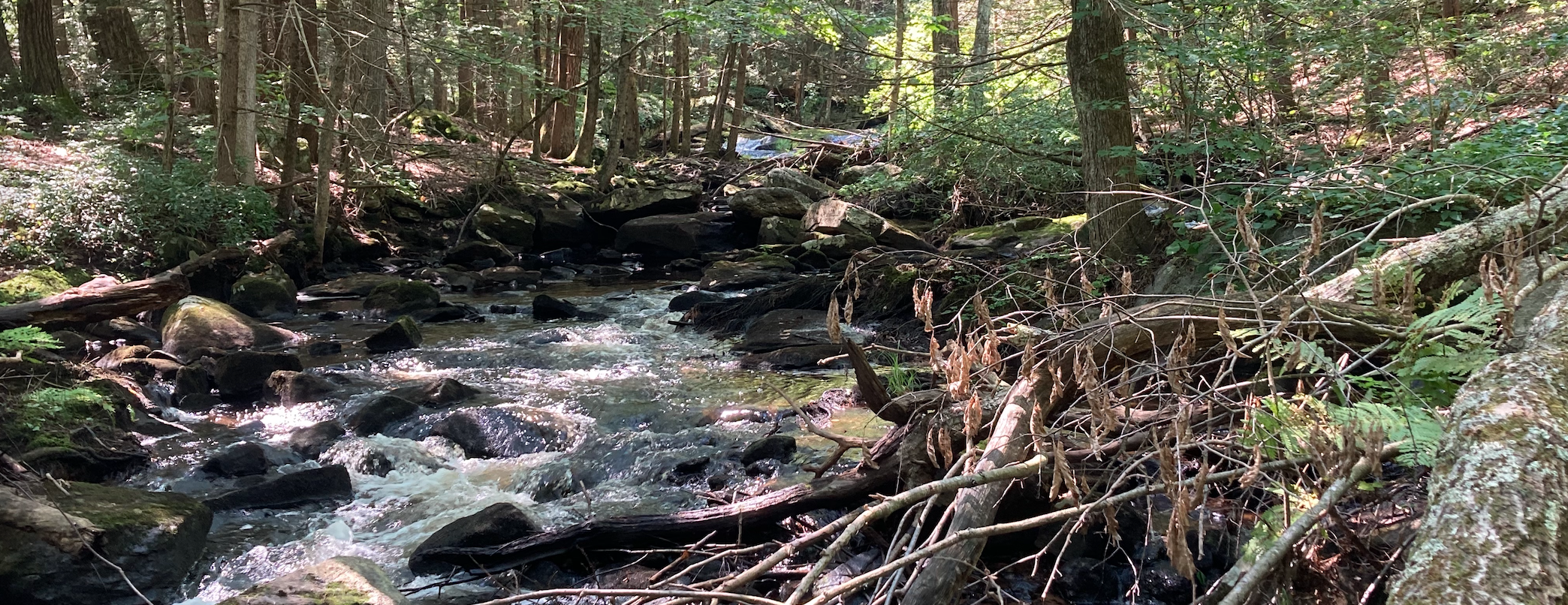
On a clear and breezy day we set off from Dave’s house, on foot, and made a seven-mile trek. The first and last mile were through conventional, indistinguishable suburban landscape. But for five miles we trekked through the Wachusett Watershed on a variety of easy rail trails; forested winding paths, a few glorious meadows, past a lovely lake, and into a rocky ravine neither of us had ever seen before. I christened it Quinapoxet Canyon, after the tributary eating away at eons of granite.
The natural beauty that lies within a mile of my friend’s house is remarkable. But perhaps even more remarkable, on Labor Day Weekend, is that we saw a total of four other people on our entire journey. Just four. While newscasts highlighted the crowds at Cape Cod beaches and New Hampshire lakeshores; while people waited in line to be checked through TSA or sat in steaming traffic on the Southeast Expressway as that invigorating salt water tingle evaporated under the pressures of returning home, we two hiked alone through gorgeous nature. Then we walked home.

Modern technologies make our innate desire to explore easy, though I doubt any of the 14 million holiday flyers discovered any place that is not already well mapped. Ironically, those same technologies contribute to our increasingly hot, hot planet. So it’s likely that sometime soon: within the lives of our children or their children or at best, their children; our ability to travel so easily, so extensively, will burn itself out.
The drive to explore is an intrinsic human quality. I believe it is mostly a good one. But like so many aspects of contemporary life, it’s time for us to reevaluate how we satisfy that fundamental need. We have to realize that there’s no reason to always to drive and fly so far away, when there is so much we have not explored close at hand.

 The Awkward Pose
In the average American’s lifetime they will have travelled by air an incredible 204 times. I think i will fall well below this figure and gladly so.